National health reports cannot fix deep-seated cultural issues. I'm sure they'll come out with a nice report on strategies to improve men's wellbeing that won't make a lick of difference unless the world at large starts to shift.
Government reports like this sometimes motivate additional studies and think pieces, which in turn creates a framing that may be used later when society decides it's truly ready for change.
So no, they can't change the world, but sometimes they can plant a seed.
This all is just pure virtue signaling and the only beneficiary will be some NGO who gets some money and produces a report and a slide deck which only they will read. It's like the Soviet joke of "we had a 4 hour meeting about improving production in communism in the factory today and after this we will work not better and not worse than before". Until that suffering actually causes measurable damage that affects something on a grand scale that the country needs, nothing really will happen.
Nationwide change doesn't happen overnight. It involves years of unglamorous work by hundreds or even thousands people you and I don't even know about.
Carney will still milk it as a way to get votes. There will be 3+ press conferences with leadership, and they will try to talk about it in ways that won't alienate the "remember École Polytechnique" crowd.
ultimately they will do nothing and pass more bills allowing big businesses to do whatever tf they want
Can you expand on this? It seems to me that deep seated cultural issues are the sort of thing that therapy is supposed to address. However, I may be looking at this from the wrong angle.
The people who see issues with themselves get therapy. The ones that see no issues with themselves don't.
That is what "deep-seated cultural issues" means. Some subset of the population aren't seeing a problem with their own behavior. They see nothing that needs addressing. The rest have to learn how to put up with or avoid them.
The report gives no indication its a male problem. It’s just a survey targeting men. Maybe its a general mental health problem. We know mental health issues in women have increased over the same time period.
This report? The existence of a male mental health problem does not imply the existence or absence of a female mental health problem or any other type if mental health problem.
Maybe you can you disambiguate your phrasing here. Which do you mean?
1.There is a MALE mental health problem -- some mental health problem wholly or partially unique to men
2. There is a mental health problem observed among men
If #1, where is the evidence? A men-only survey can't show it. If you surveyed left-handed people and 30% had anxiety, that doens't mean there is a left-handed anxiety problem.
If #2, we agree on what the research shows, but it brings your original point into question: "Isn't recognizing there is a problem the first step on fixing the problem?" Which problem are we recognizing? Labeling a general problem a male one assumes a diagnosis, which points the search for causes and fixes at men when nothing in this report shows that's where they are, and other available information shows worsening mental health in women as well.
My friend the only one doing assuming here is you. You've constructed this strawman argument where since this report doesn't prove X then just because it proves Y it's worthless. Proving Y has value.
I don't really have the time to learn the math to really understand this stuff myself, and I'm not entirely sure I could learn it even if I had the time.
But I love to read about it and marvel that we as a species even managed to figure out this much about something so tiny and complex
> Jugs of brackish water lined the walls. Buckets overflowed with hunks of marsh grass.
I don’t know, that goes a little above and beyond IMO. One typically doesn’t do science in a house-type setting, for many of the same reasons you don’t carpet a bathroom.
I can imagine truly horrifying images coming out of this. Many people who have spent a lot of time online have come across unfortunate gore images that they may have seen for only a fraction of a second that they wish they could unsee. One can imagine the brain is able to see much worse.
June 9, 2032: ReMind, a new biotech startup, has opened to a recordbreaking IPO after a demo and a series of small-scale trials that stunned the world. The company is pioneering a new way to ingrain memories into the human brain - each ReMind screen is equipped with a special camera that can quickly recognize anyone who walks up to it, and ReMind's secret sauce algorithm is able to use past data of each user to generate imagery that will have the most profound impact on their brains. They claim that the algorithm is highly effective, being able to burn in imagery into the viewer's brains with an average accuracy of 83% per viewing. The CEO has promised to launch two services to start: ReMind Long-term, which focuses on creating imagery that simulates a 'traumatic' impression for creating long-term memories, which will be immensely useful for advertisers; as well as ReMind Short-term, for milder experiences that resemble a catchy song in a visual format for a quick boost in sales for a limited-time promotion. Advertising companies around the world have already placed tens of thousands of sales and deployment of ReMind-equipped screens is planned to begin immediately. Look forward to spotting one in your grocery store, in an elevator, on gas stations, on in-flight entertainment systems and in place of billboards on public spaces. The future is looking bright for ReMind!
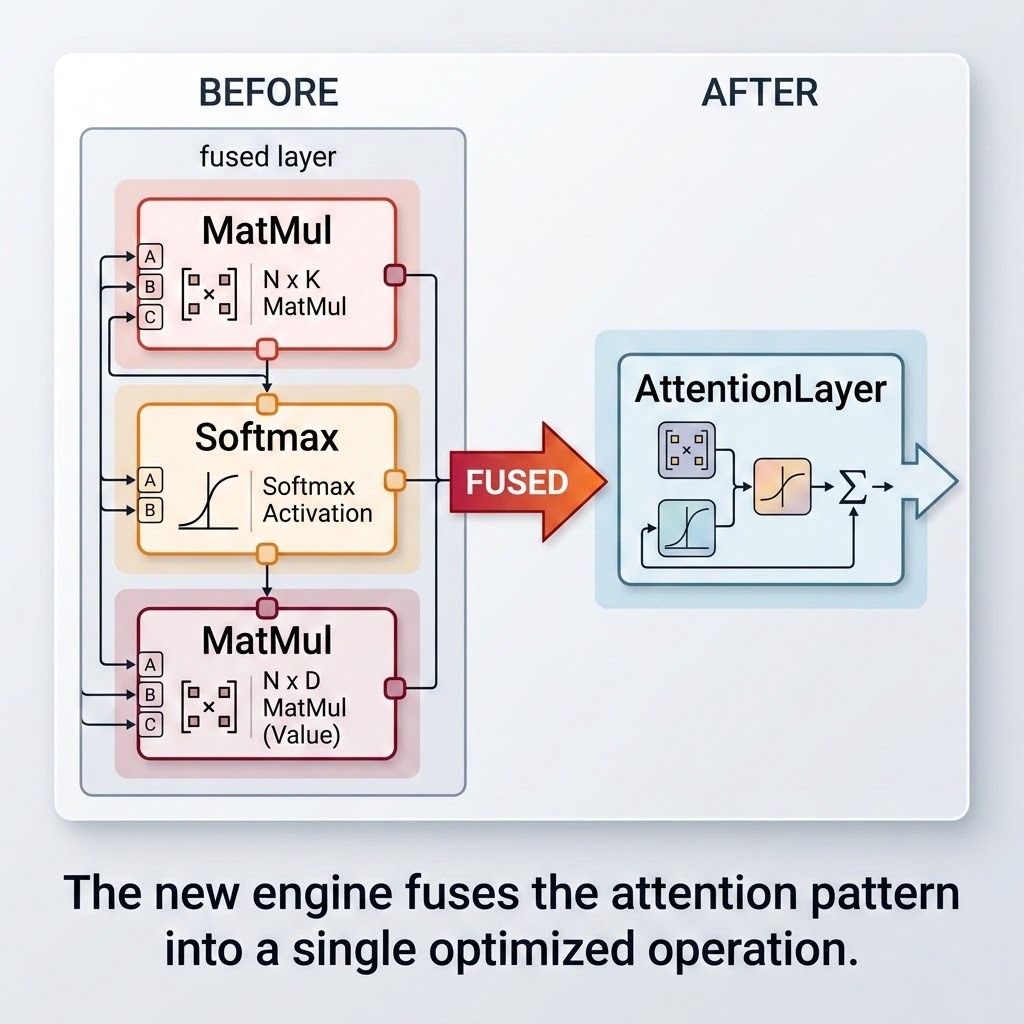
The diagrams were generated with Nano Banana Pro (most probably, or alternatively with ChatGPT Image 2), if you look closely in high contrast areas you'll see artifacts in the background that give it away.
I personally don't mind AI generated content when it's properly reviewed, but unfortunately more often than not the author just glances at the result and decides it's good enough.
I'm not knowledgable enough to determine whether this diagram is 100% accurate, but some things look off - the arrows in the bottom left seem superficial, some arrows are connected in weird ways, the mini diagram in AttentionLayer block doesn't look right (it has two Softmax icons and one MatMul icon, while the "before" diagram is the opposite).
I absolutely love the graphs that were used in old medical physiology papers. Something about the hand-drawn nature makes you appreciate both the underlying concept the graph is trying to convey as well as the work that went into it. Don't get me wrong, I'm a huge techie. I love computers and computer graphics, but sometimes a hand-drawn graph just takes the cake.


reply