I think the argument being made is fundamentally wrong. It reminds me of the Socialism vs Capitalism models - this idea that centralizing the resources will somehow unlock efficiency. It's also becoming clearly that merely throwing more data, RAM, compute, etc, is not generating significantly better behaviours.
We are far better off with millions of people running lots of little experiments, than a handful of super large companies running a subset of experiments. We really need to get agentic LLMs onto local machines at a reasonable price to really accelerate.
The likes of qwen3.5-0.8b have been super interesting to me, you have this tiny little model that can run on a CPU that can exhibit agentic behaviours (with a lot of tickling) - in the hands of hobbyists is where I suspect we will see some cool updates.
I really hope they can keep the cost down, it needs to be in the "it's so cheap just hack on it" price range for not just engineers but kids too. I'm excited to see low-cost hardware put in the hands of kids with LLMs in their sails.
I've personally stopped believing we will ever return to a world where anything computer isn't at extortionist nosebleed prices as if they're made by Patek Philippe.
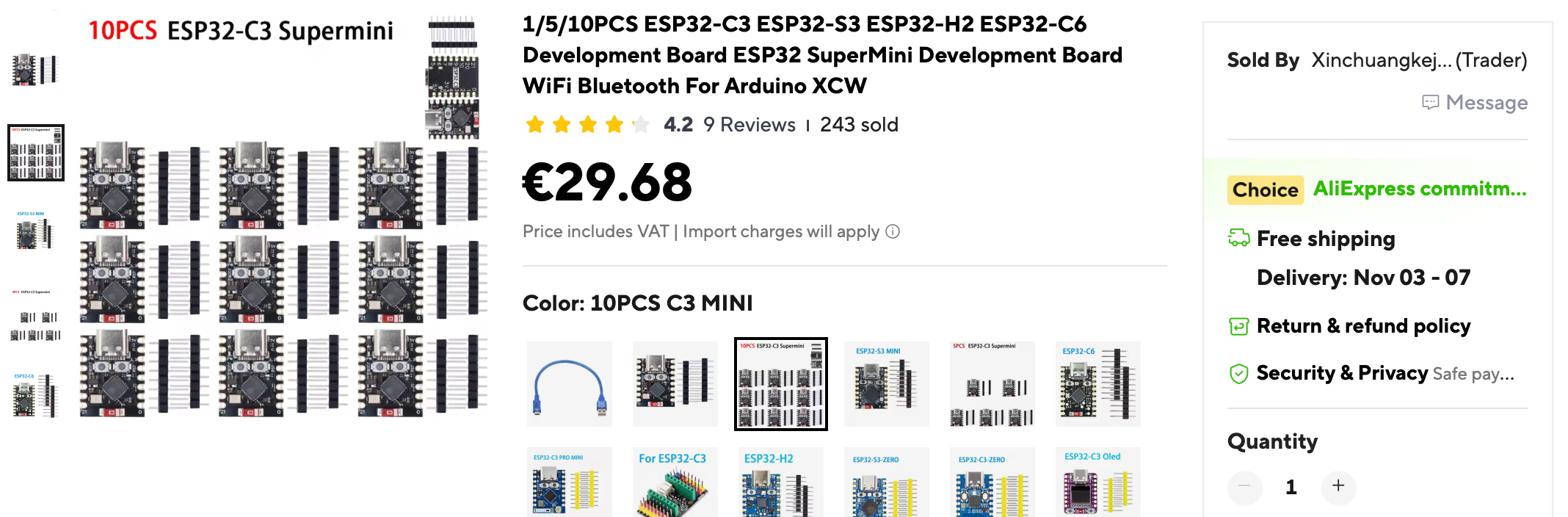
Where can you get a EPS-32 for 1,50, with shipping, taxes and duties included?
Because in the EU whether it's amazon or AliExpress, the cheapest I can get one now would be 4,50 Euros a piece, and that's only if you buy them in bundles of two or more.
Or is it that the UK lacks the lunacy parcel taxes and duties of the EU so things are much cheaper over there?
But even paying 5-30€ for a devkit still seems insanely cheap to me; that's like several bars of chocolate at current prices, even kids can afford that (or make someone buy it for them).
There's no escaping the fact that EU fucked the hobbyists that previously were able to ship stuff not even made or available in EU at sane prices from china. I f I were to buy things I did in last 12 or so years based on current rules, I'd pay like 200% on customs/taxes and bullshit charges like 3+EUR per made up category on invoice or whatever it's now.
Hopefully, it will put a downwards price pressure on middlemen/resellers, now that buying directly is prohibitively expensive.
>There's no escaping the fact that EU fucked the hobbyists that previously were able to ship stuff not even made or available in EU at sane prices from china.
EU doesn't care about hobbyists, it cares about protecting the interests of the monopolies of the major retailers who lobby the politicians, who disliked that people could order the same Chinese shit they sell at 100x markups, directly from China, and cutting them off as middle-men.
But don't worry, in their heads, this way we'll get to on-shore our HW/electronics manufacturing industry back. Any day now. I can already see the factories pumping out ESP32s "Made in the EU", popping up everywhere across the EU, creating jobs and a competitive electronics industry. Alarm clock buzzes
"Fun" fact, they charge VAT on top of the new "handling fees" (aka tariffs). Each item category is now 6.05 euros extra in Spain (5 euros + 21% VAT).
They also seem to have no way to really tell item categories apart, so it's effectively a fee per single item. You can buy multiples and only get the extra charge once, however for example, if you order one ESP32-C3 and one ESP32-C6 from the same vendor, you will likely be hit with 2 * 6.05 even though technically they'd fall under the same item category.
Obviously, in the context of hobbyists at home, we were talking about the ESP32 SBCs, and not the bare solderable chips themselves.
>But even paying 5-30€ for a devkit still seems insanely cheap to me
Yeah but I wanted to know if the 1,50 price is realistic since it's quite a big difference, 200%+, between those two price ranges.
If price differences didn't matter for hobbyists, then Arduino wouldn't have been killed, and ESP32 taken over the world.
Clearly both people and businesses are highly price sensitive, especially in the current economy.
>that's like several bars of chocolate at current prices, even kids can afford that (or make someone buy it for them).
Needless whataboutism straying from my point, as with such line of reasoning, you can justify anything that's bad: "Getting punched in the balls isn't so bad, because you could always get cancer which is much worse."
A lot of things have changed since then: EU taxes and duties, AI-induces HW shortages and price hikes. For example RPI prices today are untenable compared to a year ago.
That's why I asked about the prices of today. Whatever people paid in the past, is not necessarily applicable anymore.
This is the way forward these days. In my opinion the situations in which a Raspberry Pi is the right answer are vanishingly small these days - for interacting with physical things like relays or LEDs use an ESP or similar, run Micropython on it if you're not into writing C and the like, or ESPHome if you want something dead simple.
If you need an actual computer there are so many options along those lines now, and almost all of them are better than a Raspberry Pi in various aspects. Finally, if you just want to put some stuff on a screen then most TVs already have an operating system and a web browser on them, target that and you can get rid of the computer dangling off the back entirely.
I’ve said this other places but an x64 processor is probably better value these days unless you need video and GPIOs on the same device for some reason.
Even then, you can get a USB to GPIO adapter. I don’t use RPis much these days and it’s kind of a shame because RPi + Python usually has a quicker dev loop than C + esp-idf. I need 5 of some of them though, and I’m not buying a dozen RPis these days.
The prices will come down eventually, even if not all the way down.
But I'd be more concerned about computing staying open in general - not only as open source but at least open and accessible standards, interfaces, open to individual development, open to tinkering.
I see a concentrated push from almost all sides to lock down any platform, lock the hardware and build black box devices, lock the software under layers of attestation and certifications, all in the name of "security". I use the quotes because I don't believe security is the top concern, or even a concern at all, it's about taking the control away from users.
For now the open-computing world is still bustling and accessible but the intention to curtail this is there, with technical or legal measures.
the prices should come all the way down and go lower, that's the whole principle of technological progress. 10 year old ram shouldn't be priced like rare pokemon cards.
This isn't like precious real estate on HKI, technology pricing is supposed to be more capability for less money, as it has been for hundreds of years.
It is a cycle, and one may bet millions of annoyed nerds will invent something other than ddr dram... after all they always have in the past.
Blitz-scaling LLM for fictional future revenue assumes competing technology will remain immutable. It is a false premise with dire consequences for the credulous.
China is already filling the vacuum within the flash/ddr/cpu/gpu market, and quality/speed will rapidly improve with domestic use. We are already seeing blank label storage clones emerging in international markets. =3
Other datacenter prices aren't up 500%. CPUs, tape storage, mainboards, racks, cases, PSU, infiniband hardware, HVACs, all price stable.
But consumer grade RAM? Up 500%. USB disks? They're hundreds of dollars.
Also low density platter is up 2-300% as well. Don't tell me people are building out datacenters with 16tb spinning disks, I don't believe you.
It's companies that have price fixed doing it again.
Their EPS are up like 60x. Their stock is up like 10x and we're supposedly like "well I guess this thing you could sell for profit at $20 is now $960, cool"
And what's micron doing with it? $35 billion stock buy back. Alright. Asshole prices it is.
Prices of cheap 10 year old tech continues going up at crypto asshole speeds. Everyone should be insanely angry.
These prices aren't going to stop until either a non cartel player enters the market or there's a DOJ that's not just a bunch of kalshi and crypto scam bros.
We'll see what happens when everyone hears "black Friday? Nah, bro, prices are up another 20%, lol"
Micron made the mistake of letting the dog drive, and ultimately tied their brands fate to a dubious high-risk/high-reward market. The dram situation has already hit SSD/HDD, ram, and PC sales... as consumer dram chip supply chains are choked off by the hyper-scaling hardware investment loop demands.
"Pride goes before destruction, And a haughty spirit before a fall." (proverb 16:18)
>Don't tell me people are building out data-centers with 16tb spinning disks
Inexpensive JBOD HDD storage is still around $25/TiB, and while higher than tape ($7/TiB) it remains viable. The dram cache chips on the HDD PCB are likely more expensive than the old hardware now.
Personally, I have gone with old 25GB BD-R ($21.50/TiB for Ridata disc) for archival storage. It is janky, but the lowest cost cold-backup solution at the moment for home-scale projects. The 7 year disc MTBF should push past the 2032 estimated hype-bubble supply chain DDoS.
BD-R are slow to burn/access, hard to auto-load, and not a viable option for LLM/bitcoin project folks. I thought the tech was EOL 10 years ago, and yet here we are. =3
> Even at 10€ it was tantalizing. Please, give us something in that price range.
A few years ago we could get our hands on a Orange Pi Zero, with wifi, Ethernet, and 512MB of RAM, for less than $10. I think I bought mine for slightly over $5.
Now they sell for a tad over $30. What a shame.
We now have the ESP32 line of microcontrollers. That should scratch some of the itches.
The dollar had just over 30% inflation since the start of COVID. But not all prices increased equally, for anything with RAM or NAND they skyrocketed in the past year.
Your best option is to look into Armbian (https://armbian.com/) for these, they do the Lord's work when it comes to making sure these alternatives aren't destined to be ewaste when vendors abandon them. I'd say Radxa are probably in 2nd place after Raspberry Pi when it comes to support, but Armbian still makes that a lot better.
They are two different things. You're not running a full blown Linux OS on the ESP32. But many of the simple projects people used the Pi for can be done with the ESP32.
Got mine for circa $7 a few years back. Absolutely best tiny computer I ever had. It sips power, and is rock stable for me. Only one issue: it doesn’t reboot for some reason, it shutdowns. I can tolerate that for $7. Apart from that, I’m very happy with that tiny beast. Got three of them. And at that price, I’d buy 10 more and give them for free for friends, already setup with some services. I just hope they’d go really cheap at some point, once the bubble bursts or something.
Over time the Raspberry Pi use case shifted more and more away from GPIO. They all still have it but probably most of them are used as a Linux computer without ever touching the GPIO now. The people who do use GPIO on a Raspberry Pi are often better off using an ESP32 because they have better control of GPIO, consume far less power, and are actually cheap.
Personally I use ESP32s for GPIO to control things around the house and have one Raspberry Pi acting as a hub.
I've been doing home electronics projects since around 2013, I used to use Raspberry Pi's for everything from lighting control to robots, camera projects and lots in between (I even had a mechanical keyboard with a Pi inside) and a massive collection of hats and addons. These days, I can do 99% of what I need with tiny little ESP32 variant boards for a fraction of the cost and significantly less complexity. Hell, you can even get esp32's with really nice touch screens attached for dashboards / animations. I built a whole cyberdeck using an ESP32 and no computer in-sight.
their RP1 IO chip is such a disappointment for high performance GPIO use cases as well, literally can’t trust any IO decision they make after having hacked on that chip
The full size Pi has less and less of a niche. GPIO / low power edge? ESP32s are great. Signage? The pi isn’t really all that great, and is expensive, get a cheap N100/150. Hacking on Linux? Literally anything else.
it is also more capable than an esp32. Im dinking around with both. esp32 is very restrictive in its compute capacity. It isnt multifunctional at all either.
A pi zero is to play with, an esp32 is so tiny, that it is more of a build for a single thing, and then set it and forget it doing that single thing.
You cant really stack more and more cool stuff onto it and keep building on it.
That’s why esp-idf has components. I have a bunch of components that are basically “compile if this SDK config is set, otherwise pretend you’re an empty file” using macros.
Then I just pull in all my components. The ones I use will get compiled, the ones I don’t won’t.
Mostly works fine. Eventually you will run out of NVRAM to save binaries on, but another esp-32 is like $3.
Right now, I think the sweet spot is getting a Raspberry Pi 400 for USD$50 ( Microcenter).
A Pi400 is a very capable 4GB ram Linux machine, working out of the box. I have a few, each doing a different job. I just ssh to them with a beefier machine plugged on LLMs tools, and it's really fun and exciting.
Then Mini pcs, you can get a good deal here and there, for a more capable machine with a little bit more flexibility.
ESP32s are also awesome and I have been playing with them but not as a replacement of these light linux servers.
Marietta's did not have any Pi400s for sale (I love mine, with its built in keyboard; it is my main Kali hackbox) but did have lots of Pi5 (4gb was ~$100 IIRC; 1gb was ~$40).
I've picked up two 7" touchscreens, which seemlessly integrate into any Pi project (mine are both now installed on Pi 3b+ PiHoles, to display realtime DNS traffic 24/7); if you buy the returned/open-box, each screen is less than $50 (no more fumbling for HDMI cables).
----
Unrelated: the RTX5070Ti (purchased May 2026 for $999) is now $1449! The 5060 (purchased July 2026 for $329) is now $459; no 5090 in stock (of course).
> Then Mini pcs, you can get a good deal here and there, for a more capable machine with a little bit more flexibility.
This has been my hack for a while: eBay "NUC", reduce the price slider, select 'But it now' and get one with all internals included. But even that has now dried up.
An old Workstation I purchased for £400 2 years ago now sells for ~£1.5k. The old GPU [+] I purchased on Amazon for £45 now sells for £3k.
There is 100% a need for cheap Linux SBC's with enough compute to cause some trouble.
[+] Top top tip: For old GPU cards with old CUDA, just get <insert favourite LLM> to rewrite the CUDA stack for older CUDA. Fun times.
A few, that's 3 to me so what kind of jobs are they doing? I'm always interested in this stuff but never know what my use case would be. Can you explain what I'm missing?
I think it is false to equate this to just two options:
    a) spend my valuable developer time (this is my free time) on reading machine
    output which indeed might be completely wrong and get angry and upset for
    reasons which have been listed in great detail by those opposed to LLM-use in
    Debian on debian-vote

    b) not read the machine-generate review and have the resources that were
    required to generate it not only be wasted, but let my upload become another
    item in a statistic which shows how many tokens Debian is using up because the
    more tokens we use the better our software, right?
The fix for this could just be an opt-in/out for automated LLM review. It's just an additional tool and consideration.
That's not false. That's why he literally asked to be able to opt out.
> I will not upload anything to NEW unless there is a way for me to opt out of
this. I would prefer if the default was "no LLM review" and that developers
have to explicitly opt-in to receive an auto-generated review.
But as the system stands he only has those 2 options. Which is why he will not use the system until they add a 3rd one.
> TPM-backed full-disk encryption is now generally available in the Ubuntu installer. By tying encryption to the TPM security chip, disk encryption is bound to a specific device, significantly raising the bar for physical access attacks while improving the user experience.
That's great, but they are also intending to comply with the OS-level age verification [1]. Initial implementations will somehow be privacy protecting, but eventually the temptation to tie a specific person to an OS fingerprint will become too great.
How long until I can selectively tell certain websites I'm a child so they stop showing me ads?
They wanted the personal computer to store and report personal information. I hope they have their best surprised faces ready for when computers report what the owner wants them to report.
That is only possible when you really are the owner. And the amount of device out there in the world where people really are the owner is rather small. (Just the Linux desktops and the GrapheneOS smartphones, etc.)
You are not quite the owner on GrapheneOS either, because of Android Key Attestation (which has functionality analogous to desktop TPMs). If you re-unlock your bootloader (say, to run a custom build of GrapheneOS), attestation will snitch on you and the subset of apps that use key attestation to require a locked bootloader and/or enforce an AVB key allowlist will not work properly. This is a very small subset of apps currently, but I don't see it getting any smaller.
GrapheneOS does everything and more for key attestation, allowing security sensitive applications to test the integrity of the device. Sadly some apps like google wallet not only check for attestation, but check if Google's signed it. Which is against the idea of attestation in the first place.
So google's tap to pay doesn't work, but others do, like garmin pay. Random bank apps are hit and miss.
> GrapheneOS does everything and more for key attestation
Right, that's the problem, in my opinion. I'm not referring to the apps that require Google's keys only, I'm referring to the ones that allow GrapheneOS keys too. If you use one of these apps, you can use vanilla GrapheneOS builds, but you cannot run your own self-signed builds.
You are gaining freedom relative to running Google's OS, but you are still not free to further modify the software running on your own device.
Apps that require "integrity" should monitor their own integrity only, they should not attempt to infer the integrity of their environment.
Trick is there's no integrity without the OS. Cheats can ruin games, keyloggers can record passwords, music/movies can be stolen, bitcoins can be stolen, etc.
How so? Seems like it's a pretty big step in the right direction, sure an attested phone is going to be much harder to compromise than one with custom os, custom kernel, and a user with root.
And as always, it deserves to be stressed that Sponsorblock is far more than the name suggests. It can also skip sections like intros, tangents, etc - and it's configurable per channel.
If you're listening to a music playlist on YouTube, this removes interruptions caused by the pointless intro and outro screens added to songs.
I recommend buying your own CDs (at your local music store, directly from the band when you attend their concerts, or on Bandcamp/Discogs), ripping them, and putting them on the local file system of your MP3 player, phone, your car’s SD card, etc. Sometimes if you buy a vinyl record it comes with a convenient download code, and if it doesn’t digital albums are very cheap on Bandcamp.
I also recommend tuning regularly onto your favorite radio station (mine is KEXP Seattle; and Rás 2 in Iceland) particularly when they have live performance to discover new music.
I will never feel bad about blocking ads on youtube, because they have an effective monopoly on distribution of certain content. But when it comes to music, why not just use something else?
The Linux implementation I've seen is the Freedesktop implementation that just responds to a user profile flag. There's no cryptography involved, it's just like asking for a room number like the adduser command does.
Edit: well except American states don't flag your operating system as illegal unless they ask for your room number. Canonical and all the other Linux companies really like being able to make money and not spend all of their earnings on lawyers.
> There’s also a nasty depreciation curve to contend with. Nobody wants a 10 year old Tesla, but a 10 year old well mentioned petrol car still has a ton of life left in it.
It's worse, there's almost no second hand market for the vehicles. There is barely anybody trained to repair them (even if they will sell you the parts) and if they are crashed significantly it's almost always a write-off.
> It still often ends up a bit cheaper across comparable vehicles but not a slam dunk and nowhere near as good as the headline suggests.
Only because of government meddling. Fuel is almost uniquely taxed 3 times, which pays for subsidies to pay for green energy initiatives.
I think I'll hold out with my diesels and petrols and see how this all goes.
In the US, the used market for Teslas is quite strong, even into the high miles. I recently purchased a used EV and found the Teslas weren’t discounted enough from new for my liking. They moved quickly too, except for the ones with salvage titles.
I ended up getting an off-lease Hyundai EV because they tanked in value in part due to their ICCU failures, which are now covered under an extended warranty.
> There is barely anybody trained to repair them (even if they will sell you the parts)
No longer true at least in most decently urban/semi-urban Western countries/regions.
The parts shortage is real though, it's always been a plague for Tesla, and most established manufacturers never really recovered from Covid (and in the case of wiring harnesses, Ukraine) as a lot of their supply chain closed down shop for good.
> and if they are crashed significantly it's almost always a write-off.
That's true of all modern vehicles, no matter the engine type. Crash resiliency comes at a cost, the frame absorbs the crash energy and permanently deforms. Yes you can bend even an aluminium frame back into shape but it will never be as strong as before, and anything carbon-composite or plastic is out of the question as well.
Crash damaged cars have loads of good components though - typically allowing nearly all non-crash repairs to be done by just swapping parts about, unless the manufacturer has got software locks on swapping parts.
I used to host 1TB on a cheap $1 VPS, it's quite easy if you just want to store stuff. The trick is to just connect to a networked drive at your home on the back-end. The VPS drive just acts as a buffer for the network. If low(-ish) bandwidth is acceptable, you can offer downloading too.
We've had AI robots in our homes as the article points out in the form of a Roomba or cleaning robot. Arguably before that, we've had robotics in the form of dishwasher and washing machines with a range of sensors and actuators, and a small amount of autonomy. We've had humanoids in the home already in the form of toys, I remember RoboSapien from the early 2000's [1].
I think the next advancement are robots like the MicroDuck [2], a little gimmicky, but demonstrating higher levels of intelligence that everybody can afford and collaborate on together. Once that has the ability to return to a docking station on low battery and recharge, you basically have a fully autonomous robot pet in your home.
> Add to that the usage of AI. While I know I’m way more productive than during those first months, my thoughts are getting slower, less profound, lazier.
I have mostly stayed away from LLM usage, I think I am better for it. I use it just to offload things I wouldn't have had time for. I get more stuff done, but I am still doing what I did before.
> Plus, dopamine is available at just a tap on my phone. There’s a ton of content in shorts that interest me and require little to no investment on my end, both time and effort-wise.
If you have and Android phone, enable Developer Options and flick through to Simulated Color Space - set it to Monochrome. I only wish it was possible to automate colour space switching based on time, like is done for redshift.
You can do the same on iOS in the Accessibility settings. I have my phone set up so that I can toggle the monochrome filter by double tapping the back of the device. I keep it in black and white but can switch back to colour easily if I need to show someone a photo.
Only somewhat true, but the fundamental assumption is that it is operating during mostly peaceful times. You have hostile countries cutting or dragging anchors across deep sea fiber optics, you have attacks on energy suppliers, etc. The most effective attacks for denying service are to infrastructure.
> The only realistic way to do that is somehow finding a persistent DoS or RCE for every router vendor, hacking into an IXPs control systems, or physically damaging equipment. AI can't do any of that alone and I dont think it ever will.
An attack is not just limited to internet infrastructure, but even if it was: You would just have to take out a significant part of the backbone. It could be the backbone routers, the DNS servers, distribution boxes, home routers, etc, etc. Once the capacity is reduced, you may find the people themselves end up DoS'ing the remaining capacity.
>According to Stephen J. Lukasik, who was deputy director (1967–1970) and Director of DARPA (1970–1975):
>The goal was to exploit new computer technologies to meet the needs of military command and control against nuclear threats, achieve survivable control of US nuclear forces, and improve military tactical and management decision making.
I note in practice it mostly still works in war zones unless one of the countries makes a major effort to block its own citizens from access.


We are far better off with millions of people running lots of little experiments, than a handful of super large companies running a subset of experiments. We really need to get agentic LLMs onto local machines at a reasonable price to really accelerate.
The likes of qwen3.5-0.8b have been super interesting to me, you have this tiny little model that can run on a CPU that can exhibit agentic behaviours (with a lot of tickling) - in the hands of hobbyists is where I suspect we will see some cool updates.
reply