Short of frequent blood donation, is there any reasonably adoptable life change a person can make to meaningfully reduce expected PFAS intake, or is it best to try not to think about it?
Yes, there are a few things you can do. In rough priority / proven benefit order:
1. Eliminate as many items as possible from your diet that make use of PFAS based components, such as plastic linings. This means don't buy groceries packaged in lined packaging, this means don't cook with Teflon pans, and it means don't drink water from plastic bottles or bottles lines with plastic.
2. Get a whole-home water filtration system that is certified (NSF 53 or similar standard) to reduce/remove PFAS and if possible, on top of this do under-sink RO for drinking/cooking which is certified (NSF 58 or similar) to remove PFAS and use glass or stainless steel reusable water bottles to take water outside your home.
3. Exercise regularly so that you sweat and drink lots of appropriately filtered water, donate blood and/or plasma regularly.
4. Eliminate clothing or other items in your wardrobe that are coated with DWR or similar coatings. Don't make use of any PFAS-derived treatments/plastics in your clothing. This is especially important during the process of washing your clothes, as this generates microplastics which are PFAS contaminated and you can ingest them via breathing.
Everything else is basically guesswork, these are the only things known to have any benefit. We mostly ingest PFAS due to contamination in the food and water supply. This contamination is unavoidable, but we can greatly reduce exposure by making smarter choices about packaging materials and cooking methods, and a big one is simply not drinking anything that you can't confirm has been properly filtered and packaged.
I'm a bit extreme, I even brew and bottle my own beer and other beverages like soda and water kefir/kombucha to avoid exposure to externally packaged products that may be contaminated with PFAS.
1. Don't eat out where they might have used PFAS coated nonstick cookware such as Teflon. It is not sufficient to avoid it at home.
2. Don't use conventional dental floss as it's made of PFAS. Find ones that aren't.
3. Intake substantial supplemental fiber daily, e.g. psyllium, as it binds to bile which binds and excretes a subset of PFAS.
4. Strongly prefer certified Organic foods as these don't use PFAS pesticides and PFAS containing sewage sludge, both of which are allowed in conventional foods.
Note that RO water requires monitor pH adjustment, plus adding sodium bicarbonate on top for meeting bicarbonate/buffer requirement, and a substantial increase to one's supplemental calcium and magnesium intake if not already high. RO water is not appropriate for non-technical persons. Countertop RO works pretty well, and it doesn't necessarily have to be under-the-sink. For everyone else, a gravity filter is better than nothing.
> Everything else is basically guesswork
What's up with the haughty arrogance? It is both unjustified and wrong.
Yep, I didn't mention that regarding RO, but any properly designed system will include remineralization as a final filtration stage to buffer the water.
Definitely switch to waxed string floss vs plastic floss made from Teflon. I wasn't aware of the fiber connection, would love to see a study here.
> You completely confuse plastics and linings with PFAS. They're not the same. Linings can contain bisphenols but that doesn't imply PFAS.
I don't confuse anything. Tin cans, soda cans, and other non-plastic packaging is lined with PTFE (e.g. Teflon, made from PFAS) and contains residual PFAS that leach into the food products. One of the most common non-metallic, non-traditional plastic food packaging is Tetra Pak which is entirely constructed from PTFE. Many paper packaging products are coated with an aerosol applied DWR coating which is entirely made from PFAS, which is even worse than DWR coatings on clothing for exposure. This is especially common in paper take-out containers. Microplastics and plasticizer leaching are a separate but also problematic issue, and luckily you can kinda kill two birds with one stone by making these lifestyle changes. Due to the water propellant and flow properties and easy aerosolization of PFAS derived coatings and liners they have quietly pervaded nearly every aspect of the product packaging industry, so it's not just "plastics", it /is/ PFAS.
> What's up with the haughty arrogance? It is both unjustified and wrong.
I don't know what you mean? I provided a helpful reply to the GPs question, and I pointed out the limits of current knowledge. There's no arrogance or haughtiness here. What's with the overly defensive and uncharitable response?
I'm not an expert here, but I care about this issue deeply and I track what I've spent to try to reduce my own family's exposure, and it's not insignificant. Beyond the up front and ongoing costs of things like filtration systems, there's a cost difference today between products which are packaged cleanly and those that are packaged in a way which cause exposure. It ballpark costs me somewhere around $40k/yr to minimize exposure, and I'm absolutely certain that the steps we've taken are still insufficient. I can't even imagine how the average person is supposed to avoid the health implications of exposure. We've allowed some of the largest corporations to poison our water and food supply with no repercussions and the full complicity of our own government. We're "cooked" in the terms kids use these days. Good luck to you all.
No, you painted your knowledge as being comprehensive, which is absurd for anyone to claim. The arrogance is in asserting one’s personal knowledge as being absolute and complete. It is exactly such arrogance that has brought us to where we are. You obviously mean well for yourself and others, but understand that basic humility of knowledge is more important than the knowledge.
> any properly designed system will include remineralization
The quality of the remineralization can be quite poor. It may raise the pH without adding much minerals or even buffering capacity. Let me distinctly quantify the residual concerns of the RO output as: pH, bicarbonate, chloride, calcium, magnesium, and silica. All six are important. One has to be savvy enough to take steps to address each, failing which the RO water is not healthful.
> It ballpark costs me somewhere around $40k/yr to minimize exposure
Why so much? Where is the money going? Is it going on exclusively Organic food for a family of three?
> No, you painted your knowledge as being comprehensive, which is absurd for anyone to claim. The arrogance is in asserting one’s personal knowledge as being absolute and complete.
I never made any such assertion. I left out the word "my" to make the fact that I was only referring to my own knowledge explicit, which should have been implicitly understood as we /all/ operate from the limits of our own knowledge, all of the time. Once again, you are taking an uncharitable read of my comments even after I've explicitly clarified my intent to be helpful to others. You should disengage from this comment thread and I think it's impossible for us to have a productive conversation if your prior is that I'm an arrogant asshole, despite the fact I'm freely giving of what I do know to help other people. Be better.
i've heard some water filters can take out pfass, and a lot of it comes from food containers (i guess takeout items etc) and non-stick cookware, water-proof clothes [0] so probably good idea to avoid those...
Ha55ii's powder game is perhaps the best of the genre, and the ease of sharing made for a pretty cool online community circa 15 years ago. I remember various calculators / computers created in powder game, along with a bunch of artistic efforts.
Though I agree that inequality is less important than the quality of life of the poorest people, this article explicitly tries to characterize the latter, so even though this is done in the name of discussing wealth inequality, I'm not sure your comment applies here.
The linked article covers this - the main innovation is neither the HIV activation treatment nor the general mRNA-wrapped-in-lipids (LNP) delivery mechanism. Instead, it's a new form of LNP which works on specific white blood cells that were hard to target before.
  It was “previously thought impossible” to deliver mRNA to the type of white
  blood cell that is home to HIV, said Dr Paula Cevaal, research fellow at the
  Doherty Institute and co-first author of the study, because those cells did
  not take up the fat bubbles, or lipid nanoparticles (LNPs), used to carry it.

  The team have developed a new type of LNP that those cells will accept, known
  as LNP X. She said: “Our hope is that this new nanoparticle design could be a
  new pathway to an HIV cure.”
I built a similar thing that includes forces between particles meant to simulate a sort of fluid or, as you scroll down, a gelatinous solid. There’s a bit of free energy injected to keep things moving so it’s actually a very bad fluid sim, but I think that makes it a better interactive toy in exchange.
One of the fun parts of naively n^2 particle simulations is trying to find ways to reduce the algorithmic complexity of collision detection. I remember messing with sweep lines and similar, though I don’t remember what optimizations made it into the final code. [0]
It was supposed to be a fluid simulation, but it’s slightly broken in ways that I thought made it more fun. I made as a hobby project many moons ago.
These days there are similar looking things you can add to a site with a line or two of includes, but I think mine remains a little more sophisticated.
It’s interactive, and scrolling changes the simulation parameters.
Sure, but we saw this coming a mile away (as in, people have been saying this about Chrome for about a decade). People--especially tech nerds--didn't have to switch to the closed source, conflict-of-interest, browser. But, everyone did, and this is what we get for it. We now have proprietary DRM built in to the web standards, and all kinds of other bullshit, because a bunch of people decided to not learn any lessons at all from Microsoft and Internet Explorer.
But, every time Mozilla does something slightly abrasive, HN users pile on about how Mozilla is ruining their privacy-respecting reputation, and then go back to using Chrome... The double-standard is really something else.
Maybe instead of getting someone else to break up Google for us, we could just... stop using their shit? I'm typing this from Firefox, I use Proton Mail (and pay for it!) for email, and I mostly search with DuckDuckGo (I know that's not perfect, either). I certainly don't feel like I'm living like a caveman...
Google made something better than what existed with Chrome, it was obvious it would capture the market significantly especially among more technical people.
I don't think the fact that Chrome is (was) better is the question, it's a question of how they got here.
Google took tons of money and threw it into Chrome and therefore developed something better. It's better because Google put more money into it than anyone else would have because, in the absence of considering using it to enshrine their search and ad revenue, it wouldn't make sense.
It was only true that Chrome was significantly superior (performance-wise, anyway) for a little while. Firefox had to play catch up and it took several years. It was (mostly) called the "electrolysis" (a.k.a., "e10s") project. It was considered complete by 2018, and had already offered significant performance and stability improvements for years before then.
I wouldn't be surprised if Chrome still performs better on Google-owned web sites, for obvious reasons. But, nobody is really going to notice a difference between Firefox and Chrome when visiting, e.g., your bank's web site.
So, it's been somewhere between six and eight years that Firefox has had comparable performance, comparable web dev tools, and way cooler extensions. I'm sure plenty of people will reply that this isn't true and there was some website just this week that FORCES them to stay with Chrome because they noticed a jitter once, but people on the internet are top-tier experts at rationalizing and I don't buy it.
We could've all jumped on board with Firefox when the e10s project landed, but nobody did because it was just slightly less convenient to switch than to not. I hope it was worth it for them.
> I wouldn't be surprised if Chrome still performs better on Google-owned web sites, for obvious reasons.
Most websites (except for those doing some really fancy stuff with new experimental web apis) tend to work just fine in Firefox. Google's sites are the only ones I regularly encounter that perform terribly and leak memory continuously.
Chrome had better stability (not sure about performance) for nearly a decade - far more than "a little while". I gave Mozilla 3-4 years to catch up before finally switching to Chrome.
Even once e10s supposedly fixed their problems another 4 years down the road, I didn't see any reason to rush back. I've switched to another Chromium browser, but I'd rather try a new engine entirely like Ladybird than switch back to Mozilla, until they prove they're not going to let the browser stagnate for so long again.
This is the double standard I'm talking about. First, I honestly don't even believe your claim that Chrome was more stable than Firefox for a decade.
But, even so, you basically admit in the second paragraph that they're probably both fine, but you won't switch back to Mozilla "until they prove they're not going to let the browser stagnate for so long again." What the heck kind of test is that? And how long, exactly, will that take for you? If they "stagnated" for a decade, according to you, is it going to take another decade to prove they won't let it stagnate? Two decades, maybe? What does "stagnate" even mean? To me, it looks like Chrome is stagnating- what have they done lately that's innovative and actually good for users? Breaking a bunch of extensions and removing the ability to block ads? How many years does Chrome have to start behaving itself before you'll switch back to it after all of this? Ah, right- you won't switch away from it; you're probably only concerned about Firefox stagnating.
The truth is that you'll always make an excuse to not switch away from Chrome (and yeah, a browser that uses the Chromium guts is effectively the same thing when it comes to the monopoly on web standards).
The one that is the worst for me is Google Cloud console. It takes tens of seconds to update page state when trying to create or edit resources in Firefox, especially anything in Compute Engine. Chrome feels reasonably snappy, at least as good as AWS's console. I'm not sure who is to blame for that but I use `chrome-new` to log into Google Cloud when I need to.
Imagine browsing the web without an adblock. A single ad can consume 1GB in 5 minutes on my mobile phone. The CPU will be super slow. We often underestimate the loss of performance that ads represent.
> People--especially tech nerds--didn't have to switch to the closed source, conflict-of-interest, browser.
Do you not remember all the ads promoting chrome? First was chrome-frame IE extension, then came all the ads - then tie-ins where you got Chrome in addition when you really wanted some other app.
They pushed it hard because they knew they had no real competitors and could eat up marketshare.
Chrome won because it was more performant (read: only point of interest for Joe Average) and it was modern and cool (read: only point of interest for nerds).
Firefox failed because it stagnated on performance and code quality (read: memory leaks for daaaaaaaaays) and ultimately because Mozilla was corrupted by Mitchell Baker and still is to this very day driving away nerds and engineers by the truckload.
Lest we forget, Internet Explorer lost to Firefox despite bundling with Windows. Edge still loses to Chrome despite bundling with Windows. Safari despite bundling with iOS and MacOS only survives thanks to the Walls of Applestantinope holding against the SelEUk Empire's onslaught.
Google spent astronomical amounts of money advertising Chrome, including pushing Chrome from literally priceless Web real estate like the Google start page, bundling deals with e.g. Flash, and preinstalls on various desktops and laptops. It really is hard to say what would have happened without that advantage.
Yeah that's last part is funny but pretty true. I had always used Safari (basically since they replaced Internet Explore for Mac with it) but it became much less performant and had many annoyances regression (like the favicons in bookmarks).
Still, I kept using it but what make me switch to Chrome a few years ago (about 2) was a bug preventing proper password sync with my iPhone (acquired from a beta testing I believe, some got it successfully resolved by contacting support but I can't be arsed, they should just have a reset everything option, including their cloud thingy).
Hilariously since you can use Chrome password manager on iOS, it became a better solution overall than trying to stick with Apple mess. With it I got support for uBlock Origin (nothing is as good for Safari, and it came to a point where I just couldn't deal with the ads anymore) and a much faster/more modern browser. As a bonus, it syncs everything with my Windows installation much better and I can use my Chrome profile on other computers when I need to.
But when uBlock Origin is not supported in Chrome anymore I'll probably revisit the choice for something else.
Apple has completely lost the plot, pushing their half-assed, barely work, cloud stuff while simultaneously raising the price of entry/maintenance of their hardware.
This is why I laugh my ass choice when they brag about their privacy bullshit. If they have wanted, they could have very well figured out a sync without relying on any cloud stuff; instead, they push iCloud to make more money (it's a crutch for people with iPhones that have way too little storage and other proper computing device) even though it makes no sense for what was the philosophy of Apple software/hardware previously.
They have no competitive advantage in this matter and it often just sucks or doesn't work properly.
> Chrome won because it was more performant (read: only point of interest for Joe Average)
It's hard to argue chrome won on merit here when they were using their monopoly to actively sabotage users running firefox on the most popular sites.
> YouTube page load is 5x slower in Firefox and Edge than in Chrome because YouTube's Polymer redesign relies on the deprecated Shadow DOM v0 API only implemented in Chrome
I criticise Mozilla in tech circles, I recommend Firefox and a working adblocker to friends and family, and I donate to Ladybird. What else should I be doing?
That's it, I think. I think as long as enough of us actually do that, it'll make a difference. People seem to think that you need 50%+ of the users to "rebel" for there to be change, but the truth is that not all "users" are created equal. Developers, tech supporters (personal or professional), and "power users" matter more than typical users because it's our feedback, contributions, and demands that keep pushing these products forward. The "normies" will use whatever you put in front of them and they won't know or care that something could or should be different. If the nerds leave, the product will stagnate and other options will pick up steam.
unfortunately, there's not much else you get to do. With the exception of the anti-trust suits on google coming out with a decent outcome (which i wouldn't hold my breath for), there's little that individuals can do to push back against google's might.
If you're in a position of power in a corporation to dictate software usage, consider making firefox the default choice.
There's still hope. I would like to draw a parallel to Microsoft Windows, with my own narrative added over.
Tech nerds mostly knew that Windows was not a good server operating system. It was also not a fantastic software development environment unless you were using a big, all-inclusive, IDE that was probably aimed specifically at developing Windows libraries and applications.
But, Windows was (and still is) the choice for normies by a WIDE margin.
The tech nerds continued to mostly ignore Windows for server stuff, and more and more ignored it for other dev stuff, too (many migrating to Macs, some to Linux, etc).
If you have a lot of users, but no developers on your platform, you're playing a dangerous game. Eventually Microsoft found a way to have Linux running in Windows. I don't know or care if that "saves" Microsoft or Windows or whatever, but I do see that as a win for the tech nerds.
All we have to do is get the tech nerds to stop using Chrome. Chrome can't survive forever if the nerds stop using Chrome, if we stop optimizing our web pages specifically for Chrome, and if we stop writing and maintaining extensions for it.
Eventually, they'll probably cave and put back more stuff to make the nerds happy, in order to bring them back to the platform and save their normie userbase. Either that or Chrome will die. Both are fine with me.
With the path Apple/Google are taking it looks like Microsoft will be the best bet for quite a while still.
The thing with Microsoft is that while they lack taste and have some nasty corporate behavior, they are less greedy than the others and are willing to work with their customers more, respond to needs/demands better.
Oh, and they don't try to have a captive hardware market, that is a massive plus.
The reason the "normies" "choose" Microsoft is because it's the only choice that make somewhat sense from a financial standpoint if you don't care that much.
There is a whole mythology about Apple hardware lasting longer and all but, in my experience, the reverse is true and you get much more for your money if you opt for a standard computer that happens to come with Windows.
Linux would have a fight chance with better hardware/software support but dev/manufacturers can be arsed because it's a chicken and egg problem (there are also too many variations of what is Linux, so that doesn't help).
With the iPhone success, Apple had a chance to gain market share for "real" computer in a way that would have long lasting effect both for business and consumer support, instead they went full greed mode and found many clever ways to close even more a platform that was already not the most open, while had the same time selling weak computer that are clearly lacking for the price, very often with terrible engineering decision (like their new Apple Silicon iMac, already having issues, less than 4 years after release, what a joke).
> All we have to do is get the tech nerds to stop using Chrome. Chrome can't survive forever if the nerds stop using Chrome, if we stop optimizing our web pages specifically for Chrome, and if we stop writing and maintaining extensions for it.
Meh, the "slightly abrasive" stuff Mozilla is doing is stuff like buying up ad analytics companies and adding features to help ad tracking companies track users. Fuck Mozilla, and fuck Google even more.
I admire your optimism by the way that a few technologists saying "stop using Chrome, Google is evil, use Firefox" is enough to overcome the market dominance of a monopoly like Google's, but I sadly don't share it. People have been saying it (and similar things, like "don't use Windows, Microsoft is evil, use Linux") for decades with little success. Even the few people who do get swayed will switch back after a few instances of "I was late for my important meeting/was unable to open this important document because the website didn't work with Firefox".
Most people's tech choices are deeply pragmatic and based on familiarity. And to expect anything else is honestly foolish, in my opinion.
This is coming from a Firefox and Linux user by the way.
I was going to make a joke about giving Firebug a look but (TIL) Firefox's Devtools actually subsumed Firebug a few years back. That's pretty cool and a nice note for that project to end on.
They make it sound nice, but the last release of Firebug was after that page says they were unified, and only about half a year before Firefox Quantum removed XUL, which would have killed Firebug anyway. I was still using Firebug because its console was still better than the built-in devtools.
I use a little `chrome-new` script to develop (and sometimes take video calls or use buggy apps) against a totally clean fresh Chrome profile, then I use Firefox with uBlock Origin and uMatrix for daily driving.
The first line lets me override which Chrome version I launch if I want to try instead google-chrome-stable or google-chrome-beta for example. I keep them all installed from the AUR on Arch.
Better just use 'HOME=$TMPDIR chrome <args... > without the export. With export the Home variable will persist for the current shell, potentially leading to unwanted results.
What makes them less good? I'm used to Firefox and while the Chrome devtools have more features they're harder to use (eg smaller touch targets, can't accept JS suggestion with enter key)
I use FF and my coworker uses Chrome. He says the thing that pisses him off the most when watching me use FF is that there is no fuzzy search when manually applying styles. I.e. you have to search "justif..." to see "justify-self". You can't just search "self". That's the only example I've really noticed between the two but I'm sure there are more. It doesn't bother me enough to change though.
I know chrome dev tools are capable, but to me they feel much more dumb and convoluted. There's lots of convenience and golden nuggets in Firefox dev tools that makes you feel they've been designed by and for developers.
My needs for webdev debugging have always been satisfied by Firefox, but last time I was really in the weeds ~4 years ago I had the feeling both it and Chrome were still missing things I took for granted with Firebug long ago.
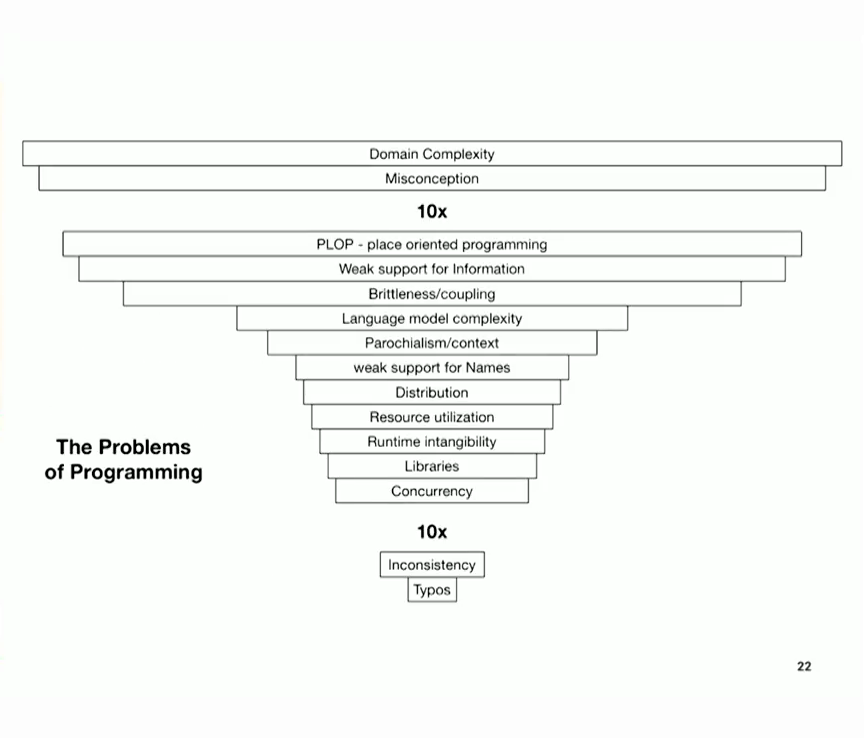
I don't mind nice and powerful tools, but one thing I learned with Java (where the tools are so much nicer and so much more powerful) is that if you're leaning on them heavily, that's kind of a sign you've messed up. Like on the scale of severity (https://raw.githubusercontent.com/matthiasn/talk-transcripts...), at least as severe as really bad coupling or brittleness. Thank goodness for the tools that let people efficiently figure things out and get on with things, but it's really better to have not needed to be in such a situation to begin with.
I have a similar view with valgrind -- amazing tool everyone would rather exist than not, one could imagine a "Google Valgrind" and "Mozilla Valgrind" competing on mild differences of amazing, but really, life is better if you can just use a managed language and never have to deal with any flavor of valgrind. I think there are ways to do webdev that significantly reduce the need to use any browser dev tools at all, though the domain necessitates some use. ClojureScript in 2014 was showing the way.
I'm not super familiar with KYB, so it could be that this would pass a human check as well, but I got in with a couple of mostly-blank utility bill / AOI templates and a pastebin saying 'this is the company x website, we do business y' as the official company website.
In any case this is a cool demo, and the type of thing that I expect to be mostly solved as LLMs get better. Good luck!
There's a big difference between the nature of fraudulent documents submitted to our customers today, and the ones that one might create knowing that the system is build with LLMs - we've mostly optimised for the former so far.
I'm also glad to see it took a number of attempts - security through obscurity is not something we want to rely on but the real system requires your identity and will offboard you without explanation at the first hint of misbehaviour.
We'll continue to improve our system to be more vigilant and make fewer assumptions.
It is not possible to give the reason for offboarding as it may tip off fraudsters on how they can evade detection next time. This is standard across the industry.
i.e. "Security through obscurity" - which isn't a phrase with a good reputation in these parts...
I note that if you know your way around the dark web, it's relatively straightforward to find a "financial crimes advocacy" website with suggestions on evading KYC and other compliance hurdles; obviously I won't repeat them here (and I know that probably the majority of would-be bank fraudsters probably aren't into checking the darkweb for advice) so I hope there's more to it than just information-control...