I imagine CNN does, but they might have been smart enough to unburden the payment pages from the marketing/surveillance cruft. Or perhaps not. There have also been browser escape vulnerabilities.
I'm a fan of formal methods, having first seen them used to verify the T800 FPU at Inmos in the mid-80s. But eventually I came to see these techniques as what you might call "fancy testing". They're not really different from "dumb testing", just better in some respects for some use cases. There's no silver bullet, as he said.
Comcast has tons of fiber just like their competitors. They're using "Hybrid Fiber Coax" plant, where only the last 100m or so is coax. Walk around the neighborhood and you'll see the fiber (orange sleeves on the cable and slack coils).
Quick note that sometimes it's not that simple. I've worked on a somewhat similar system (although overall much smaller in scope). What we found was a) clients hop between networks and hence IP addresses quite frequently: mobile devices. And b) with sync type protocols you can't just randomly serve whatever sliced and diced subset of the incoming traffic you like. What happens is that many devices end up never achieving current sync state, so they re-try. In our service we had to implement a protocol-aware, and device ID-aware filtering scheme. It had the property you mention where you could dial the proportion of load up or down, but it did it across the known population of devices: if a device got white-listed at t=0 it remained white listed for the remainder of the day. Once it achieved up to date sync it got put into another load bucket. The bucket of devices transitioning from out of sync to synced up was what we limited. It was only after we implemented such a scheme that we got past our thundering heard / can't bring the service back up after an outage problems.
I don't get this issue. The vast majority of clients would not change IP during a short sync that takes maybe a few seconds. And a switchover from an unblocked to a blocked IP would either result in a partial or in a failed sync, without any consequences.
If the load balancer already does some connection tracking, it can just keep serving existing connections and only drop new ones. If connection tracking is not available, the IP blocklist would be a suitable option.
IP blocking is dirt cheap on your edge routers. Application-aware binning needs at least your app gateway to have spare capacity. I can see that going tits-up.
> IPs on every sync on some networks because of carrier NAT
Okay, they get different IPs during the day, fine. But it's still kind of randomized. Stepping through IP ranges will reduce load and give access to more people.
I really don't get the issue you are seeing with this.
Paper! That would have been a luxury. I could write machine code in my head. Including negative branch offsets.
Having established my chops though, I'll say that contrary to the comments on this thread that's not "how people did it back then". The typical tool chain for professionals was to run an assembler (and often an emulator too) on some larger computer such as a pdp-11 or a dec-10. Anyone interested in this particular period should read billg's latest book "Source Code". It's very detailed on this subject and tells how he and Paul Allen were able to write an 8080 BASIC interpreter despite never having seen or used an 8080. He does describe writing portions of what was to become the interpreter while on a hiking trip (as in, while actually hiking), so he could do my thing of writing code in his head.
Under those conditions it would be un-licensable (since a license is essentially an agreement not to sue for copyright infringement) but it can still be made open by publication. I'm skeptical that the "anything that comes out of AI can't be copyrighted" argument will end up holding, but in the meantime it provides a strong incentive not to make that code public.
And putting things in the ocean is only marginally less idiotic due primarily to sea water being corrosive, wet, and full of creatures that tend to want to grow all over anything.
Microsoft did attempt ocean racks in a sealed container , and it sounded like the 3 year test ended successfully but was not renewed.
I presume the cost of setup, teardown, lead-time, low power density when scaled up, and lack of convenient access for mid-life repairs made it not worth the trouble
This is the sort of thing that highlights why space is such a dumb place to put a DC.
Everything about storing a DC underwater is easier than it is in space (except corrosion).
It's easier to access, cheaper, easier to cool, easier to get enough power, easier to update.
Heck, doing a second story data-center resolves a ton of issues with today's data-centers (while being a bit more expensive due to additional structural support requirements).
There are so many options for terrestrial DCs to overcome whatever problem space might supposedly solve, and they are all cheaper than the space solution.
Spacecraft in LEO deal with corrosion from - among other causes - atomic oxygen atoms up there, which are eager to cause oxidation in almost anything they come in contact with. The rate of this can be greater than on Earth's surface, though I'm not sure how oceans compare for corrosion.
Overall it's probably true that it's less of an issue than with sea water, but it's not a nonissue either.
> Everything about storing a DC underwater is easier than it is in space (except corrosion).
LEO does have corrosion (mono-atomic oxygen) as a matter of fact
When power blocks enter escalating computational races (searching for number theoretic breaks in cryptography) thermodynamics heavily favors space, the one who can launch datacenters at the highest rate will tend to be ahead of the competition.
how is power easier? solar power in orbit seems like a no-brainer - no losses due to the atmosphere / weather, and with the right orbit you can get sun all the time. Was the ocean DC tide-powered or something? how does that compare?
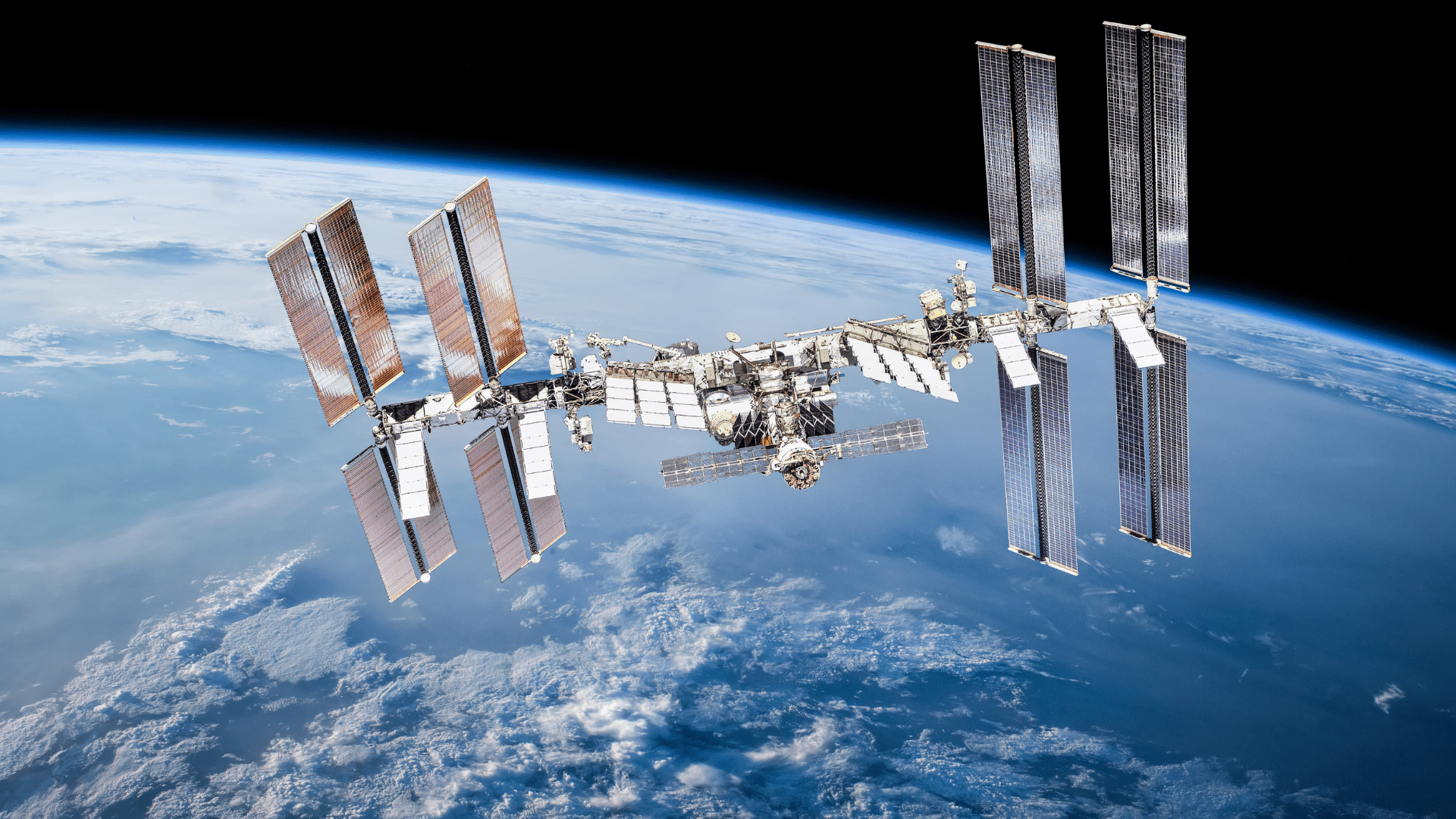
It looks like ISS can generate 240KW peak from 2500m2 of solar panels, and runs at half of that nominally [0].
A single B200 can consume up to 1200W. A single GB300 system needs 14.5kW. So, you can only have ~15 (incl. satellite's energy needs) GB300 with ISS' solar panels, which is absurd. See [1] for the size of the panels we're talking about.
People dream about Starlink-style close flying systems to aggregate them to a single data center. With these power requirements, it's more like an AI hallucination. If we can build way more efficient chips or run smaller models on modest hardware, etc. We may go there, but needing ISS sized solar panels to run frontier models in space?
Also, don't forget the radiators. You also need those to pump that heat out of these systems.
In space, you have to deploy all the power production you want to consume in the same package that's consuming that power.
On earth, you can build a power plant miles from the DC. And you can use all sorts of different sources of power, tidal, wind, nuclear, solar, fossil fuels. All options. And like the DC, if there's a problem with any of those sources, you can go fix it or replace it with different power sources. If there's a problem with the solar panels in space, your DC is dead.
In a computational race, and restricting to earthly computation, we'd quickly heat the globe by prompt heating, no CO2 needed. Of course, long before that actually happens Average Joe is priced out of energy or climate control.
We should be thankful to those who propose to "let's step outside" instead of starting a bar fight down here on Earth.
Yes, but that apparently proves the point of the poster above you.
The moderate improvements in cooling we're not worth the extra complexity.
So it just didn't make sense to do outside of a single media stunt project.
Data centers in space don't even get the cooling benefit.
The whole idea just doesn't survive modest consideration. Data centers aren't particularly dangerous. There's no forcing function to put them away from where people live. The best location for a data center is going to be a decent sized urban center with existing utilities (power and network) and acceptable land costs.
There are nearly forty of them in Atlanta, people walk by them every day with no idea what they are.
Unless you burn them during reentry. When this idea started to be discussed for the first time, somebody ran the numbers, and burning defunct ones during reentry created a massive fallout of hazardous materials, threatening the health of everyone on the planet.
Microsoft can’t catch a break. Their Surface mashup with Nvidia probably is probably dead within a year. Copilot and the gaming empire appear to be falling apart, other than massive Capex being lit on fire what does Microsoft/Nadella have to show for it right now aside from a plan to layoff 60,000 people.
I think if we manufactured most of the infrastructure and maybe the chips or solar panels in space it might actually make sense. Nobody is talking about that though, I guess Elon is saving the we will make the solar panels in space for a down quarter.
I would not expect that to happen any sooner than 50 years from now. If a flight to the Moon on a Starship really requires a dozen refuelling flights, then we need an even bigger rocket (because the larger a rocket is, the more efficient it gets). Then we need to develop and build automated and teleoperated lunar factories, maybe ship the electronics from Earth for final assembly on the Moon, establish lunar mining and metalworking to build the structures, motors, actuators, solar panels, radiators, find raw materials and process them into heat exchanger fluids and propellants, and launch the satellites at least to Lunar orbit so they can self propel to their destination orbit where latency is not two seconds.
Even with an intelligence explosion guiding the development of all these technologies, it’d take many decades.
How would it make sense? Have you seen how things are manufactured? Why would you want to make something harder and more expensive than it has to be? It's delusional to think that these things will work better in space/on mars than on earth.
Some metallurgy on the Moon might be easier - at least the atmosphere doesn’t want to react with the materials. For other processes, you actually want some of the atmosphere to do exactly that.
We’ll need to develop base industries from scratch for these environments, but, eventually, we’ll get there. The downside is that it’ll take at least multiple decades, if not more than a century.


reply