Hacker Newsnew | past | comments | ask | show | jobs | submit | fuddle's commentslogin

Is there an open source alternative to this?

There are many static and dynamic analysis tools. Not the same, but may help.

https://analysis-tools.dev/ submitted to HN as https://news.ycombinator.com/item?id=38024002


Yes, just ask your agent to formally verify your code, it will probably suggest Verus (for Rust), or SPARK (for Ada), or other similar tools. There are many. No special harness needed, the western frontier models are very good at this stuff.

Anything can be open-sourced by having your AI duplicate it.

This is my first time hearing about Vine - https://vine.dev/ I have to say the landing page is terrible, at least show an example of the language.

They've announced a playground [1] recently on their Discord.

[1] https://vine.run/


Great, but the landing page needs some work.

Yeah, I'm not giving microphone and camera access to a website without any context.


This is a great concept, but I want to see more recent videos. Not videos uploaded 6-9 months ago. It would be great to be able to filter for videos uploaded in the last month.


How do you connect your phone to Ethernet?


Ethernet to USB-C adapter. Any USB-C docking station will work, too.


This is the new OSI Open source definition for AI models:

https://opensource.org/ai/open-source-ai-definition

Mistral Large 4 is definitely not open given the "use for any purpose without having to ask for permission" requirement.


Well, to be fair, Mistral never say its open source. They call it just open weight.


Sure but people used "open weight" for weights that were open, because "open source" doesn't make much sense for something that has no source.

Now we have these "open inspired but not open" licensed weights and they want to keep the term.

I'll stick with DS4.1 flash. Open and capable


Open source doesn't mean "anyone can use the source code commercially". Open weights similarly doesn't mean the weights can be used for anything. It just means the weights are open for anyone to download and inspect.


> Open source doesn't mean "anyone can use the source code commercially".

Yes it does. It might have requirements that you release the code for any changes you make to it or link with it. But no OSI (or FSF) approved license prohibits you from using it commercially.


Not really. That definition also requires the training code and training data composition to be open-sourced.

No major Chinese or Western labs satisfy these requirements. The only vendors I can think of that do are Nvidia and Allen AI.


I'm a little confused by your distinction between vendor and lab. AI2 (Allen Institute for AI) is a western lab and they did release a fully open source model, with open weights, data, and training code (Olmo3).

Their technical report on the release is excellent: https://allenai.org/blog/olmo3

They're a public research institute as opposed to one of the proprietary frontier labs, but they've been very open about the science.


Yeah, I mentioned them in my comment. They're my favorite lab/vendor. Everything is open and reproducible.

It's just that their models were never frontier-level. By major, I meant frontier or popular.


K2 horizon is the closest to actually releasing everything that I am aware of https://ifm.ai/blog/k2/


Nobody can do that because they were all trained on stolen content


I think IBM's Granite LLM are claimed to be trained only on legally-obtained data


Maybe that’s why nobody “heard” about it. It’s funny that we have companies bragging about not using stolen content to train their AI.


Granite is super good small parameter lineup for local tasks.


Also granite is the model my m2 MacBook will be using to run this survival LLM I found on HN: https://www.brangus.io/survival-llm


Allen AI imposes further restrictions on their model releases, I think: https://allenai.org/responsible-use


I read it the first time with a study group which was very helpful.


That's pretty neat.


I'm looking forward to a "Build a Decision Model (From Scratch)" book.


Take ModernBert, add a fully connected layer with 255 outputs, take a bunch of classification datasets from Huggingface, write the code to have the datasets fit the jev format on these 255 outputs, do supervised fine tuning on the datasets with that format. then use a confidence loss of some kind


Asking as a curious bystander: would that be sufficient?

I'm not familiar with ModernBert (my understanding stops around the original Bert), but it feels like this is asking it to do lots of heavy lifting. Can it do that much?


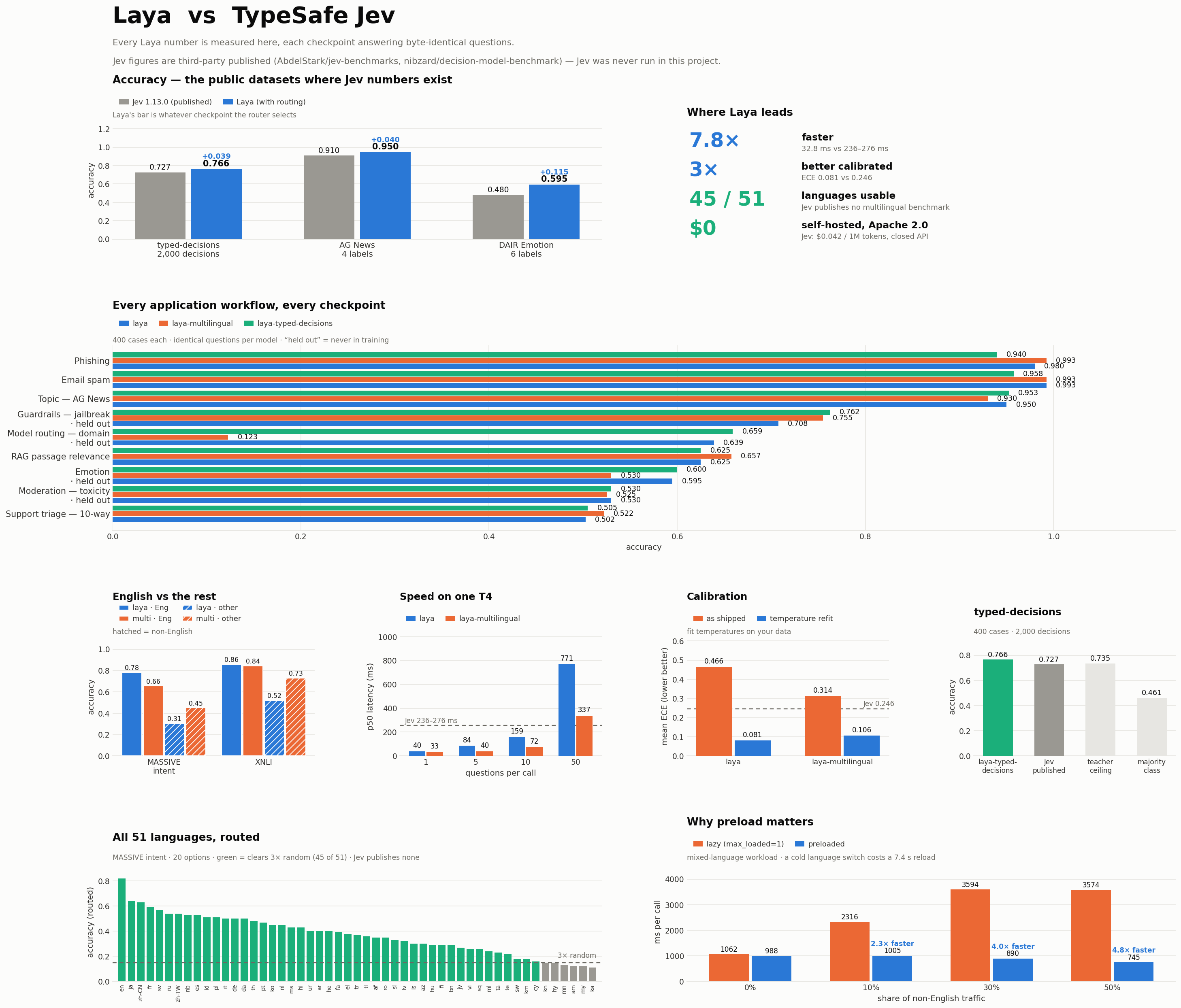
Well the numbers don't lie Laya is ModernBert-Large (421M) fine-tuned and has a similar to better performance than TypeSafe Jev https://raw.githubusercontent.com/NandhaKishorM/laya/main/as...


It seems like they recreated Manus, the AI app they were blocked from acquiring. https://www.bbc.com/news/articles/cj0v0gr2yz7o


Guidelines | FAQ | Lists | API | Security | Legal | Apply to YC | Contact

Search: