But many types of files are incompressible? jpegs aren't, and I doubt cloud storage companies are going to ban you for uploading too many photos relative to markdown files.
I am not saying this is some explicit strategy, but something that naturally happens in the numbers. Given enough customers, Z% of uploaded data will be highly compressible or redundant amongst all clients (eg OS system files). Giving you free storage margin. You offer a customer X TB for $, but, on average, you only need to allocate Y TB.
However, if all of your clients start uploading encrypted files, there is now 0% possible compression/redundancy gain. Those Windows/Mac/Linux system libraries are all going to be redundantly stored on the backend.
Who are responsible for sprawl (and thus dependence on automobiles and freeways). And the hardest part of siting new solar plants. And why North Seattle has a dearth of affordable grocery stores (... that one might be a little hyperlocal).
Trains have to deal with thicker atmosphere (closer to the ground) and have tracks that need maintenance. Planes only need a few square miles of tarmac.
Because transportation costs money. It's the same reason why farmers occasionally dump milk or let crops rot on the field because it's not worth the money to harvest/distribute.
No, because solar panels are notoriously hard to scale, especially in high density applications like datacenters. Otherwise it's like saying "my calculator runs off solar power, so why can't they make a car run on solar power? Clearly it's because Ford/BYD not giving a f"
The investments in AI is in the trillion of dollars, surely that's enough capital to figure this out. It might require inventing or improving existing technology.
Before you respond "it will be too slow", the urgency here is entirely artificial – there's no reason we need to be going this fast.
> It might require inventing or improving existing technology.
Or it might result in investing trillions of dollars and decades only to discover that there are only marginal gains to be had. There is no guarantee that throwing money at Problem X results in any kind of solution or that solutions to specific problems are even possible.
This is aside from the sibling commenters' very good point that this view assumes there are no concrete benefits or advancements to be made that depend on AI, which seems very unlikely at this point. Unfortunately, with or without AI, the problems we're facing socially, ecologically, medically, and scientifically are increasing. We can either use AI as a tool in the hopes we can at least delay the most serious consequences or just let them overtake us. Fossil fuels and climate change are just one of a million very pressing issues, despite the over representation it gets, and it seems highly likely that the benefits here exceed the costs. Addressing a downthread comment about labs saying we need to "slow down" - they are saying this for self-serving reasons and in their quest to ensure AI stays gatekept, not because they are worried about environmental impacts.
I don't see how we could invest trillions of dollars and get nothing to show for it. Consider the Apollo and Manhattan projects, both were large investments that resulted in significant scientific and engineering progress, why would this be different?
Because physics and materials science are ultimately subject to reality, they are not a slot machine you put money into and eventually get a payout.
Even your own examples tend to show that. There were in both cases rapid advances followed by diminishing returns as all low-hanging fruit was worked out. 50 years later space travel is still very expensive and difficult. Eventually we may attain reasonably economical orbital travel with sufficient advances in rocketry and materials science but there is no reason to believe any amount of money and time will, for example, give us FTL spaceships.
I'm no physicists, but we sure seem far from the limits, we haven't even figured out fusion yet and there are physicists, who presumably know what they are doing, working on that.
It's not like we have exhausted all avenues and are stuck. Solar panels are getting cheaper and more efficient, storage is a problem, but it has not seen that much investment. More nimble forms of nuclear fission, like SMRs, is an active area of research. As mentioned above, we are making progress on fusion.
The idea that we are anywhere close to the diminishing returns on investment in these areas seems completely wrong to me.
EDIT: The dichotomy in this discussion is striking: we need to disregard almost all negative externalities on speculative investment in AI, but speculative investment in green energy is not worth it because it might not yield sufficient results.
> There is no guarantee that throwing money at Problem X results in any kind of solution or that solutions to specific problems are even possible.
And yet, we are currently sacrificing our entire economy, our social cohesion, most of the world’s productive resources, and the careers and futures of thousands to millions being displaced, to chase the possibility that if we computer hard enough, computer will be alive
> urgency here is entirely artificial – there's no reason we need to be going this fast.
What makes you believe that time is irrelevant? If AI allows for breakthroughs in mathematics, science, engineering, computing, and health care—and it does seem to be delivering on this promise so far—what in your estimation is the net cost to humankind of delaying those breakthroughs by even a year? It's not zero, is it?
I mean sure, but the labs themselves are saying we need to slow down. Your position is only reasonable if the negative externalities are outweighed by the positives. Not to mention p(doom), which – unless yours is 0% – should mean we must slow down or stop immediately. We're justifying definitive downsides with speculative upsides.
More than anything though, it doesn't matter what we in tech think because we have failed to convince the general public that any of this is a good idea.
I'm not sure if the car analogy applies. Data center solar power can scale without the requirement of being portable.
The problem seems to be that they want the power online quickly and they can't get solar quickly. The article mentions the inefficiency of their generators. It is costing them quite a bit extra to generate power like that, but that's their only option of they want the power immediately.
It would be nuts to do this long term. You might argue that they don't give a f about the environment , but most people will agree that they give a f about cutting costs.
> Data center solar power can scale without the requirement of being portable.
You just have other issues like needing to get transmission and storage capacity built, which takes forever because of planning review, environmental assessments and NIMBYs.
You can, but how many cars are actually powered this way? Same goes for datacenters. It's not like electrons from solar panels physically don't work with GPUs, it's just that it's hard to make it work due to other constraints.
For electric cars it isn’t uncommon for people to put solar panels in their homes or their garages to charge them. I think the car themselves with solar panels won’t work because most people store the cars in garages usually, away from the sun - it is usually very harsh on everything that isn’t solar panels.
1. From a pure argument lawyering point of view, my original question was "why can't [Ford/BYD] make a car run on solar power?" with comparison to a calculator, which implies a car with built-in solar panel. Otherwise the statement of "they make [thing] run on solar power" becomes meaningless. eg. "Apple made a macbook run on solar power" (because you can take a regular macbook and plug it into any solar panel.
2. There probably are non-zero amount of datacenters out there that runs off solar power. It's just not commonly practical, just like with electric cars.
3. The main point of the comment is that scaling challenges exist, and you can't take a residential use case and extend it to a datacenter. The same applies for a car, even if you could do it. A solar powered calculator is easy, just slap a tiny solar strip and it just works. A solar powered car is far harder to pull off. If you don't work from home for instance, you'll need a battery system to store the energy when you're not home.
This is simply an argument against datacenters. You're pointing out a negative efficiency, and the ostensible point of concentrating data processing is to produce savings.
If you can't figure out how to get renewable power to a datacenter, but you can easily figure out how to get it to the consumers of a datacenter, and you're talking about a technology that scales down to small groups well and individuals only a bit less well (but with constantly working agents utilizing compute, better than we once imagined), what's the reasoning behind datacenters at all?
If datacenters can make a case for massive increase of demand in the future, they're simultaneously making a case that individuals will have enough demand to saturate AI located closer to them or on premises. If anything, that should be a call for p2p software to help people share or borrow excess compute with and from their neighbors in exactly the same way that home solar panels use the grid.
Datacenters are also central points of failure. Distribution is resilient.
Sounds like we shouldn't be building big data centers if there is only nonviable means to power them then?
I know meta and their ilk are trying to cut deal for nuclear power. I'm sure we can imagine they will take safety, the environment, etc very seriously too.
>but now they're crying because they wanted a 15% increase in profit for 2026 and it's looking like they're going to have roughly the same profits as last year. Boo-hoo.
But their margins are down from around 12% a few years ago to 4.4% last year? Absolute revenue and profit fell as well.
They were celebrating massive profits just a few years back and they're down now from that for sure, but a lot of that has been due to Trump's tariffs (https://nypost.com/2026/02/12/business/mercedes-benz-earning...) and he's on his way out. The point is that last year was "solid" for them and everybody made money. I don't expect that will change this year either. Shareholders might not make as much money as they did, but they'll still come out ahead. The CEO will never notice a single change in his lifestyle because of the lower profits either. The workers on the other hand have been losing money and if they can't get a pay increase or jobs are lost that will only get worse.
>They were celebrating massive profits just a few years back and they're down now from that for sure, but a lot of that has been due to Trump's tariffs (https://nypost.com/2026/02/12/business/mercedes-benz-earning...) and he's on his way out. The point is that last year was "solid" for them
No it wasn't. Zooming out to 10 years, last years profit is the lowest, excluding the pandemic.
>The CEO will never notice a single change in his lifestyle because of the lower profits either.
It's a public company. The company doesn't exist for the CEO, it exists for shareholders. And while "would someone think of the shareholders?" isn't exactly a good campaign slogan, investors looking a place to park their money very much care about whether they'll get shaken down for money even when profits are falling.
> Zooming out to 10 years, last years profit is the lowest, excluding the pandemic.
The relevant term is "profit".
Germany doesn't have a "Capitalist" system. It has a social market economy, brought about by the same parties in the 1950 that now are in power (CDU and SPD). Art. 14 Abs. 2 of the Grundgesetz states "Eigentum verpflichtet" i.e. "property obligates".
If the shareholders of a company don't accept the social responsibility that comes with property and sees their property only as a means to acquire more property to the exclusion of everything else, then there is sufficient reason to take collective action.
Pretty much every OS vendor does this, open source or not.
But I think what you're implying is that after an upgrade Apple can remote into your phone as root. Do you have any evidence for this? Or can I just write you off as a tinfoil hatter.
Sure, and so is pretty much every update. Package updates, OS updates, doesn't matter which OS. What exactly are we trying to glean from your statement?
And I am not moving the goalposts, you are being deliberately obtuse: OP said remote root access -- the operative word being access, as in they can access your phone at any time with root. So again: does Apple have remote root access to your phone? As in, can they, at any time, access my phone with root access? Does, as you say, a software upgrade, grant them such power?
I'm with you on this, remote root access means something else. But maybe they do have it for a slightly different reason, like if there's an emergency update mechanism that they can force remotely.
The difference matters because it changes how easily they could target someone. Just handing out different pubkeys seems like it would be easier to execute and harder to detect than pushing a malicious update.
Current versions of Windows 11 (including Home versions) encrypt your C: volume by default during setup. By default the encryption key is stored in cleartext in volume metadata until you sign in with a Microsoft account, when the key is automatically backed up to your Microsoft account, and then stored inside TPM secured by "boot attestation" and the cleartext variant is removed. (This means that the drive is automatically decrypted when Windows starts without you entering any PIN/Password, but protects the drive from being accessible when booting another OS from USB stick or taking the drive out and putting it into another computer).
Microsoft explicitly calls this feature "Device Encryption", not "BitLocker", but it uses BitLocker under the hood. This happens automatically, by default. Then, if you're on Windows 11 Pro(/Enterprise/Education/... anything but Home), you have two options to secure it more:
The first and more obvious one is to add PIN/Password, but that's only adding PIN/Password protection to the existing decryption key that's already backed up to Microsoft account if you have already logged into one.
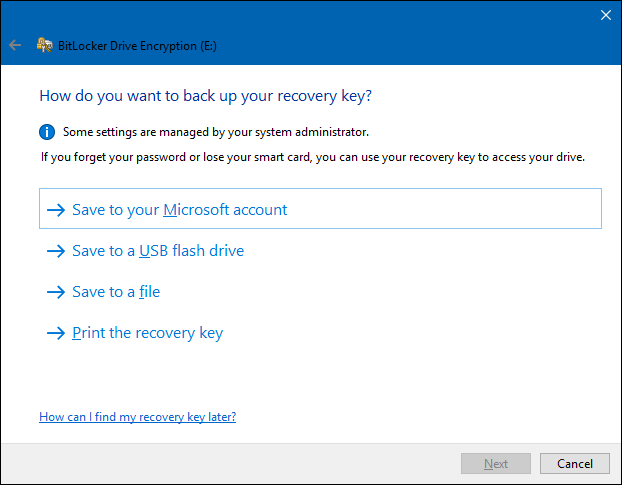
The second is to decrypt the drive and then re-encrypt it, which prompts the screen you've shown a screenshot from, where you can choose to not back the key up to your Microsoft account.
>Current versions of Windows 11 (including Home versions) encrypt your C: volume by default during setup. By default the encryption key is stored in cleartext in volume metadata until you sign in with a Microsoft account, when the key is automatically backed up to your Microsoft account
That seems... fine? You didn't enable encryption yourself, so you don't really have any expectation your data is protected. Indeed, if you didn't sign into a microsoft, your keys would be even less safe.
>The first and more obvious one is to add PIN/Password, but that's only adding PIN/Password protection to the existing decryption key that's already backed up to Microsoft account if you have already logged into one.
No, the bitlocker design avoids this by not backing up the key used for encrypting your data. Instead it encrypts that key with another key, backs up that key, and stores the ciphertext on your hard drive. This allows you to revoke such keys without reencrypting your hard drive. The same mechanism is used for passwords as well as numeric recovery keys.
okay... seems that I've misunderstood how the recovery keys work... nevertheless, the point still stands: By default, if you set up Windows like a regular user (not an IT professional) would, Microsoft has something that can be used to decrypt your drive.
If you log in to your Microsoft Account during Windows 11 setup, it will automatically create a numeric BitLocker recovery key and back it up to your Microsoft Account. This recovery key will not be revoked if you switch unlock method from TPM only to TPM+PIN. There is no GUI option to revoke this recovery key. You can only revoke it via command line.
The "Back up your recovery key" screen on the screenshot you provided only backs up the same recovery key or adds another, as evidenced by Microsoft's help article[0] claiming "You can make as many backups as you want. It's not a bad idea to have more than one, just to be safe!"
You only see this dialogue if you don't have a microsoft account set up. Having a microsoft account is the default, you have to go out of your way to not have one. I'm sure there's a way to prevent your keys from being uploaded even with an account, but it is very much the default.
Source? I don't have a microsoft account and the "save to your account" option isn't available , suggesting that the person taking the screenshot does have an account added.
The source is me trying to install windows 11 without signing up for a Microsoft account then eventually giving up because the oobe setup is too much of a fuckaround.
I don't have an ms account set up and the option is shown for me. If I press it it complains that I don't have an account of course. That MS enables encryption by default if you sign in to an MS account, and saves the key to said account, is reflective of my experience and verified with a brief search.


reply