I don't think that's true, I think you're still limited to the range of < c * lifetime, about 390 trillion miles. If you think this is wrong, can you post some links?
Edit: nevermind? The equation here does indicate that length contracts to approach zero as velocity approaches c
If you can instantaneously accelerate up to 0.99 c, you end up with a range of ~500-1000 light years before you die (dilation at that speed is 7:1, you have ~80 years of ship time).
So the distance you can travel does depend a great deal on how fast you can actually go.
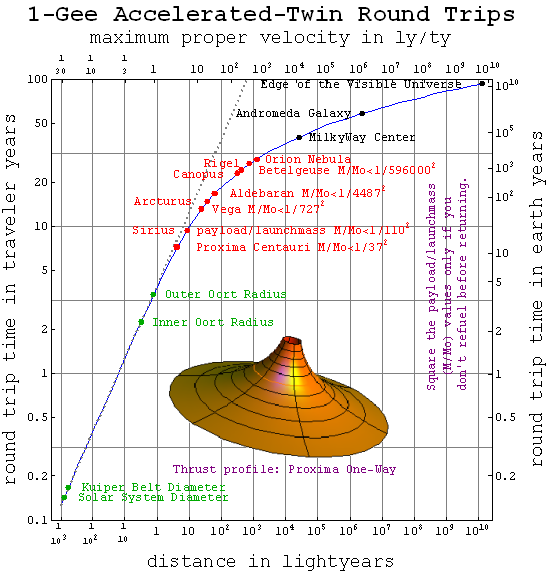
I should have clarified: the case is sufficiently obvious that there are a bunch of illustrations of how long (subjectively) it would take to travel various distances at 1g constant acceleration.
It takes a while to get going. For round-trip subjective travel times, Prox. Centauri is about 7 years. Galactic center about 42. Andromeda Galaxy, 50 years. Edge of the observable universe, 100 years.
Mind, the folks you left behind would be up nights waiting slightly longer. About 15 years to Prox. Centauri, rather longer to some of the remoter destinations.
But is it meaningful to talk of spending a year or more of subjective time accelerating at 1G?
According to the Wikipedia page you link to, it does not become harder to accelerate a spaceship the closer it gets to c, at least from the point of view of its occupants.
So you've been accelerating for ~300 days (shipboard time), and you're now nearly at c. In fact, you're only 10m/s below it, so you should reach light speed in a bit more than a second.
But we know that's never going to happen, because it can't.
I'm assuming (I don't know, I'm a layman) that that final second-and-a-bit will stretch like taffy, in time-dilation terms. You're already travelling at 0.999999966c, at which for every second of shipboard time more than an hour will pass on Earth. Dilation will only increase the closer you edge to c: at some point, every yoctosecond of shipboard time will equate to many times the predicted lifespan of the universe outside.
It's hard to imagine something terminal wouldn't happen to the ship in that final second, assuming there's anywhere left for it to happen in.
My point was just to clarify that the arbitrary range from time dilation doesn't really start to kick in until you approach c. The simpler, coarser calculation still shows that quite well.


Edit: nevermind? The equation here does indicate that length contracts to approach zero as velocity approaches c
https://en.wikipedia.org/wiki/Length_contraction