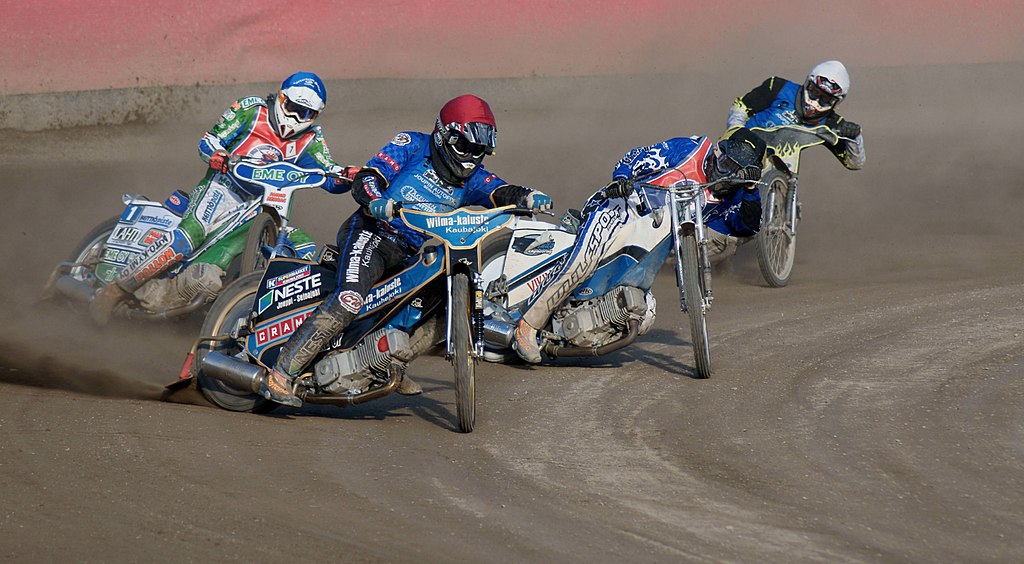
No, I don't think it does. Counter-steering is only a feature of a turn being initiated. Once the turn is in progress, the front wheel will very much be pointed in the direction of the turn.
Based on my experience, I believe that's not true. You counter-steer through the turn or your momentum would push the bicycle-rider system upright (centrifugal effect). Pointing the front wheel in the direction of the turn will initiate countersteer in the other direction (i.e., getting out of the turn). (I ride bikes most days of the year, if that helps.)
Unless we are talking something like speedway motorcycling[1] a constant-rate turn is accomplished by, after the initial counter-steering, pointing the wheel in the direction of the turn, such that the self-uprighting tendency of the bicycle matches the speed at which it falls to the ground due to gravity.
If you kept pointing the front wheel to the other side of the turn, the bike would fall over. (This property is what you use to initiate the turn, but not to maintain it.)
I believe you are mistaken. At steady state turning the steering is typically pretty subtle, and of course you can oversteer and have that mess with your balance in the opposite direction, but some steering has to be there to get the wheel to go in the right direction.
I went outside and did some empirical observation. I think the stable equilibrium depends on how fast you're going. At low speeds the equilibrium is in the direction of the turn. At higher speeds it isn't. Angle of the turn / lean and bike+rider system weight might play a role, too.