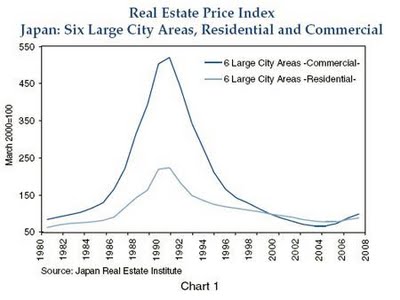
In Japan in 1990, did people suddenly stop wanting to be in Tokyo? If so, why has the population of the country been pouring into Tokyo ever since? If not, how does that square with Japanese real estate being almost the most terrible investment you could make in that year?
Maybe land in popular places is always a good investment, or maybe that sentiment is already factored into the price when you buy in, and subsequent returns are mainly driven by macro factors like interest rate adjustments and banking crises?
Japanese homes are disposable like trailers in the USA. They are often demolished and fully replaced after 20 years or changing hands. So yes, investing in a disposable thing would yield poor results.
This argument makes no sense, no matter how often it's repeated. The Japanese housing bubble crash represents investment losses on land, even empty lots, and is not a result of high upkeep costs. The losses in that graph represent many several multiples of the cost of the structure. Furthermore, depreciation of structures happens everywhere worldwide, and while it may happen faster in Japan, it's mostly balanced there by low construction costs.
Competition for land could be structured as 30 year leases (give or take), rather than perpetual ownership. Then A. prices don't reflect an asset premium and B. the surplus accrues to the public, rather than to rich people.
The problem with the 30 year lease idea is that it heavily discourages investment. Why would you build a billion dollar skyscraper when the state will reposes it in 30 years? What we need is perpetual leases that charge the full value of the land. We need LVT
The "give or take" caveat was intended to cover different terms for different zones. 99 year leases might make sense to incentivize green-field development, 45 years might make sense for heavy infrastructure (going by depreciation rules), and 30 years is calibrated more towards families. Lower durations could be sold as extenders or to synchronize move-outs in place of eminent domain.
The exponential decay of net-present-value calculations means that time horizons do not have to be infinite to encourage investment. Making them infinite doesn't even help very much at all. When you compare this against the dramatically higher capital requirements of the perpetual ownership model, it actually has very little to offer. Except ensuring that rich people can get paid for being rich, of course, which one starts to suspect is the actual purpose.
Leases from the public to the person who wants the public to stay off a chunk of land. The perpetual ownership model is actually pretty weird: the public in 2023 agrees to stay off Bill Barnes' land in transferrable perpetuity in exchange for... a railroad built in 1850 that went defunct 100 years ago. And a dribble of property tax. Lol.
Yes, the USA was founded by english nobility for english nobility. Is it really so surprising they upheld one of the most important institutions for ensuring that rich people can get paid for being rich? They also upheld slavery for similar reasons, though thankfully we sorted that one out 150 years ago.
Again, this is in effect what property tax does. You effectively lease the land from the government because the second you can’t or won’t pay your property tax they will take your land and sell it.
Private ownership of land is actually in the governments best interest. Private individuals will improve land creating further tax. And buildings and people are the 2 things of value a government has. With private ownership the people are truly invested in the government and the government with the people.