> The Spanish Diplodocus lived roughly 150 million years ago near the end of the Jurassic period.
> [...]
> According to the team, the presence of Diplodocus in Iberia offers strong evidence that dinosaurs moved between North America and Europe during that era, likely crossing temporary land bridges that appeared as the proto-North Atlantic Ocean periodically receded.
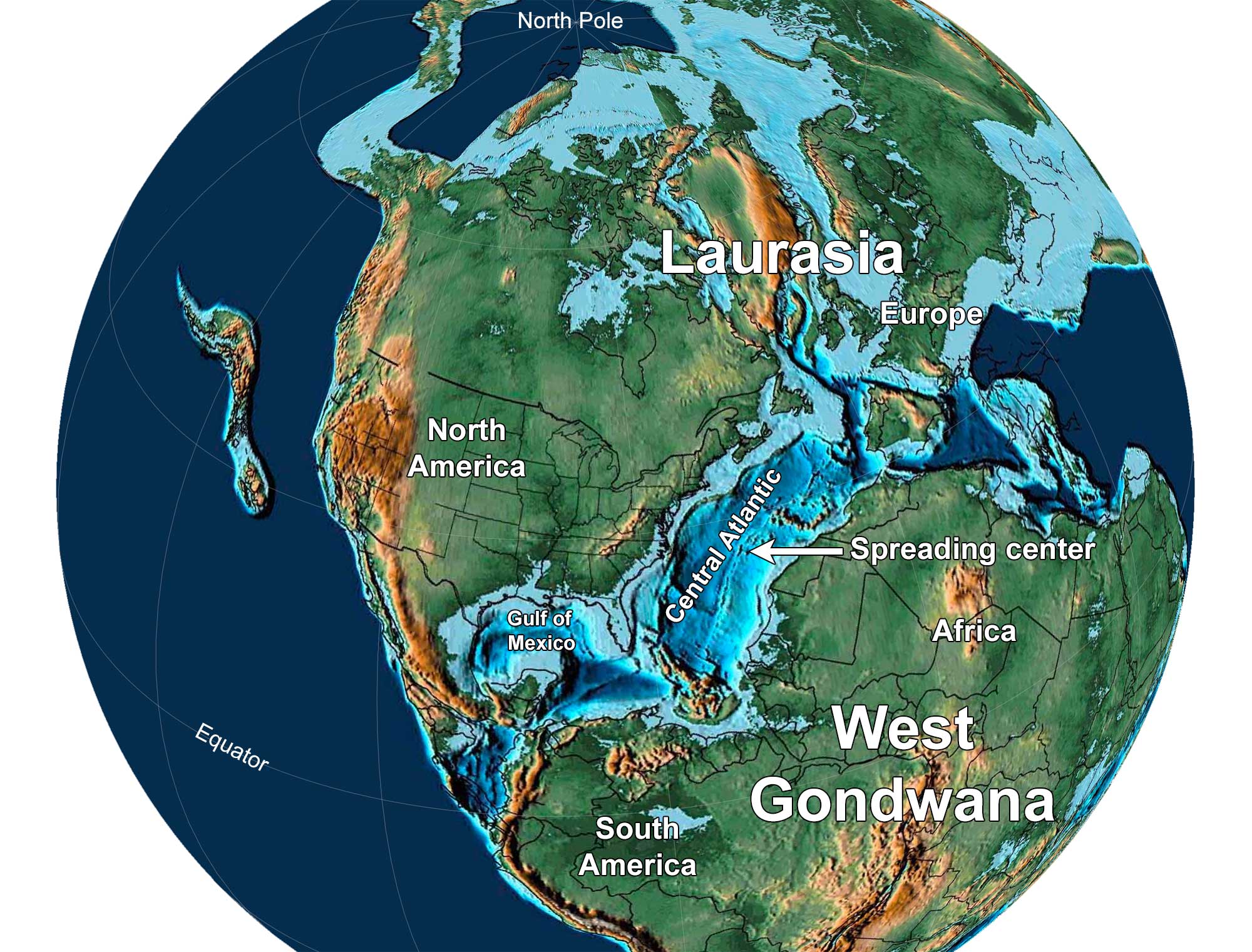
I want a map! I found this: https://www.sciencephoto.com/media/167017/view Is it the correct map? Is there a land (ice?) bridge between Newfoundland and Portugal? Am I interpreting it correctly?
Else comment I made, trying to answer that same question, I found https://thepangeamap.com - one of the neat features is being able to put dinosaurs in the timeline. The Paleotopography selection (rather than GPlates) also gives hints about the expected height and depth of the land and sea.
Yes, I have very positive interactions with people outside of the US, and (hopefully!) most of them would say the same about me. That doesn't mean that what my government is doing isn't really shitty though, or that I would expect the other 350 million people around me to be uniformly positive to interact with. For starters, a lot of them voted for the government that's being like this, and although that doesn't necessarily mean that they would interact poorly with people from countries that are having to deal with the fallout, I wouldn't blame someone for not wanting to give them the benefit of the doubt, or even not wanting to give me the benefit of the doubt (I can't prove how I voted, and even if I could, it wouldn't be unreasonable for that to be considered insufficient for exculpability).
My honest impression is that most of the time when governments are at odds, the people living in the countries will often not share those sentiments when interacting at an individual level. During the brief period when TikTok was unavailable in the US (before the ban kept repeatedly getting pushed until they finalized Ellison et. al. acquiring the US rights for it), a lot of people apparently went onto a Chinese social media app as a silly form of rebellion, with both sides basically agreeing the whole thing was silly and that even they their governments thought they were enemies, the citizens didn't have to.
Too far south for an ice bridge - Newfoundland is south like modern Florida - tropical. And it's the Jurassic, hot with high sea levels, so even though its continental shelf extends out towards Spain, there are no ice ages to bare it (as was the Eastern US shelf a mere 12k years ago). But Pangea is ripping apart, it's a mess with crust blocks variously uplifted and tilted, massive weathering and sediment fluxes, so...
From the TFA paper[3]:
During the early Mesozoic, North America and Europe were connected to form the western and central part
of the supercontinent Laurasia. With the opening of the North Atlantic during the Late Jurassic and earliest
Cretaceous, the region fragmented into smaller tectonic units55–58 that might have periodically formed contiguous
land masses57,58 during sea level low-stands, characterized by exposure of continental margins and draining of
continental interior seaways55–58. The presence of a land bridge between North America and Europe during the
late Kimmeridgian-earliest Tithonian13 might explain similarities in some dinosaurs such as Stegosaurus59 and
Allosaurus60. However, the absence of turiasaurs in the Morrison Formation suggests that this clade dispersed
into western North America after the mid-Tithonian. Thus, unless we wish to argue that turiasaurs were actually present in the Morrison Formation but have not been found yet, a second later land connection between
Europe and North America is required. Specifically, during the mid-Valanginian (c.137Ma), a dramatic drop in
sea level7,55,56 potentially reconnected Europe and North America and so permitted a fi al exchange of vertebrate
clades across the Atlantic. Th s Valanginian event could also explain apparent faunal exchanges between these
continents proposed for the late Hauterivian-early Barremian13. Taxa that seem to disperse in the Hauterivian/
Barremian might actually have done so during the Valanginian lowstand, but gaps in the fossil record mean that
the results of these dispersals might not be detected until we access better sampled post-Valanginian deposits.
58 is available with a plate.[4] 57 is old, with only low-res global plates, ggl books preview has 138 Ma on p42. 56 I skipped. 55 is available[5] but is temporally low res.
There's a 2016 paper Late Mesozoic North Atlantic land bridges[6], Elsevier paywalled with excerpts, and on sci-hub.
Apparently I'm a bit slow today, because my brain started completing the headline as "Diplodocus, Long Thought Extinct, ..." before my eyes could finish reading it.
> The animal’s fossilized remains — 14 well-preserved tail vertebrae and several chevron bones — were unearthed at the La Tejería site near the city of El Castellar in the Spanish province of Teruel.
According to Wikipedia (if I'm reading correctly), the chevron bones are also part of the tail [1]. It's pretty cool how such a small part of the skeleton can carry so much information!
I am not a dinosaur expert, but the headline seems off.
The actual paper linked from sci.news starts with this (citations removed):
> Diplodocids are known from deposits present in the U.S.A., Europe, South America, and Africa. According to the available evidence, the oldest diplodocid sauropod dates back to the Oxfordian of Europe, whereas the most recent ones are from the lowermost Cretaceous of South America and Africa.
It als says that "The European diplodocid fossil record is scarce and fragmentary," but that still sounds like evidence for Diplodocus in Europe, doesn't it?
Once again, history and medicine are two fields that reliably make me happy. Dinos were my faves as a child and they continue to inspire. The way we (my family) mispronounced this one: diploDOEcus. But I also got Heredotus very wrong, so I guess it was a Midwest thing.
What's wild about this is that it makes really obvious how limited our perspective on dinosaur biodiversity is. Our best view on the best-known dinosaurs comes from a few places that were really good for finding fossils from specific eras.
And then you're using a bit of the west and Great Plains (Utah, Colorado, Montana, North Dakota) for all the different species that live in North America.
We've only got snapshots of them in time - often from some disaster which aided in the formation of fossils... but all that other time, species evolved and went extinct without leaving a single identifiable fossil.
(One of my families great roadtrips of my youth was out to Dinosaur National Monument during a sibling's dinosaur phase... and it was neat. I was there on a road trip of my own in '09, but it hadn't reopened yet... someday I'll get back out there again.)
Looks like there was a land-bridge to "Europe" around the Jurassic-Cretaceous boundary if you stick it in Paleotopography mode.
(I like that mode better because it appears to show the actual landmasses at the time vs the plates with an approximation of the modern masses overlayed)
They'd be so confused if they tried to come to Spain and spend time with other Republicans, their head would hurt wondering why all of them are either socialists, communists or anarchists.
FWIW "American" might be more continental than national; my recollection is that one of the places where tons of dinosaur bones were found in the early paleontology days is Alberta.
As someone who grew up in the Boston area and is a baseball fan, I always have a strong emotional reaction to someone referring me to as a Yankee. Those are the other guys!
I honestly had the opposite misreading; I thought it was intentionally trying to say it also had been found in South America, but from some googling I can't find any reference to that. Wikipedia seems to have already been updated to "North America and Europe"
Mild correction, but unless you're talking about something in Columbia or maybe Panama, I think what you're referring to is between North American countries.


> [...]
> According to the team, the presence of Diplodocus in Iberia offers strong evidence that dinosaurs moved between North America and Europe during that era, likely crossing temporary land bridges that appeared as the proto-North Atlantic Ocean periodically receded.
I want a map! I found this: https://www.sciencephoto.com/media/167017/view Is it the correct map? Is there a land (ice?) bridge between Newfoundland and Portugal? Am I interpreting it correctly?
reply