Seriously though, if you're determined to doubt the law of demand applies to the market for labor - as I suspect you are - then Don Boudreaux has some questions for you:
(I can of course give specific EXAMPLES of people being denied work they would like (and that their employer would like to give them) because their productivity is too low to justify the minimum wage, but I suspect you'd just dismiss that as "anecdotal evidence". Is that what you want to see? Or if not, what would "data that explicitly shows this causation" have to look like for you to find it relevant?)
Oh, and if you decide correlation data might be acceptable, I'd start with this report:
(TLDR: in 2007 it was attempted to gradually bring the minimum wage in American Samoa up to the level in the rest of the US. The resulting hit on employment levels was truly impressive and hard to explain any other way than that setting the wage level above the market level destroyed jobs.)
>what would "data that explicitly shows this causation" have to look like for you to find it relevant?
I'm not sure, because I don't think anyone's found any. The american samoa link is interesting, and it certainly looks like employment took a hit for it. But how comparable is American Samoa's economy, to, say, Washington DC or Birmingham Alabama?
I assume they're all comparable in the relevant attribute which is: if you make labor more expensive, employers will tend to consume less labor. Do you have some reason to think they're not comparable in that way? Do we need to find evidence of a general economic principle in EVERY locality for you to accept that it is, in fact, a general economic principle? Or is it sufficient that we have a strong intuitive argument and hundreds of studies showing it in action in various places and times? (And if you think the difference is "monopsony" as per Card/Kruger, how do you answer Boudreaux's questions I linked above?)
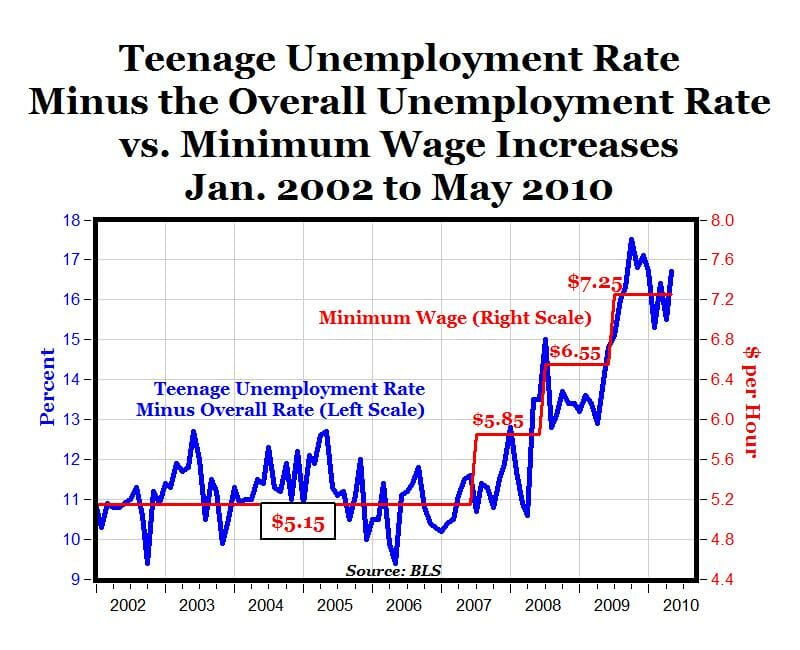
In the US, here's a plot of the correspondence between the teenage unemployment rate and recent large minimum wage rate hikes:
Quote: "Each 10% increase in the minimum wage [since 2007] was accompanied by a decrease in employment of 1.2% for Hispanic males, 2.5% for white males and 6.5% for black males. When looking at hours worked, we saw a similar effect: Each 10% increase in the minimum wage reduced hours worked by 1.7% for Hispanic males, 3% for white males and 6.6% for black males.
The data clearly show a disproportionate loss of hours and employment for black young adults. Let's put these lost opportunities into context. Between 2007 and 2010, employment for 16- to 24-year-old black males fell by approximately 34,300 as a result of the recession; over the same time period, approximately 26,400 lost their jobs as a result of increases in the minimum wage across the 50 states and at the federal level." (source: http://mjperry.blogspot.com/2011/07/second-recession-from-mi... )


Show me the data that explicitly shows this causation (correlation not encouraged), please.