I can't help but think Andreesen's gone off the deep end a bit, especially after he started gushing over Adam Neumann's second run at a real estate company (“We think it is natural that for his first venture since WeWork, Adam returns to the theme of connecting people through transforming their physical spaces and building communities where people spend the most time: their homes.”).
> AI is simply already illegal across most of the economy, soon to be virtually all of the economy.
This just isn't true - AI won't necessarily be a product in the sectors he's talking about, but it'll absolutely improve them. Hospital services? AI is clearly going to be involved, at least in things like radiology. College tuition? I suppose that depends on how much the value of higher education remains in scarce brand names vs. education, but clearly AI is going to open up educational opportunities in a way that brings the costs way down.
And then AI will eventually (and to be clear, it might be a while) get us to general-purpose robots. He says "Those industries are monopolies, oligopolies, and cartels, with extensive formal government regulation as well as regulatory capture, price fixing, Soviet style price setting, occupational licensing, and every other barrier to improvement and change you can possibly imagine." but in an industry like construction, if you accept what he's saying, all of that control is in the hands of the rich folks at the top. What he's suggesting is that they'll protect the jobs of construction workers when they can replace them with cheaper, more efficient robots who are exempt from safety standards.
Yeah, his whole post is thinly veiled anti-regulations blather. I suppose it’s a nice break from his web3 nonsense and his deranged anti-“woke” posting.
I have no special love for this guy as he said some stuff that pissed me off in the past, but what is your specific argument against this post right here?
> Hospital services? AI is clearly going to be involved, at least in things like radiology
This is very far from the main point: accuracy of the claim that AI will wipe out (in this case health-related) jobs (and/or make health-related services cheaper). "involved" here is so vague as to be meaningless.
> clearly AI is going to open up educational opportunities in a way that brings the costs way down
It may be crystal clear to you that AI will bring the cost of popular education down, but it is not clear to me at all, and adding "clearly" and "obviously" to some future claim does not make it any more convincing. He's trying to work with existing trends and data, you are saying "clearly the trend will reverse just because".
I realize the original post was written by somebody who has a reputation for saying one thing and doing something completely different, etc. etc.
> This is very far from the main point: accuracy of the claim that AI will wipe out (in this case health-related) jobs (and/or make health-related services cheaper). "involved" here is so vague as to be meaningless.
Let me rephrase: AI is better at human beings at the sort of pattern-matching work that radiology entails, so the majority of radiologists will be unemployed (I'll say in 20 years, if you want to check back down the line a bit and see how I did). This will both improve patient outcomes (fewer mistakes) and lower costs. Some radiologists will remain in supervisory/research/needing to have a human to rubber stamp type roles.
> It may be crystal clear to you that AI will bring the cost of popular education down, but it is not clear to me at all, and adding "clearly" and "obviously" to some future claim does not make it any more convincing. He's trying to work with existing trends and data, you are saying "clearly the trend will reverse just because".
I'm not saying anything "just because." I'm saying that technological changes in the form of AI will cause the trend to change, as technological changes have caused numerous economic upheavals. Nonetheless, I will be more specific - AI will give everyone a completely knowledgeable, fully personalized tutor. It will be able to very specifically identify places where a student is having difficulty and create custom exercises that are tailored to not only the subject, but also the student's optimal methods of learning. It will be able to custom tailor curriculum to fit a student's specific knowledge and career goals. The relative inefficiency of the large-scale lecture model of higher education will be so significant that the value it'll retain will just lie in the brand cache of the institute of higher learning (effectively, you passed the Stanford admissions AI's muster, so you're smart).
The statement that "AI is better than human beings at the pattern-matching work of radiology, so the majority of radiologists will be unemployed" oversimplifies the role of radiologists. While AI can assist with pattern matching and improve scan quality, radiologists are doctors who diagnose pathologies based on multiple factors, not just scans. They also interact with patients, make important judgments, and determine when further investigation is necessary, for example.
While it is possible in theory for AI to handle these tasks, they are complex and difficult problems to solve. There is currently no evidence to suggest that AI will replace radiologists in the two decades. Therefore, it is important to recognize the valuable role that radiologists play in patient care and not underestimate the challenges that remain in developing AI technology that can effectively replicate their expertise.
> doctors who diagnose pathologies based on multiple factors
This is part of “patterns”. Multiple factors are just patterns.
> They also interact with patients, make important judgments, and determine when further investigation is necessary, for example.
Judgements and determining further investigation can be just output of AIs. Interacting with patient can be important, but as we can and could see, that is not preferred by many people. For example, I used an AI in the past few years for every of my medical problems. It was better than my doctors averagely. I still followed my doctors advices, but they failed many-many times when it wasn’t a simple cold or injury. It’s a matter of time when something will click in my mind and I start to ignore doctors as the first contact points. Especially that there is a good chance that you get an asshole, or an idiot, who just causes more problems (both happened to me way more frequently than it should be acceptable).
I am 90% sure that some form of "this was clearly written by ChatGPT" will be the new go to comment for people who don't have a counterargument to people who disagree.
> ...AI will give everyone a completely knowledgeable, fully personalized tutor.
I want to see a GPT-based implementation of A Young Lady’s Illustrated Primer-like open world that constantly teaches. We have a lot of the precursors needed to attempt it and give it a shot.
This is my life long dream. To get to work on gen1 of something like this.
In place of paid mechanical Turk tutors I want to create an epistemological engine consisting of 3 main things: an inventory system of composable pieces of collected knowledge about the game world, a set of story writing design tools to create vignettes and connect pieces of narrative… a kind of narrative procedural generation system, and finally a set of original ui elements to showcase how the “knowbits” can be used to interact with the games narrative. AI will be used for character actors.
But, i get the gist of it, we can probably find many more niches that might suffer.
My take on the bigger point is, I wouldn't be so sure about the economy-wide apocalypse. I agree with what he said about the outsourcing scare of 2000's, and if pure cost+customization of education, for example, were an issue, you could conceivably hire a very good personal tutor (professor even) from a low-COL English speaking country, even like 15 years ago, or build yourself your own full custom curriculum for free from MIT videos and plentiful other information that has been around forever, mostly for free. Yet, colleges haven't been abandoned, people are taking on more and more debt every year just to be a part of that system. This is probably not technological in nature. Same for healthcare, there are so much money (and technology) getting poured into that but the system keeps getting more expensive and not too much more efficient, will probably start regressing at some point.
My personal point of curiosity was that autonomous driving, which 10 years ago was promised to have fully arrived 5 years ago, among other things would have turned 2,000,000 not-very-retrainable-in-such-numbers truck drivers in the US into basically near-homeless people. Well, it hasn't really happened:
> from 2020 you will become a permanent backseat driver
We've been, too, promised that AI will revolutionize healthcare, e.g. that Watson will replace your doctor (at least, according to the IBM and friends' pitches). Watson turned out to be less than a rounding error in the healthcare equation (i think they got rid of parts of it by now).
The point being, to me it's not very clear cut, and some of what MA pointed out seems really to be caused not by inferior pre-ChatGPT technology but for more societal/economical reasons and incentives (perverse or not).
When the television first arrived any TV optimist would’ve said:
“clearly TV is going to open up educational opportunities in a way that brings the costs way down”
… and that is exactly what happened. Since 1960 every kid in the world “clearly” gets the absolute best education imaginable thanks to the economy of scale afforded by TV broadcasting. It’s basic economics. Oh wait.
Well the thing with education is that there is always more to learn since knowledge keeps increasing. So arguably what you want to measure is productivity. Has television, say PBS increased educational productivity. I would say yes. I remember watching Nova shows in science class and so forth. So yes TV has reduced costs.
Books also increased productivity in the same way.
The cost of educating 1 child was never lower than when they were taught by their parents how to work the fields while doing said work. Education costs tell us very little about both quality and efficiency of education.
Do you mean education as in actually education? Then the cost has fallen to basically nothing. Or do you mean education as in credentialing, which is the way most people use the word? In that case it hasn't because, as the value of a credential rests entirely on other people not having it, it is in the interest of schools to restrict the supply.
It is not clear to me that is the case. Has the proliferation of screens actually improved learning outcomes?
It appears to me that e.g., HS graduate standards have been gradually lowered over time, particularly the further back you go. Maybe this is independent of the screens.
Unequivocally yes. Not every usage of a screen in education is beneficial.
But there are absolutely numerous use cases where being able to display graphics on a screen (or even better interactively) is a massive benefit. Think of any sort of science that's better shown with animation than just a static image on a page for example.
Sure, no doubt, a video can sometimes make things much clearer. A great example (to me) is this [1] for example. I had understood from the old illustrations that I was supposed to imagine something like that, but video makes it incredibly clear.
The actual net impact of screens in classrooms, however, appears to me to be extremely negative, and I think learning outcomes bear that out.
> but in an industry like construction, if you accept what he's saying, all of that control is in the hands of the rich folks at the top. What he's suggesting is that they'll protect the jobs of construction workers when they can replace them with cheaper, more efficient robots who are exempt from safety standards.
That doesn't follow, particularly in construction.
There are many regulations that require something which is nominally better but is a trade off against cost, making the lower cost alternative unavailable. Much of that increase goes to the construction contractors as labor costs or markups on more expensive materials, so it's their unions and trade organizations lobbying in favor of the cost increase. The regulatory capture is by the construction workers.
They're also aligned with anyone who wants housing costs to stay high, including realtors and real estate investors. So yes, the rich folks at the top will protect the jobs of the construction workers when the high construction costs help them keep rents high.
> Might just be drink being less affordable, or other drugs being more affordable rather than a fashion decision
Or they're just joyless teetotalers who've replaced their friends with SSRIs and amphetamines.
Inebriation is vulnerability. It's too risky to drink around other people these days, which is the entire point of it. I don't even see/smell anybody smoking weed despite it being legal and accessible...my local dispensary is a ghost town.
Loosened social inhibitions is a footgun, and drinking alone is miserable, so why bother?
Crypto was a big mistake on his part, imho . Crypto is not at all like the 'next facebook' or the 'next world wide web'. At best it will be a niche and limited to gambling. Even I could have told him it was a bad idea, but it's not his money, so what does he have to lose. As long as there are people chasing the latest thing in the hope of getting rich, there will be people selling shovels and ticket.
Limited to gambling is hardly limited at all if your mission is life is to extract money out of people by any means possible.
If your mission is whatever noble sounding thing most investors claim then yes, it is very limited.
On the topic of the article. Employment and unemployment are social constructs and how AI changes them is up to us.
It won't inevitably lead to a post-scarcity society or to mass poverty.
What happens will depend on what you, the reader, do. Do you assume it will all work out? Do you get active in remaking the social contract? Do you try to exploit the situation for your own ends?
Probably realizes the Crypto ting is tainted, he needs a new steaming pile of shit to scam people with. AI is perfect like crypto, because you can use techyspeak to confuse people.
he led the mosaic project at ncsa, creating the first web browser most people today would recognize as a browser, with things like images mixed in with text
then he went off and founded netscape, creating the dot-com boom
since then he's mostly been running a successful vc firm
Copying comment from earlier thread because I sent it two days after thread:
You should add your Matrix to your contact page.
Edit: Also, is there going to be another der* release this year? They and therefore you have taught me more than I'd learned in the last five years otherwise.
wow, that's astonishing and wonderful to hear, thank you
i hope the things you learned from them were mostly true
i was planning to do one in december but i felt like i didn't have much material because i had a pretty unproductive year in 02022, and i'm increasingly dissatisfied with the medium
i don't think you can be brilliant without being kooky; if all you know is consensus reality you can never reach any conclusions before consensus reality does
You are not wrong. This is what I would call a severe imagination deficit. Which is of course not a great trait for a venture capitalist. Andreesen is framing things in a very US centric context. Which of course represents the status quo there and the way things are; mostly for historic reasons. That's going to change for two simple reasons. Number 1 would be that it is sub optimal to say the least. It's simply not sustainable. And number 2 is that this is not the way things are elsewhere and the US is in competition with those places. Andreesen is making a closed world assumption and navel gazing. Failing to adapt basically means a slide towards being less relevant, less competitive, etc. Which is of course another way of saying that change is inevitably coming. Whether people like it or not and whether they are ready for it or not. Eventually the economy would collapse and people would adapt. But probably some time before that people will get a clue and start fixing things. Either way, things change. So predicting that things won't, shouldn't or can't change is a foolish prediction to make.
If you want a concrete example of a few places that aren't going to be held back by regulation and bureaucracy: China, India, most of Africa. They have bureaucracies of course but they are also booming economies and very much making the difference via technology. People are going to push boundaries with what is possible technically and some places are going to be more comfortable doing that than others. Ultimately, the willingness to push boundaries is what will lead to breakthrough results. If the US is not willing, too complacent, or too scared, that just means it happens elsewhere.
All this is true regardless of AI. But of course given that we have that, people are going to use that in anger for all sorts of things. Some misguided, some foolish, and some very productive and practical. Andreesen is arguing that flat panels are cheap and education is expensive. Flat panels are cheap because they are not made in the US and the production of those is not bogged down by how inefficient things have become in the US. For the same reason, you are better off getting your education outside of the US. Education is more or less free in other parts of the world. It's only this expensive in the US. Probably silicon valley is the worst place in the world to get one in terms of economics. Which is why a lot of the people working there are coming from abroad. Which is where they get most of their education.
Probably education is at the forefront of what AI can do short term btw. I've played a bit with chat gpt and it's an obviously awesome educational tool. It's like this patient tutor that is willing to explore any subject and answer any question. It might be a bit off with the facts and all the bat shit crazy hallucination. But that sounds like it should be a fixable problem. Once that is fixed, there will be no shortage of teachers any more. Anyone willing to learn will be able to learn and receive an education that is completely tailored to them. Anything, anyone, anywhere. Kids are using chat gpt already to fool their teachers. The next logical step is replacing them entirely. That's not going to take a lot of time. And it won't cost anywhere near a million dollars.
The stagnation of certain industries is because of tax policy and the insane greed injected into our healthcare systems when the HMO laws passed in the 1980's.
I'm not even sure what pmarca is talking about here. It's like he's waving his arms, "look over here at my BS and don't look over there where AI is about to slam information workers."
AI will absolutely change the way software engineering is accomplished. We already use things like Cloud Formation templates to auto-build and scale cloud-based architectures. We have code generators to build microservices. We even have modeling techniques to simplify complex systems.
All of those "things" will be plugged into an AI and one senior technologist will be able to write a detailed functional description of a system in natural language, domain models, with data points, and an AI will write, test, integrate, and deploy production level code.
I absolutely see entire divisions of software engineers being wiped out by AI-generated systems.
Pmarca makes the argument that even so, all those engineers will do "something else" that pays a salary and benefits society. The ones that can elevate their skills to systems design and architecture will probably be okay. But people that like coding...they're going to be creating building blocks for the AI to use in its generation processes and those are going to be low-wage jobs.
AI is going to change humanity in dramatic ways. I just hope that in the process, someone builds an AI that figures out a path out of international conflict, through global food and water safety issues, and speeds up our ability to restore the planet's health so humanity can survive.
I'm also tired of how market fundamentalists always keep comparing their opponents to the Luddites, as if the Luddites were irrational fools with eternal egg on their face for their inability to see the blessings that technological advancement would bestow upon society.
No, the Luddites actually lost their livelihoods in the early Industrial Revolution, and they would reap none of the eventual benefits of technological advancement. Their quality of life decreased suddenly and dramatically because they were replaced by technology.
If you'd be told that some technology will make you obsolete and you will become a homeless pauper by next year, but it's ok: decades from now the improved technology will lead humanity towards a post-scarcity paradise; would you be ok with that?
If I really believed that my suffering would lead to a post-scarcity paradise, yes, I would (but I don't believe it). And this rhetoric isn't just from free-marketeers. On the left, that's also what motivated people to endure the insanity of Stalin's and Mao's regimes -- that all the suffering they endured was temporary and was for a higher purpose -- to achieve a utopia that always seemed just out of reach.
The luddites were fundamentally selfish. Imagine if workers in a business burned down a competing business so they didn't get laid off during a downturn - zero sympathy right?
My sympathy depends on context. In the society I live in, my sympathy would be very limited, as there is a social security system so these people will not go homeless or starve (though the experience will still be painful to them).
In a society where there's no such system, I don't blame them at all. If someone is coming for the roof over your head and the sandwich you eat, it doesn't matter if they're doing it legally or illegally. You can't begrudge someone defending their own existence.
> AI will absolutely change the way software engineering is accomplished. We already use things like Cloud Formation templates to auto-build and scale cloud-based architectures. We have code generators to build microservices. We even have modeling techniques to simplify complex systems.
> All of those "things" will be plugged into an AI and one senior technologist will be able to write a detailed functional description of a system in natural language, domain models, with data points, and an AI will write, test, integrate, and deploy production level code.
Are you sure? Imagine someone saying the same thing about compilers: "Before we employed 20 programmers to write machine code but now we can employ 5 C programmers because C is so much more productive". Of course the opposite happened. Compilers increased the demand for programmers.
The improvements in efficiency for programming also occurred at the same time as it was undergoing explosive growth across every industry. How much room for growth is left is anybody’s guess.
Just based on how the entire article is structured, and the way it links in supporting evidence that normal people don't do, its like a delusional rant almost, but there's something off, honestly, the inconsistency in certain areas makes it looks like a number of articles that were generated by chat-GPT. Anyone else getting that vibe?
Aside from that, it completely ignores the division of labor, and AI isn't being developed to augment production, its being developed to replace human's as the source of productive effort.
For the communist bashing it does about universal basic income, its positively influencing socialist topics, cherry picking, and quite ironic.
The benefits we get from being the primary form of production are growth from challenges, professional experience, money, food, the means to support children, etc.
There's a lot of good reasons why thinking machines are generally outlawed/banned on pain of death in realistic scifi literature.
Overpopulation isn't a problem anyone wants to touch. What use is humanity if the environment becomes disadvantaged to human intellect, and there are too many mouths to feed for the resources available. There are always limits to growth.
Most benefits we enjoy today have only been possible through the division of labor.
Software Engineering is only one of the fields that will be revolutionized by this technology, and to agree with the article at least in one point, regulation will be the major inhibitor to how far it goes. The two big problems for our current AIs is a) copyright of training data and b) liability when adhering to the output.
In the case of self-driving for example, having cameras that film everything around the car can be a problem if handled incorrectly, there are some countries where it might be outright illegal (eg. Germany). There will also be huge legal battles on liability when things go wrong.
But speaking of legal; law is one of the industries outside of SWE that might see the biggest shift. The stakes here are also high, sometimes possibly as high as with decisions made by driving AIs, but for a lot of people getting free or very cheap legal advice will be an incredible blessing. Law firms might be able to cut out most non-partners if "legal assistant AIs" get sophisticated.
The chances for medicine are what excites me the most. Already, most doctors google a lot. (Personalized) Medicine is simply a field too complex for a human to fully encompass, and AI has the potential to sift through all the literature, and all the available medical data, to find possible relations in symptoms. And, again, free medical advice (even if dubious) would be a blessing for the billions of people without access to healthcare.
> AI is going to change humanity in dramatic ways. I just hope that in the process, someone builds an AI that figures out a path out of international conflict, through global food and water safety issues, and speeds up our ability to restore the planet's health so humanity can survive.
I agree with this, although I'm deeply scared of an AI that capable. Increasingly, I'm agreeing with the hawks who believe AI is one of the biggest existential threats of the ongoing century.
> regulation will be the major inhibitor to how far it goes.
This likely won't be true if China also has the technology. Regulation would give serious disadvantage to western countries while China keep improving their AI without giving two fucks about copyright of western content. The choice will be either to let China take all the software engineering, writing, creative etc. jobs, or to deregulate to not cripple the country.
China has a huge and restless population, and their economy at this point isn’t designed around outsourcing. I see them using AI in an authoritative way, but they wont be rushing to replace people with the zeal that Silicon Valley has.
>All of those "things" will be plugged into an AI and one senior technologist will be able to write a detailed functional description of a system in natural language
I fully agree that this will be possible.
However, having worked in the industry, especially FAANG, Ive seen people getting hired and teams grow from 4 devs to 8 solely based on metrics of how long it takes those engineers to finalize projects, and when you look at the work that they do, so much of it is dealing with bullshit friction that doesn't need to be there.
One of the most memorable examples was people writing Cloudformation stacks. One of the issues that used to happen is that if you fucked up your template, and the stack started deploying a bunch of infra like EC2 instances, and then it ran into an error, it would take the time to delete all the instances it created, which took forever.I suggested that we just use python+boto3 to define our stacks to avoid this, and people looked at me like I was crazy.
So this developer rent-seeking behavior is going to exist for some time thats going to keep jobs in place.
I read the article far enough to confirm that it’s too biased to be taken seriously; I’m commenting more from the general high-level discussion of AI and labor.
The advances you mention wiping out software divisions: if you apply that to robotics, half of the workers in the world will be out of work.
This kind of thing is very far off, yes? (Which, in my opinion, makes your comment a tad bit nonsense in and of itself.)
I personally enjoy trying to get ChatGPT+ to try to write code for me. It’s really bad. It’s like a junior dev who can piece together puzzles you spend more time creating than it would take to do yourself. There’s really a paradigm shift between now and functional software-writing AI.
You’re implying technology will exist where it doesn’t currently exist, not that current tech will be rearranged. I feel you’re predicting the future in a almost-as-ridiculous way. I personally stick to the (perhaps oversimplified) notion that software will be the last industry to be replaced by AI.
You don’t need a physical robot to replace software engineers. I can envision one person scripting an entire complex application and an AI generating all of the code to perfection. To update the app, that one person adds qualifiers to the original text and the AI will update the code and automatically handle api/schema changes.
I see this happening within five years, maybe sooner.
Your prediction here incorporates the paradigm shift I mentioned above. The AI software upon which your prediction relies does not yet exist. There is a huge gap between the current functionality and AI that can produce non-trivial end-to-end programs.
It’s tempting to fall into the trap of “five years away” because things like copilot are so significantly different from what we had before.
As far as I’m concerned, Occam’s Razor tends to suggest much bigger changes in how robotics affects labor. We simply have to build new robots. There’s no paradigm shift necessary to design a new robot; only labor on the part of the engineers. It’s also relevant here that most folks aren’t too keen to be employed as automation engineers. It’s not exactly glamorous to work explicitly towards the purpose of removing others’ jobs.
I personally feel that scientific advances in AI will slow down, not speed up. There’s plenty of research to do in computer science, obviously, but scientific breakthroughs slow down over time.
All of those "things" will be plugged into an AI and one senior technologist will be able to write a detailed functional description of a system in natural language, domain models, with data points, and an AI will write, test, integrate, and deploy production level code.
Given that the severe limitations of the current state of the art (as we've seen from from how trivial is to show that these systems are basically spouting nonsense, and certainly have no meaningful understanding of the world we actually live in); and that this 100 percent waterfall model of software creation you describe has never worked in the aforementioned actual world that we live in -
How, exactly, do you "know" that the above will come to pass?
>>The stagnation of certain industries is because of tax policy and the insane greed injected into our healthcare systems when the HMO laws passed in the 1980's.
The growth of the healthcare bureaucracy is generally attributed to the increase in regulations:
While somewhat better designed to constrain costs, other countries' central economic planning in healthcare are also leading to runaway growth in healthcare spending as a percentage of GDP, and increasingly dire crises, e.g. Canada:
What your comment illustrates though is how the dominant narrative will be shaped by the entrenched special interests who benefit from growing regulatory control, ensuring that Conservatism will remain the bogeyman even as the economy becomes increasingly centrally planned: https://ourworldindata.org/grapher/social-spending-oecd-long...
The administrators are a direct consequence of insurance-mandated budgeting.
You can't seriously argue that they're caused by "regulations" when front-line doctors are having to call insurance companies from their offices to get clearance for life-saving procedures.
Or when patients having an emergency have no idea how much treatment will cost because their insurance company has to work out whether treatment will be in/out of network, what the co-pays and deductions will be, and other bureaucratic friction which has nothing to do with providing care and everything to do with profitability.
The US has the highest per-capita spending on health, and also the highest level of personal bankruptcies caused by health insurance.
It's quite a strange point of view to consider that latter point any kind of win.
Regulations make the provision of healthcare and health insurance more complex, so seem like the most probable culprit.
The decline in the share of healthcare spending constituted by out-of-pocket spending, due to growing insurance-mandated budgeting, could very well have played a role in the growth of healthcare costs, and I believe it did.
But two points:
1. Those mandates are regulations, so this development doesn't contradict the thesis.
2. Out-of-pocket spending declined from 44 percent of total spending, in 1965, to about 10 percent today.
That can't explain a 32X increase in the number of hospital administrators. It is probably one component, among the many that are responsible for the growth in the number of hospital administrators.
To elaborate on 1: the rise in the reliance on third party payers has been mostly due to the steady expansion of Medicare/Medicaid, and the piling on of laws that encourage reliance on health insurance over out-of-pocket healthcare spending, like "Patient Bill of Rights" laws that probibit all but the most comprehensive health insurance plans, and rule out catastophic-only plans that were at one time more common:
> will be able to write a detailed functional description of a system in natural language, domain models, with data points, and an AI will write, test, integrate, and deploy production level code.
Yes, once math is also done in natural language, this will be the next step. I don't believe I will experience this in my lifetime unfortunately, but it will eventually happen.
Math has been done in natural language since the very beginning. Whatever math writing is not in natural language serves a specific purpose, such as being more precise than usual. In time, a jangon develops naturally as people with a lot of shared background knowledge optimize communication within their ingroup.
Is conservative the right word for that? For example there's a graph of inflation/deflation in different industries and it blames the inflationary industries on government regulation holding back technological progress. Wouldn't those be considered conservative policies that are meant to preserve the status quo?
> someone builds an AI that figures out a path out of international conflict, through global food and water safety issues
None of these are engineering problems, these are entirely political problems or non-profitable problems where specific entrenched/corrupt interest groups have got large benefits from exploiting them
But yeah, let's shoot down more weather balloons, hopefully that will help
What an incredibly, idiotically reductionist interpretation of cherry-picked data this is. First of all, he selected a fairly random, non-representative set of goods and services. I can immediately think of a glaringly obvious counter-example that his dataset excludes: energy. It's one of the most highly regulated industries in the US and yet energy inflation has been barely positive over the last 20 years (https://tradingeconomics.com/united-states/energy-inflation), completely contradicting Andreesen's hypothesis. So basically all of his conclusions are unsubstantiated and likely false on that basis alone. But there's more stupidity here.
He also does not define "heavily regulated" or how one can measure the level of regulation applicable to a given good or service in a way that allows for apples-to-apples comparisons to other goods and services. But even just taking a colloquial understanding of what the term means, car manufacturing is incredibly highly regulated. Perhaps not so much as medical services, but certainly far more than household furnishings or clothing. And yet the inflation curves for those goods are nearly identical to the one for new cars. If regulation is the sole explanation for the differing inflation trajectories between each of these goods and services, then why is such a highly regulated good performing identically to substantially less regulated goods?
There are many more flaws in his thinking but I won't bother digging into it because this is a childishly stupid article that would never have made it to the front page of HN if it weren't written by an especially wealthy idiot.
He also doesn't acknowledge that regulations exist for a reason. Sure, there are some onerous or silly regulations. But TVs are cheap/unregulated and medical devices or aviation equipment are expensive/regulated for very good reasons.
His interpretation of “industries that are allowed to innovate vs those where it’s illegal” is laughable.
Has Marc considered that there might be some other fundamental difference between the inflation-positive sectors of health, education, food and housing, vs the inflation-negative ones of TVs, cars and software subscriptions? I’ll give you a hint Marc: some of these are essential to life and society and some are not.
Because housing is essential to life does not mean it should double in price every ten years.
Because education is valuable it doesn't mean the amount of student debt in the country needs to double like it has in the last two decades.
At least in these two examples, these "industries" are flying off the charts in the last two decades not because of how essential they are, or how technologically progressive they are, or how the value they bring to people's lives has correspondingly doubled just now (nope, same essential value as before), but because there are large groups of people who have figured out how to milk the shit out of these parts of society, and technology (which didn't start with ChatGPT yesterday) doesn't seem to be helping with that.
> Because education is valuable it doesn't mean the amount of student debt in the country needs to double like it has in the last two decades.
If we change the basis of our model to financial pain, for things that are purchased with significant leverage, the cost going up as the interest rates go down would keep the financial pain relatively constant.
> Because housing is essential to life does not mean it should double in price every ten years.
I agree, and didn’t mean to imply that the price rising is inherent to these services. What I should have spelled out is that a capitalist market can only self regulate when the buyer has the ability to say no. Largely a customer of health, housing and food has limited ability to opt out.
They're not though - the regulations keep getting stricter. Housing (building), for instance is expensive because the requirements tighten to match what people can afford. Remember when single glazed windows were legal? 2000 standard healthcare would probably be cheaper today if we were allowed to use it. But now we have newer more expensive (and better) treatments. Cars go like that too with safety growing.
> energy. It's one of the most highly regulated industries in the US and yet energy inflation has been barely positive over the last 20 years
Because the USA is still using oil and petroleum derived products to produce energy, shale oil is the single best source of energy in the USA... regulations barely had to be updated, only for shale oil.
Compare that with Europe where they stopped using petroleum derived forms of energy.
Specifically, compare the natural gas prices in both regions:
This claim that AI won't cause unemployment baffles me. I understand the argument being made that new types of jobs will be created, but what the people making that argument miss is the massive level of up-skilling/re-skilling that is required of the population whose jobs are replaced. This has not worked out well. Just look at the communities in some poorer parts of the UK, who were relying on coal, mining and steam locomotive(yes, for that many generations the effects of job losses are felt). These communities have not yet recovered.
The challenge with AI is that it is going to touch every spectrum of the jobs, and the people required for the available jobs will be far less and require very niche skills.
It’s very surprising when people talk about AI but not talk about the Industrial Revolution. The power loom hugely changed the world. You don’t have to write a substack about your opinions — just read a history book.
Second, Marc quotes outsourcing but that’s not at all a relevant example. Outsourcing was not a technology. His other example is of robots but robots have not been revolutionary like the power loom or even the assembly line have been.
He's likely referring to not just the general concept of outsourcing, which has been around forever, but the programming offshoring scare of the early 2000's (which - the scare - was very real, having worked through it). It was very much caused by technology - messaging, Webex (before Skype even), source control and issue tracking getting mainstream adoption (Bugzilla, CVS, Subversion), combined with an influx of people into tech companies and the subsequent market bust in 2000. It was the first time when regular office workers (programmers in this case) realized they could be made completely disposable by the millions, and that would not have been possible before the technology i listed became mainstream.
Still, technology didn’t make for a significant productivity gain. One human wasn’t getting more done — one human was simply being paid less for the same work (arguably worse work).
IMO it’s more of an example of globalization and specifically where globalization works and where it doesn’t.
Technologists making historical claims and arguments while not engaging with actual historians and also arguing that the humanities are a waste of time and money... name a better pair.
Like, Stanford has some world class History of Technology scholars just down the road from Marc's home. He could go speak to any of them.
I think he means that the Industrial Revolution made a lot of human work obsolete, yet here we are almost without unemployment. Same for the invention of the wheel.
So how was that possible? Turns out people didn't want to work less, they wanted more stuff.
(Bigger houses, more houses, better food, health care, ...)
The same will happen again with AI.
Thanks to infinite human wants.
We're only "without unemployment" because most of the population is spectacularly underpaid. This makes it cheaper - so far - to use human labour than machine labour.
And we don't use human labour very efficiently. A lot of activities are pointless make-work or zero productivity wealth transfer.
Which is almost the point of AI. It's not just about partial mechanisation or automation, which is what happened during the first Industrial Revolution. It's about making all human activity obsolete. Including all forms of mental and physical labour. All forms of culture. And all forms of economic and political organisation.
There will be nothing humans can do which a machine won't do better.
We're like the dinosaurs. A few of us are looking up at the new light in the sky and thinking "Well, that's interesting" without much of an idea of what's actually incoming.
> because most of the population is spectacularly underpaid
Underpaid compared to what? I'll start assuming here, so please forgive me: it sounds like you mean "we have a right to not be underpaid" which would be nice but I don't think there's anyone that can bend economic realities to make this right meaningful.
It would be like "we have a right to eat meat" in prehistoric times which is simply a concept but it's not feasible simply because we call it a right. If we have a fixed amount of meat, someone will have to eat less if someone else eats more.
Yes, we can increase meat production but then someone else will again eat less than the others ("underpaid" in terms of meat).
> This makes it cheaper - so far - to use human labour than machine labour.
Yes, new technology is equivalent to putting a maximum salary on human work, eventually it's just not efficient anymore to use humans.
> It's about making all human activity obsolete
I think what you're describing is paradise and I don't see it happening anytime soon. And if it happens, well, no work all play sounds like Star Trek and there we still needed humans to work in politics, defense and research...
> All forms of culture
I think the artist that works in spite of his low income is a counter-example. There are people that like to be "productive", e.g. by making music, ...
> without much of an idea of what's actually incoming
I don't see it incoming anytime soon. But if it happens, I think must people will kill themselves by overdosing on endorphines (using drugs, social media, opioids, whatever else comes along)
"We're like the dinosaurs. A few of us are looking up at the new light in the sky and thinking "Well, that's interesting" without much of an idea of what's actually incoming"
That was the one of the most funniest and at the same time scariest thing I have ever read.
>So how was that possible? Turns out people didn't want to work less, they wanted more stuff. (Bigger houses, more houses, better food, health care, ...)
Make smaller houses and density legal by removing zoning laws and we will see people's true preferences.
Not up-skilling but down-skilling. AI is going to come for the mathematicians and radiologists first and work its way down to the pizza delivery boys. This is because robotics is a couple of decades behind. Anyone with a desk job as a knowledge worker is most at risk.
> AI is going to come for the mathematicians and radiologists first.
As a mathematician I can see that
1) chatgpt is not able to make basic computations correctly.
2) there are not many gigabytes of information about how a great mathematician use his brain to develop a new theory or concept.
3) Common language, like that used to train chatgpt, is far from the pure concepts and intuitions used in math
From all of the above, I fail to understand on what basis are you suggesting that AI is going to replace mathematicians.
Perhaps new systems with new capabilities might emerge but what we have now are very simple systems that use some clues to perform the most simple computations.
So you're saying the only thine ChatGPT needs is a reliable pocket calculator and fine tuning with arxiv papers?
You seem to imply that's hard, but to me it doesn't sound like a lot of work, especially compared with humanity collectively training thousands of Math PhDs every year. It's true that we're not quite there yet, but I know I wouldn't bet a 30 year career on this. Are you close to retirement in say 2 years?
Mathematicians are more than just number crunchers. Perhaps the most important part of a mathematicians job is formally defining problems. Even if the next generation of ChatGPT can solve any math problem you give it satisfactory, you still need a mathematician to ask the question.
Presumably this AI won’t be omnipotent either, and there will be some limit to its mathematical prowess. I suspect most human effort will be spent inventing new ways to push the AI further.
LLMs stand to be much better at research mathematics than humans. Breakthroughs in mathematics often come from taking a concept from one area of mathematics and applying it to another area. Humans find this difficult because it's hard to be a research-level mathematician in more than a few areas, a human life isn't long enough to learn that much. Humans learn depth-first.
LLMs learn breadth-first. You can go ask ChatGPT about literally any field of mathematics and it will give you an answer (probably a bad one). It's been trained on the entire Arxiv and (likely) library genesis. When they do become as good at humans at abstract reasoning, they will be as good at humans on all fields at once: an ultra-Tao.
LLMs aren't new and there has been no sign of them being able to automate maths research so far. If they do, I will acknowledge them as AGI as it has been my goalpost for over 30 years. I've never moved it once, and I won't.
Computers were invented in large part for this purpose. The hope was to have a machine that could spit out interesting theorems. It turned out that generating theorems was trivial (you can just enumerate them) but generating interesting theorems was a task of an entirely different nature. To this day, computers are frequently used as tools by maths researchers but cannot do their own independent maths research, i.e. invent and prove their own interesting theorems. This is surprising if you think of research maths as ultimately a game of symbol manipulation, but I think what it tells us is that that is not what research maths is.
The discovery that in trying to make a maths machine we made a computation machine instead, and it wasn't inherently any good at maths, made the difference between computation and maths very clear. What we have now is algorithms that are able to learn patterns in symbol use from large corpuses of text, and generate new text by recombining those patterns. Personally, I'm pretty sure this will be a demonstration that that isn't what research maths is either.
If LLMs do turn out to be capable of independently inventing and proving interesting new theorems (every word of that is important) I will have to throw away most of what I have come to think about what intelligence is, and I will do so without complaint because it will have been shown to have been wrong. Indeed, I'll do it with joy, because I've always believed AGI is possible and the biggest thing I've always wanted out of its invention is a better understanding of what mathematics is. This will have been provided.
However, I don't expect them to. Usually when I mention this people bring up various examples of attempts that have been made to make AIs "do maths" in some way but I'm aware of what has been done so far and none of it comes close to AI "independently inventing and proving interesting new theorems" or looks like its heading towards that any time soon.
It would be interesting to try these things out. I've been experimenting with making art with ChatGPT - instead of telling it how to do it or even what to do specifically I'm asking it for ideas, to then pick its favourite and expand on why etc. It's worked surprisingly well. I've moved on to asking it how you'd make an art show of multiple images, then just asking it to "follow step one in your instructions", "now follow step two".
Results were good enough feeding that into a SD model that we're commissioning the first one it made to get it in real life.
I'm not arguing chatgpt can research maths, but I do think the tools available are now fundamentally different than they were perhaps even last year. I don't think we're even at a point of knowing how best to use what we have, and the models should continue to get better.
I'd encourage you to experiment and see how far away you think things are. I'd do it, I probably will, but I lack the mathematical background to understand whether it's responding with garbage or not.
Interesting meaning interesting to humans? If an AI is doing all of the work then maybe it doesn't matter what we consider interesting? You gave a prompt asking for 2023 nostalgia pop music in the care home, and the AI found novel theorems to generate it for you, but it didn't even notice or care! Maybe there will be some hobbyist human Mathematians and the AI can throw them a clue once in a while, like a good murder mystery host.
Interesting generally means having some sort of sufficiently broad applicability to be useful and sufficiently narrow applicability to have enough explanatory power. If you are too narrow you don’t get applied in many situations and if you are too broad you’re generally too watered down to prove anything significant about the situations in which you apply. Some exceptions which makes everything harder.
1+1=2 is a theorem but a very uninteresting one because it applies exactly once.
Every number n has a double successor S(S(n)) is also uninteresting because while it applies more broadly it’s too watered down.
There are no numbers n with n greater than two such that x^n + y^n = z^n is extremely interesting.
The underlying concept I’m getting at is that there is more than just human understanding here. Our understanding of mathematics is highly subjective but it seems to me theorems do have some sort of true value with some of them being more useful for doing mathematics and others being things you prove once and never use again.
A robot could prove infinite theorems about every number having a double successor, triple successor and so on. If it does so it’s not just human subjectivity saying it hasn’t done any meaningful mathematics.
If "interesting" is the keyword here, I'd have hope that language models based around mathematics research would at least be able to narrow the scope of theorems being iterated through to those closest to what mathematicians are already talking about. We'll see
There are an astronomical number of true theorems, but almost all of them are uninteresting and not useful. We've had automatic theorem-generating software for decades, and there are so many useless true theorems that it can keep busy with all the CPU cycles you throw at it without necessarily generating anything useful at all. Even if you let it run with huge resources and generated loads of theorems, searching through them seems pretty hopeless.
Where machine learning systems like LLMs may be able to help is to spot analogies and ways to translate theorems to different areas to do something useful (but the tendency to hallucinate seems a formidable obstacle for things that must be proven). For real automated headway/assistance, I think we need something like Alpha Go's "intuition" at judging the value of a board state somehow applied to mathematical arguments. That's how mathematicians usually work; we have an intuition that we can use a particular approach to prove something, and then we fill in the precise particulars.
I hope that intelligent mathematicians don't contribute too much to feed the AI. First develop a method by which all of us get better financial outcome in the long run, and then teach the AI some basic thinks just to please investors.
Why does society have mathematicians right now? It's some mix of "the people find mathematics intellectually worthwhile" (public universities) and "we sometimes need to ask them to solve hard problems". If AI makes it less intellectually interesting, the first reason goes away. If engineers can just ask the AI to solve a hard problem instead of the mathematician, they don't need the mathematician as a middle man. So AI also breaks this reason.
> I suspect most human effort will be spent inventing new ways to push the AI further.
You know, this conversation had given me a short story idea. I wonder if anyone's written anything like this.
Humanity produces an intelligent mathematical AI. It starts by solving already solved problems, then leaps to relatively simple unsolved problems, then leaps directly to solving any problem that can be defined to it, including problems that humanity has battled for centuries. It even will give fully consistent proofs and the small group of researchers we're following are astounded. The resident proof experts say that the proofs it's giving are strange and sometimes inelegant but always logically sound. They go about proving many different problems until eventually someone disagrees with the request, saying obviously this one isn't true, it's logically impossible, it won't be able to prove it. But then the machine does, and gives a perfectly valid and consistent proof that to the highest of humanities knowledge, appears correct. Then the mathematician requests it to prove the inverse to explore his fault logic, and again the ai spits out a fully consistent and valid proof, for the opposite condition. No one can find any fault in either proof. They go through asking it to prove all the opposite conditions as they had requested earlier and it always outputs intelligent and fully self consistent proofs. No one can find a flaw in anything it outputs, even when it outputs conflicting information. It's as if it's playing on some higher plane, able to just toy with the absolute maximum of human knowledge to make the results look like anything it wants. Our once thought rigorous foundation is easily thrown away by the machine. Everyone claps and looks scared. The end
Exactly downskilling. So basically not at risk. There is always a shortage of the best. If the best lose their jobs they can take the next best job, or create a new job for themselves.
If we assume an economy with a demurrage currency, then Say's Law applies and involuntary unemployment is impossible. Without a demurrage currency, Say's Law is not guaranteed at all and structural involuntary unemployment is possible even without increases in productivity unless you have a central bank that has to constantly increase the money supply and emulate the demurrage fee with inflation.
> Just look at the communities in some poorer parts of the UK, who were relying on coal, mining and steam locomotive(yes, for that many generations the effects of job losses are felt)
In order to make money selling coal, someone has to buy that coal. They're selling something that nobody buys anymore. Try selling ice cubes in the North Pole.
The purpose of those coal jobs was jobs creation, not problem solving.
New generations need to be re skilled in understanding that jobs don't come from government policies but from problem solving. And government can only create new problems.
Yes, basic Economics, price is determined at the margins.
Europe is learning the hard way that fossil fuels are the best energy supply to heat your homes. There's no sun shining in the UK and for some reason you want to run on solar power to heat your homes? Tell me about madness
The US is the single largest food and energy producing country in the world. The US economy barely depends on exports to work and it's most important trading partners are the two neighbors, Mexico and Canada. Mexico for labor and Canada for fertilizer.
There is no other country in the world with the relative and absolute advantages of the US. And that has nothing to do thanks to government, but instead despite government.
In particular, the USA energy supply kept running of fossil fuels, which is the government just doing nothing.
The USA is in a position to take a lot of bad choices and still have a great economy. The rest of the world only chance to have a good economy is to make good choices.
The next possible country that had a proven track record of very bad choices and still working out is Argentina. Net positive Food and energy producer. And yes, they tried hard to f*k it.
This still sounds like Reaganism "Government is the problem" rhetoric. Sum GDP is not a good measure of a country, particularly when it is concentrated in a very small group of people.
If citizens (as carried out by their democratic representative government) give corporations an inch, they will take a hundred miles.
If we take the industrial revolution as an example, yes, it is true that on average, at the minimum and as a whole indistrialized nations and societies are better off after it then before.
Also true, the period between before and after sucked, killed and ruined the health of generations, affected mostly those whose skills weren't as valuable as before anymore and the poor. Ignoring this change, and the social impact it has, is heartless capitalism at its worse. And during the industrial revolution, it was only addressed due to labor organisation and action, unions and public pressure so high that governmebts couldn't ignore it anymore. And it gave birth to communism.
Not sure if AI amounts to the same level of impact as industrialisation did, but f it does maybe it it would be sound policy to address the resulting social problems before they are to severe to ignore. And no, I am not talking about six figure salaries tech "workers", I talk about all those under paid and close to minimum wage blue collar real workers.
Honestly, in my opinion, the claim is clickbait misinformation, it fails to address several common issues, and basically relies on the claim that because it hasn't happened in the past it won't happen. There's also a decent number of Chat-GPT like mistakes in the article, so probably a test for clickbait.
Also, credibility is important. I looked up the guy, and he's a hedge-fund guy, who's got a lot of money.
Don't you think if you are in the business of investing, that you've heard and understand intimately the phrase; "past performance does not predict future results".
The reason technology doesn't net destroy jobs is that things that destroy jobs lower costs, which leaves people with more money in their pockets, which creates jobs.
What net destroys jobs is things that unproductively increase costs. Resources that are wasted can't be used for productive labor that improves quality of life.
The reason technology doesn't net destroy jobs is that things that destroy jobs lower costs, which leaves people with more money in their pockets, which creates jobs.
This is true so long as two other things are also true;
- There needs to be something else for people to do instead. In the case of the industrial revolution power looms in factories replaced home weavers, but the factories were huge and could employ all the weavers and more. The factories created more jobs than they destroyed. In the case of AI that isn't immediately true, nor is it obvious that it's going to be true in the short term. So far we can only envisage the destruction of jobs.
- Secondly, the lowering of costs only puts money in people's pockets if the very wealthy don't hoard it for themselves. There are trillions sitting around doing nothing for the economy according to leaks like the Panama Papers. AI could potentially just make those numbers a bit bigger while everyone else starves.
In the long term I'm reasonably optimistic. I think society will organize around AI to let computers do things and we'll settle on an alternative model to 'time worked = money', whether that's something like UBI or artistic patronage or whatever really. I think that's 50 years away. We'll only get to that because in the short term it's going to be painful though.
> There needs to be something else for people to do instead.
This is trivially the case. We still need people to build housing and fell trees for lumber and grow food. But let's suppose AI could do all that.
Then those things would be available at trivial cost because they require no labor. You could work for one day at minimum wage and cover your food and housing costs for a year.
> Secondly, the lowering of costs only puts money in people's pockets if the very wealthy don't hoard it for themselves.
Hoarding money isn't the root of the problem because money isn't resources, it's just paper or bits. If you print a trillion dollars and give it to Bill Gates to stuff in his nefarious mattress, not that much changes.
The true evil is artificial scarcity. But that's an entirely separate problem which is already happening independent of automation.
Suppose there is plenty of labor available to build new housing but you have a law against building new housing. Then people have neither jobs nor housing and get screwed. The thing screwing them is the law, not the AI.
Just because there are new jobs doesn't mean the people whose jobs were automated out of existence will be able to take them. This is the whole "teach truckers to write code" thing from back when people thought the next wave of automation would be self-driving, rather than art.
> Just because there are new jobs doesn't mean the people whose jobs were automated out of existence will be able to take them.
Yes it does, because those are the people whose labor will be available. They'll take whatever jobs they're qualified for, which may lower wages in those occupations until the lower price increases demand or reduces supply by driving anyone currently in those occupations who is qualified for another job into the other job.
The change isn't necessarily Pareto optimal. There can be people who are worse off because the amount their cost of living went down was less than the amount their wages went down. But for most people it will be the opposite, because the change is an increase in productivity. You get more production with less labor, so you on average need to do less labor to meet your cost of living.
> Outside of undergraduate economics 101 textbooks Labour is not perfectly fungible.
It wasn't claimed to be. That's why people whose skills are now in lower demand may make less money than other people. But that doesn't mean they can't find jobs.
> You get more production with less labor, so you on average need to do less labor to meet your cost of living.
Citation Needed.
This isn’t how it works out in practice though. If the predictions of the 1950s were to come true, we’d all be working 10 hours a week and bringing in the same wages.
They weren’t wrong though. Efficiency did go up. It’s just that these efficiencies were never passed on to workers. Instead you’re now 3x productive, but for less money. That’s a pay cut.
The same thing happens if/when AI automates us all. We won’t become unemployed, because people like pmarca are scared to death of people with the time and energy to be mad about the raw deal they’ve been given. So instead, we’ll all get paid less, while working longer in more bullshit jobs.
This is the most cynical take, but also sadly the most true to history and therefore probably the future. Sure, the future might have every one of us with the ability to boot up with a command a self-assembling automated factory that previously took a supply chain of thousands of workers to run, but due to the suddenly enormous cost of land and raw materials relative to our make-work wages, nobody can afford to build it.
I am somewhat serious, but also being a little factitious here. There's a breaking point of widespread democratized (runnable by like 1-5 people, or a small community) technology where these companies don't have the same ability to absorb all these gains. If/when the basics for living are largely automated and able to be bootstrapped for very cheap / very little labor by AI-assisted tools, then the only way people are going to settle for jobs that give less than what these provide is by top-down dictatorial artificial scarcity and rent-seeking, blatantly destroying this production ability. I think there's definitely a cynical reality where that happens - and definitely regions of the world where it will - but everywhere..? Eh...
My money for the cynical take is much more along the lines of "massive social upheaval kicks off a world war with terrifying consequences" or "AI eradicates humanity". Less than that and honestly - we're gonna be golden in the long run, and it's gonna be an awkward but neat short/medium run.
> There's a breaking point of widespread democratized (runnable by like 1-5 people, or a small community) technology where these companies don't have the same ability to absorb all these gains
That is actually a technological solution for a societal problem that I see as a way out:
A device that produces food, water, energy and does sanitation for a family of 4-5 people. This device would make it possible to give families higher leverage in any negotiation because they can not be forced to work for survival.
We have the tech, only limiting factor is the size, but we will find a way.
- Solar Foods [1] (Protein production with CO2 and solar energy with a fermentation process)
Yep, exactly. I hope and expect to see automated vertical farm systems as cheap consumer products soon enough, for one. Though I also don't think we necessarily need to reinvent the wheel with this stuff - it doesn't have to be some independent micro system (which are typically much less convenient than mass-produced systems). We can still use standard farming/water/energy-production/sanitation - we just need to reduce the bottom-line cost of those services (which I am still strongly betting AI will impact hard) and make it so creating a competing system takes much less capital to boot up, in case existing services decide they want to try and charge the same consumer prices while eating up all the efficiency gains from AI.
We don't need to settle for lower quality, or convenience. We just need to ensure capitalism does what it's supposed to, and pass on the efficiency gains down to the consumer.
Though also, for my money - water, energy, sanitation? Those are already very cheap, and will get cheaper naturally. And food is cheap if you keep to basics. Automated housing construction and automated high-quality-meal kitchens (not just basics) seem like the areas to tackle for real cost savings. Ultimately the last bastion will be rent seeking on land though - which could be alleviated by creating housing alternatives off the conventional grid, or uplifting the quality of services in much of the developing world so there are much more options of safe areas to live (which again, is happening fast already and will happen much faster with a rapid improvement from AI tooling).
My argument is this is the natural way capitalism works - or is supposed to work - and we should treat that with hearty skepticism. But the only way this doesn't happen seems to be if there are monopolistic forces actively holding it back. Otherwise there really should be an abundance of cheap options for living coming to consumers in the near future, which would effectively be close to a UBI, and a "living off the land" alternative to wage labor.
(P.S. for housing, my bets are more on modular housing production in a factory setting becoming highly automated - the quality level of those builds is already quite high. But also just automation on the materials production all the way down the stack. There's hope for in-place construction savings (robots!) but I think that'll come much later. Logistics transportation was already due for some major improvements before AI reared its head - cheap electric engines just enable some very different structures that effectively have a net-0 cost of operation when combined with solar. Any innovation on that front would dramatically reduce the cost of everything else.
Dark kitchens are already a thing, and expect them to keep growing - especially as the tools improve. You could probably supply a whole city with the same wide variety of well-cooked dishes from a single facility with efficient transport. There's an element of dystopia there as cook jobs disappear and thus the personal touch, but the consumer reality (should be) basically-free meals at the same quality we expect from restaurants, on demand.)
You're ascribing the evils of market concentration to automation. Automation isn't why housing and higher education are so much more expensive now than they were.
Yeah, I saw that post too, but didn’t want to pile on every one of your facile economic takes.
You’re right, automation isn’t why housing and education are more expensive now. The increase of those is direct result of government policy choices encouraged by the voters. For housing, were taking zoning laws, and public objection laws. Higher education tuition increases for public universities is directly tied to cuts in government support for said government institutions.
But let’s get back to the topic at hand, whether or not benefits of productivity increases are felt by workers, or if it’s primarily concentrated with the already wealthy.
The answer is clear. The benefits are concentrated with the few. Sure prices drop, but so do wages and overall wealth by the majority. This isn’t even a controversial take. Government statistics have been tracking this for 40 years.
You’re asking questions like they’re some great unknowable, but not only is this common knowledge, but just an google image search away.
Company size drops too though. Enough automation and every person has the abilities that took hundreds of people in their parents' day. Sure, the wealthiest will be able to leverage their gains the furthest - that's just how capital works - but it's also reducing people's dependency on these big firms and enabling them to personally capture the gains from the drastically-improved means of production. If and when communities are able to self-sufficiently produce most of what they need with just a few people and some AI tools, the game changes. Sure, at that point the rich would already be building death stars and wealth inequality would be even more laughable than it is today, but it'd at least still be a step-up in quality of life from the current regime.
> Higher education tuition increases for public universities is directly tied to cuts in government support for said government institutions.
Government spending on higher education has gone up dramatically.
Most of the increase there is probably attributable to student loan subsidies and the inability of borrowers to default. Make it possible for anyone to borrow an obscene amount of money to bid on status goods like elite degrees and the consequence isn't that hard to predict.
> But let’s get back to the topic at hand, whether or not benefits of productivity increases are felt by workers, or if it’s primarily concentrated with the already wealthy.
> The answer is clear. The benefits are concentrated with the few. Sure prices drop, but so do wages and overall wealth by the majority. This isn’t even a controversial take. Government statistics have been tracking this for 40 years.
What you've failed to establish is any link between the productivity improvements and the concentration of wealth. Why has capital captured the higher share? TFA provided the answer. Market concentration as a consequence of regulatory capture.
Consider the result if we had this degree of market concentration without the efficiency improvements from automation.
A significant part of productivity gains went to workers up until 1999. There is no universal law that says productivity gains are inherently captured by shareholders. Of course if this is a possible option capitalists will choose it. I think this is a consequence of government policy where monopsony power prevents labour from getting a fair price due to only a handful of monopolists having the things that improve productivity.
The predictions of the 1950s were wrong because people chose more stuff over less work. Partially because of the rising cost of land due to concentrated demand leading to needing “more home” in wage adjusted terms. Labour saw gains from increases in productivity and this didn’t really decouple until 1999 after which it mostly didn’t.
It seems to me all the money is just getting more and more concentrated. If Amazon succeeds in completely automating it's warehouses, who will see the bulk of that saved money, the customers or bezos?
> If Amazon succeeds in completely automating it's warehouses, who will see the bulk of that saved money, the customers or bezos?
The answer depends on whether Amazon is a monopoly. If everybody else who sells goods on the internet also automates their warehouses and customers choose the retailer with the lowest prices, they have to pass the savings on to the customer or the customer will buy from Walmart or some other competitor.
But "monopolies raise the cost of living" is a separate problem the solution to which is to get rid of monopolies, not to get rid of automation.
Wholeheartedly agreed there. If (still an if) the automation tools are widespread (preferably open source), the vector of possible businesses that could compete in those areas also greatly increases. What once took a firm of thousands of people might be doable by a few nerds with some AI tools they copied from the internet. Yes, that means a lot of jobs lost at those firms, but it also means massive competition to drive prices down to their minimums - which benefits the consumer and enables entirely new second-order effects.
Regardless of how this all plays out... there's gonna a whole lot of Abundance of Things, and Services. As producers/workers - it's gonna be an awkward time. As Consumers? Ho boy baby - shit's gonna get crazy cheap
Without a doubt the customers will see the bulk of the saved money. But Bezos capturing 5% of it will lead to an even more massive fortune. The minute any sizeable competitor follows suit it’s likely to be back to the typical roughly 2% retail margin with 98% of the savings going to customers.
Well the more you automate everything, the less consumers you're going to have so it does create a bit of a conundrum no ?
Probably what's going to happen is everyone will get more productive as open source AI models become more accessible and cheaper to run yourself, tooling, robots etc, then it will kind of end up leveling off again. Amazon will become less relevant because many other companies will have factories that are automated too.
It would be nice if we end up in a society where it's so cheap to produce everything that we're all wealthy.
I actually think there are so so so many variables at place that no one can predict where this is going... I get a feeling it's going to be a surprise.
If those communities were moving to London they would be doing fine. The unemployment rate in the UK is really low. It doesn't mean that a job will show up at your doorstep without having to do anything.
The communities are moving to London. Hundreds of thousands of (primarily young) people have been moving into London each year from other UK regions for decades. It's mainly balanced by migration out of London due to house prices and immigration from other countries.
I grew up in a coalfield area. I have friends and family who made that move and further afield. It's a big ask for people to uproot their families from their support network and stable council house for a very uncertain future in London. What transferable skills do you think a coal miner had?
How about you also check poverty rates, rents and housing availability, standard of living, not just counting those employed (which includes zero contract hours...)?
UK is not doing well and moving to the incredibly expensive London is not some easy fix you think it is.
Thats what many did and they're not doing fine though. One of the reasons London became so unlivable was so many people have to move there especially early in careers just to get a job. Which has a bonus effect of draining the original communities and speeding up the feedback loop.
You make it sound like there are no other factors. People like where they are. They like their communities. They may dislike cities, and they may not have the means to move to them even if they did like them. You dont seem to understand the absolutely rapid pace of change over the last 200 years.
Sorry, but there's so many things wrong with this...
- nobody cares about "unemployment" - they care about investing decades of their lives and losing their jobs and not being able to replace them quickly at the same level of income and quality of life, including a million photographers, models, makeup artists, etc. who are looking at diffusion model results and wondering who'd pay for their work next year, let alone in 10. "employment" is a made up number that could be 100Ms prospering and optimistic about the future, or 100Ms terrified of the future and millions giving up and disappearing from the employment stats: https://www.google.com/search?q=working+age+men+employment
- nobody cares about average prices by category - they care about what they pay for the goods they buy, and the baskets of goods used for these surveys are comically different from what actual consumers experience. Notably, the "TV" from 20 years ago is not the same "TV" as today, let alone cellphones or even healthcare. Also, healthcare has seen continuous improvement e.g. cancer therapies, while the TV innovations that consumers care about have sometimes zoomed forward (thin displays, larger displays, 4K, HDR) and failed to take hold (3D, long-throw projectors).
- MA is not an expert on employment and neither am I, but I'm not prognosticating.
Just a side note, I honestly think models, photography people and markup artists will still exist. People will still make clothes, whether that's AI assisted or not, and people are going to want to take real photos of the clothes, with models wearing them.
No not in all cases, but as long as there are people there will be some demand for this.
Same goes for fashion shows, they will still exist too.
People will continue to like celebrities, follow their lives and hope they can be like them or meet them.
Maybe what people are forgetting is that people do actually like doing things with other people, whether that's taking photos of them, looking at photos of them, or watching them walk down a cat walk.
There is a reason why we haven't already completely replaced models (for photography) with wax dolls, mannequins etc. Sure they'd be cheaper, but there other drawbacks too.
Even using some of the latest AI technology, it's still not really easy to get what you want in the same way working with a good model is, then there is also sometimes the creativity that a model can inject into a photo shoot, which yes yes yes, can be automated, but I'm not sure why we'd bother when you can actually just enjoy working with another person.
Like it or not, sex sells, sex with algorithms, doesn't sell...happy to take the down votes for that statement but there is something in it.
Ever wonder why young people listen to a lot of (IMO) crap music? It's because many young people are attracted to the musicians and that attracts other young people which attracts more young people. It's also why AI won't replace bands. It's not just about the quality of music, it's about being part of a tribe and sharing that experience with other like minded people.
While I know AI will replace some areas of our lives, I think people do forget that it's not always about the quality and quantity of something. Making perfect music, a song no one has ever heard before every time, is going to be less attractive to many people than a band your girlfriend really likes and you both like going to see live together.
Handmade goods are another example of this, whether or not it matters, people definitely enjoy using handmade tools, knives, skis, surfboards etc. People will actually go out of their way and pay more money to support people doing these things.
The market ahare of handmade goods is going down. They are forming a parallel luxury sector with better quality in some items and equal or worse in others at significantly higher price. The analogy for music would be a lot of bands who don't write their own music and can't sing or play their instruments (assuming they even have instruments), relying on technology or other people for these things. In essence, an existing trend exacerbated.
I don't know what you're talking about, but I'm not talking about luxury brands, I'm talking about the fact that regular people enjoy buying handmade niche products that are made by other people.
Anyway I know people who work in fashion, pretty much all luxury brands are good made by hand, you just don't know it because it's happening in slave labor, sweat shops and the like.
The analogy for music would be a lot of bands who don't write their own music and can't sing or play their instruments (assuming they even have instruments), relying on technology or other people for these things. In essence, an existing trend exacerbated.
I know you said it's exacerbated, but his has been the case for the last 100 years, Elvis had song writers, all the K-Pop and J-pop is already this, it's generated or music written by third-parties. We might end up with MOAR MUSIC!, but I don't know, who cares?
Anyway, generated music is besides the point, for something like AI music to be useful, needs a market. There is already a market for music generated by computers and AI. There has been for a long time. I'm talking about live music, young people going to see people play music, rap, do performance art etc. This is what young people like to do, they're social animals. It's also what makes old people often follow suit, because it's popular with younger people.
I was just walking through my neighborhood ten minutes ago and there was a guy DJing and a bunch of young people hanging out in a bar listening, that guy could easily be replaced already with a spotify playlist, but why isn't he? I'd argue there are better mixes and playlists already in existence, but "optimization" isn't necessarily what life is about, I think it's hard for computer people to understand this.
Before there was a music industry, there was people singing and dancing around campfires, that spirit is not going away so long as there are people. That's what music is really about, "the industry" on top of it is a bit of fun, but we can live with or without it.
I hope you're right but I'm friends with a number of second and third tier photographers, and work is already a struggle. Many are already moving to other professions.
The cost and hassle of a professional photo shoot is insane, the cost of a model agreeing to allowing her/his likeness be AI generated is pennies.
Do you think it might also have to do with a downturn in the economy or similar ? Post covid slump etc? Not saying it isn’t because of generative art by the way, just wondering if you’re sure about the reasons ?
> While I know AI will replace some areas of our lives, I think people do forget that it's not always about the quality and quantity of something. Making perfect music, a song no one has ever heard before every time, is going to be less attractive to many people than a band your girlfriend really likes and you both like going to see live together.
This is very much worth keeping in mind when it comes to AI in any field, not just music. Not all products and services are equal, and not all fields are about what's cheap and cheerful (or some technical sense of build quality).
Oh sure, there are some like that (I like to say companies like Walmart, Amazon, McDonalds, etc are mostly successful for price and convenience reasons for example).
But art and media are not 'products' in the traditional sense, and people don't pick them because they're the cheapest or technically best. There's often a sense of sentimentality there, an appreciation of the work because of either the person/people that made it, or the fictional universe that it exists as a part of.
A good recent example might be Pokemon Scarlet and Violet. Technically speaking, the games are a travesty. They're glitchy, look terrible, have serious performance issues, are lacking in content in many ways, etc.
In theory, many companies and indie teams could create a better game, at least tech wise. And in the future, an AI system probably could too.
But it doesn't matter. People like the Pokemon brand, and the games sold 20 million copies in a matter of months, with 10 million sold in the first three days.
So as far as established media and creators go, AI isn't really much of a threat or replacement. The brand matters more than the technical quality does.
It is a bit more of a threat to upcoming creators since the flood of AI works makes it harder to stand out... but again, the technical quality isn't the most important part of work or creator becoming successful anyway. Self promotion/marketing plays a bigger role, and luck is a huge factor too. If I was a creator looking to become big in a field dominated by AI, I wouldn't have to draw/write/sing/whatever better than a machine, I'd have to sell myself as better than a machine/those using a machine.
I think there is real difference between a) devaluing someone's work, and b) and voiding work of value. What makes AI different from previous technological innovations is that it seems to have the potential to make peoples labor worthless, rather than merely devalued. To give examples, if your writing is worse than ChatGPTs then your writing is worthless. If your art is worse than stable diffusion then your art is worthless, and if it takes more money to feed, clothe, and train you for construction than it does to run the Atlas robot then your physical labor is worthless too.
I do not think our current social policies are ready for that.
> I do not think our current social policies are ready for that.
Understatement. (And also, they weren't really ready for the previous waves either)
The upside is we exist as both producers and consumers - and while our value is about to go down (or be voided entirely), so is the price of all the things we want/need. Can't afford a house because the Atlas robot outperformed you at construction? Well, get a few buddies to pool funds to buy an Atlas robot yourselves and get it to build your houses. The barrier of entry is similarly dropping fast. It's gonna be a weird, sad and awkward short-to-medium term as the fluctuation of which drops first - employment or consumer prices - plays out, especially if government doesn't step in to protect people. But long-term I think it's hard to argue that there's not going to be an enormous increase in overall quality of life. (barring some sort of annihilation event...)
How is this different from previous leaps in industrialization or technological innovation? If you make widgets worse than a machine in a factory then your labor is worthless.
We moved from farming and digging ditch to offices where we think for a living. But tell me, what is left after physical labor and thinking? Sex work? I don't think most of us are cut out for that. And with AI taking on creative work it won't be long before someone makes a Cherry 2000.
Well you might be farming again when you have nothing left to do?
I'm sure a shit not going to be laid off due a robot and do nothing about it, I'll be doing whatever I need to do to survive, this might be farming and living a simpler life, even if it's considered a step backwards, I have really no idea how far it will go.
My theory is however, I'll be either building AIs, or developing new ones, helping optimize them etc.
I'm not really sold that we're going to every create an AGI that can reason and will just want to sit in a box all day and work for humans, I think there are some serious ethical considerations there too.
So as long as we're not talking about sentience, these thing are systems, and there will be demand for new and improved systems.
Correct, most here think that this time isn't different because "unemployment goes down as technology improves since demand increases more than supply". The issue is that AI makes the supply effectively infinite. I claim humans do not have "effectively infinite" demand, and even if they did, the cardinality of the supply infinity is higher than the demand infinity.
But this is the story of technology for two centuries or more. Somehow we kept income and aggregate growth going even as we needed far fewer farmers, factory foremen, and travel agents.
Except it isn't, and the failure of most people to perceive this nuance could be catastrophic.
We have never created (and we still haven't, but recent advances are starting to become frightening) an artificial replacement for general human cognition. General cognition is the only thing that makes us special and valuable. Replace that, and most of us will be reduced to just another discardable animal.
This could end up great, and could usher in a post-scarcity future. There are also a number of dystopias, and outright near-extinction scenarios that could result if the wrong actors develop AGI first.
Arguably there is a larger portion of people unable to adapt as specialization has skyrocketed. Look at how much education is now expected, more than 12y in most industries. And the portion of the working age population under employed or on SSDI.
> The jobs apocalypse is always right around the corner; just ask the Luddites.
The obvious yet unaddressed point here is that automation was bad for the Luddites. They lost their jobs to machines. The implied retort is that people can and should be reskilled, but as people like Andrew Yang have said many times, reskilling has mixed results.
It seems very weird that I, as a moderately knowledgeable layperson, should be able to have 3 or 4 steps of conversation into this topic that Marc simply does not acknowledge. I can only imagine how insulting it would be to an economist or social scientist who has seriously studied this stuff. This essay pretends we know nothing at all about automation.
The presumption that there are alternative jobs or that a given worker can attain new skills imposes a tax on them they may not be able to pay. There are disabled and unemployed people who cannot handle "reskilling".
i also think that "information workers" were always a bit slushy in so far that an average "information worker" will likely have 3-4 "careers" during a lifetime anyway and AI will mostly affect information workers IMO -- or at least affect them first and the most.
The trouble is that if what you're mostly contributing is pushing and processing info because so far it was not automatable, you might find no adjacent fields to slip into.
Most the reskilling will ironically be in knowledge workers who will be forced into skilled physical labor. AI plumbers are a lot further out than most other forms of AI workers.
Quite possibly. Though if you have that many cheap knowledge workers looking for work, that's quite a lot of brainpower to be dumped into the few remaining unsolved problems in robotics mass production (not that there are many - those robot dancing videos are terrifying, and Cobot arms are getting extremely versatile and affordable). i.e. digital work might be the first to go - but manual would follow quite quickly.
This is Mark Andreessen talking.
Feels like Philip Morris telling you to stop worrying about smoking-induced cancer. He has also recently been particularly active in defending the massive inequalities generated by his favorite economic system, and by tech in particular.
It’s as if he also indeed feels the pressure of a wider malcontent this time around.
That said, I’m surprised he disses UBI as “communism” and inherently wrong. For billionaires like him UBI would be a strategically low price to pay to keep social unrest in check in a growingly automated and AI-based society.
But hey, capitalists are gonna capitalize and he’s definitely good at that, so he might have his own view of where we’re headed.
Or maybe, like all other capitalist billionaires, he just has a knee jerk reaction into code red defensive mode anytime something akin to redistribution of wealth looms large at the horizon.
With AI-assisted production tooling, a lack of a UBI in the coming years should be basically treated as an act of war. The bar to achieve it is going to be ridiculously low - the only way it's not happening is if the powers-that-be are actively preventing it. At that point any mob could and should just spin up their own AI-powered factories for basic needs regardless of corrupted government/big business approval.
You could also argue that the "red" categories align more closely with "needs" people have little to no choice but to pay, and are ripe for predatory pricing.
It's true there are monopoly problems here, but the answer isn't to remove regulation it's to strengthen it. A return to real anti-trust in particular.
The blue items lean more towards luxury items and discretionary spending, so pricing can't be so exploitative.
Even the American Enterprise Institute, where he's getting the chart from, frames it more in terms of globalization, competition, and of course given the source, regulation. Their preferred talking points on it are a little dubious as well: e.g., cars are subject to substantial regulation on all sorts of axes and yet are flat and therefore "blue" on the chart, while college textbooks aren't really meaningfully regulated at all and are one of the worst categories. (AEI's post also without irony points to the influence of open and free textbooks as something sure to bring down prices in the future, brought to you thanks to the free market).
Anyway, regardless of your view on AEI's gloss on those numbers, it's much more reasonable than Andreesen's claim that "technology is banned" in all the red sectors.
> (AEI's post also without irony points to the influence of open and free textbooks as something sure to bring down prices in the future, brought to you thanks to the free market).
Further irony: the open and free textbooks (and textbook alternatives, and increasingly efficient distribution of second hand textbooks) are probably one of the main drivers of the price rises. Publishers sell to tiny niches with a significant core market who find it really important to have the latest edition of the course text, and fringe around that that now has much cheaper alternatives. There's no mass market potential from pricing really low, so the publishers try to offset the loss of sales to the second group by squeezing the first group for higher prices. In any case, textbook revenues are already in decline despite the price rises.
This is much closer to reality. Markets are priced by demand far more than supply - if you have a perpetual source of demand to milk, the pricing isn't going to come down easily, even if supply could have been made more efficient. I suspect it's a bit of a mixed bag - regulations certainly can be (and are) used as a tool to lock in control in ways that benefit the corporations leading the industry and not the consumer - but abolishing said regulations just makes it even worse. Regardless, if AI is able to lower the bottom-line engineering/labor costs of producing these things (which it absolutely will) then you'll see pretty clearly where the corruption rests. We should expect far better as consumers going forward, and demand both better prices and quality.
I feel more like the red items are all the ones where the price pressure has been removed for one reason or another, where a new company with a rich investor can't arrive and create a hugely increased supply.
Housing in desirable areas works that way due to zoning/NIMBY restrictions, education works that way because at the point of choosing to pay there's no effective price competition as student loans cover the difference so that potential students don't really change their decisions meaningfully because the price is $10,000 higher than in another place, textbooks have the same but even more - because students paying for textbooks have almost no say in which textbooks will get chosen and can't choose a different book because it's cheaper, and medicine because of both of these factors - artificially limited supply of doctors due to restricted residency&licensing spots, and a price disconnect with insurers paying huge bills according to rules of what needs to be paid or not and lack of price transparency (and price competition!) for procedures; the majority of medical cost is for planned, non-urgent procedures but even for these people aren't making a meaningful choice whether they'll do the same thing in Hospital A for $10,000 or in Hospital B for $7,000, it's either covered/in-network/whatever or not; so there's no free market price setting that would limit these costs.
Disagree. AI will cause mass unemployment because it’s way more efficient than a human, doesn’t get sick (relatively less than humans) and costs less. Simple economics. I’ll give you one example. The checkout counters in supermarkets, if the supermarkets would have hired young people on those positions not only we might have less young people going towards drugs and hooliganism but it would have also made them better productive citizens as they gain skills in their teen years.
Corporates need to understand that their greed for infinite profit will eventually create a singularity which will consume them one day. People without jobs buy less. May be we will finally get rid of the consumerism.
Good example actually. In Switzerland nearly every store has automated checkouts and depending on the local demographic more and more people are using them. There is one human supervising like 4-16 automated checkouts, or 1 open real checkout that keeps an eye on the machines.
That is at least 2-3 workers less for every single store in the country in just the last few years.
You should also mention that one classic checkout line with an average-skilled worker is, in practice, easily as fast with regard to the "items processed per minute" metric as 4-8 self-checkouts where average-talented customers perform self checkout.
You’re applying what I would call the fallacy of scale.
Your take is correct as long as these singularity happen at relative scales.
We don’t know at all what happens when massive scale becomes a factor.
Computers and the internet allowed virtualization and we now base our economies largely on virtualization and abstraction.
That also means almost infinite replicability. In turn, infinite replicability allows levels of scale never before seen.
Now we are at the verge of a large optimization of the economy at a level of scale that we have never ever experienced before.
While I’m sure that in the time of a couple generations we would probably find ways to rewire our brains around the new AI normal like we did in the past, we will probably have to face an unemployment risk to a level we haven’t experienced so far.
With inequalities growing, the question is if societies can grow through this phase unscathed, or if it will be enough of a critical mass and tipping point for partial or complete collapse.
Don't you think that a lot of what you're talking about depends on how people react to this technology and it's use? To ask another way, if everyone around you is in complete suffering and misery from "AI", we're all broke, hungry and miserable, maybe people will just not want to use AI and prefer to buy and trade services with other humans so that we maintain a nice quality of life?
There is an assumption Silicon Valley is making here which is whether we like it or not, we're all going to have to give up everything, our money, careers, professions, lives and just use AI(tm) because they've made it and while economists will tell me I'm wrong, because "economies of scale etc", I'm certainly not going to trade everything, and everyone I know so I can get images cheaper than I can today from Getty Images.
Maybe <Insert billionaires who control all the bots> will just build his own robocops who will come and make sure I do what I'm told, or maybe even just wipe me out completely for growing my own food and trading goods and services with others who are out of work, I don't know. But I just can't see humans, who still actually do have brains btw, to just roll over and let our lives descend into chaos over Clippy.
Edit: I want to say that even to this day, I actually buy things from people who grow things locally etc just to support them rather than go to the grocer, I do this because I know it's doing some good for my community, I'll just be doing more of this in the future if people aren't working.
This is a good point but I’m not sure we can really compare the size and reach of what corporations can do with this tool with smaller circular and local economies driven by ethics.
It’s again a problem of scale :)
My steelman of what you're saying is that "this time it's different" because this will be a much bigger change than the normal yearly loss of 2-4% of all jobs.
I'd add that it's different in that it will hit us college educated professionals who are not at all used to this, instead of the usual blue collar industries. We as a group are not ready and will scream very very loudly if/when this happens :)
It's important to remember that a society consumes as much as it produces. This is how "rich" it is in aggregate. And job losses like this come from being able to produce as much as before with fewer people. So even if no one finds a new job, the society is as rich as before.
All experience is that those losing their jobs find/create new ones after an adjustment period. Maybe this adjustment period will be longer, but it will clear in time.
Unless, of course, Eliezer is right and AI kills us all.
I think that the visible impact will also be different because it not only matters how many people suffer but what types of people suffer. When the bad stuff happens to mostly disenfranchised poor people, they can (and will) push for change by e.g. protest votes for populists that promise to break the status quo and turn back time (and, to be clear, I'm not talking about the USA here - this is a global phenomenon), but that won't effectively advance their interests, as that simply can't be done even if the populists both get power and try to keep their promises.
On the other hand, when/if the same suffering happens to "semi-elites" with social capital and connections, they will raise noise in media and try to use the government establishment to "do something", and while it also might be ineffective, at least the appearance of governments needing to take action and help the adjustment will be much more significant than for the blue collar troubles.
It took 20 years for self checkout to really catch on. It's not even fully there yet.
It took months for Book and Magazine publishers to say. No more submissions please, we have enough content for a while.
The winner of a massive photography comp in the US took no pictures, had no subjects and didn't write the back stories of his "subjects". He AI'd the lot.
The advent of AI will absolutely eliminate jobs, either by decimating the required headcount or by making whole professions redundant. I don’t think we can accurately predict which industries will be affected either, as surprisingly many creative disciplines are being impacted now.
How our society integrates AI and robotics technology will determine who is impacted and how we handle it. This is actually a great opportunity to find what is valuable and meaningful. For instance, what can we do to improve people’s lives with excess hands and funds?
I think the foundation will be in providing equitable access to society. For instance, greater accessibility technology will help those who are disabled or differently-abled. There is so much beyond ADA compliance that can help the blind, deaf, lame, and mentally handicapped.
Coming out of a global pandemic, we’ve also learned how crucial socialization is to mental health. Rather than using technology to cut people out of the system (self-checkout; ordering from kiosks; automated support desks), I imagine we will expand services like counseling, fitness, and social events. Places where we prefer interacting with humans to machines.
In the end, it is a bit of a reckoning - what can I do that’s meaningful when I am outperformed by a machine? It means throwing away the culture of being the best, and picking up the habits of doing the best for others.
Uhh… from the point of view of someone that has spent 12 years in academia (post-secondary education, in Canada) essentially studying health sciences and healthcare, the premise of this article is delusional— completely disconnected from reality.
The conclusion may be correct, I don’t know… But if it’s correct, it’s only accidentally so. Garbage reasoning.
Honest question (willing to be consider new info): I always thought that housing, health care, and college are more expensive than TVs and cell phones because those things can't be OUTSOURCED to another country.
- If an American/Westerner wants a TV or a cell phone, Samsung or Apple can manufacture it overseas and have someone ship it here cheaply.
- If an American wants a house, they generally have to hire local labor, and pay local prices for land.
- If an American wants health care, for practical reasons, they must be treated by doctors and nurses who live here, and who are generally educated here.
- If an American wants to send his or her children to college, they often pay a huge premium for a campus in this country, with educators who also live in this country.
i.e. these are the industries where "remote work" is less appealing for inherent logistical reasons.
Andressen says that prices have increased because of regulation, but he doesn't provide evidence for these claims:
Why? The sectors in red are heavily regulated and controlled and bottlenecked by the government and by those industries themselves. Those industries are monopolies, oligopolies, and cartels, with extensive formal government regulation as well as regulatory capture, price fixing, Soviet style price setting, occupational licensing, and every other barrier to improvement and change you can possibly imagine. Technological innovation in those sectors is virtually forbidden now
Sure, there are little mini-cartels in all those industries. But wasn't that also the case 50 years ago? (I remember watching a documentary about the Mafia in the 20th century in NYC, and even then it was common for real estate builders to have to pay the mafia for labor. The mafia controlled some union leaders.)
So how much of the tremendous price increase is due to regulation, vs. labor costs? And there are obviously more than 2 possibilities.
Not being outsourced is part of what's going on. There is more to it, and each of these different goods have their own particular factors going into the rise in their costs.
A big factor leading to this graph is labor productivity. An hour is an hour for everyone, but while we've figured out how to make a TV in a lot less labor hours, it still takes about as many labor hours to set a bone or read a book.
The idea he is trying to say is similar to old school investors in which the the prices continue to be hiked up in order to afford people who are willing to bribe / lobby to reduce the possibility for disruption. I think there’s a UC Santa Barbara talk by Charlie Munger on this pricing power.
> The sectors in red are heavily regulated and controlled and bottlenecked by the government
Pmarca, you're around these parts sometimes. No one wants to hear your musings on government regulation affecting housing prices until you address your own hypocritical contribution:
'Andreessen and his wife recently submitted public comments to the Atherton Town Council denouncing a plan to green-light the construction of around 130 multifamily properties in the area.
"Subject line: IMMENSELY AGAINST multifamily development!” the email from the Andreessens to the council read.
“I am writing this letter to communicate our IMMENSE objection to the creation of multifamily overlay zones in Atherton…Please IMMEDIATELY REMOVE all multifamily overlay zoning projects from the Housing Element which will be submitted to the state in July,” the couple wrote.
“They will MASSIVELY decrease our home values, the quality of life of ourselves and our neighbors and IMMENSELY increase the noise pollution and traffic.”'
That argument is extremely underwhelming and repeatedly makes assertions that are flat out wrong. Somehow high inflation areas like "college textbooks" are more heavily regulated than low inflation areas like "new cars". Meanwhile, the article completely ignores how much labor costs make up the prices in those different sectors. It does this in an article explicitly about fears that AI will be used to drive down labor costs and cause unemployment.
I have dramatically less respect for Marc Andresson after reading an example of such poor reasoning.
Wow, that's maybe the dumbest thing I've read today. Not the part about the 'woke mind virus', that's just garden-variety lazy parroting of culture war slogans.
It's the part about AI noticing and understanding things. This guy is ostensibly a technologist or at least spends his time doing technology-adjacent business, but he thinks ML text or image generators are capable of understanding (and passing judgement on) abstract ideas?
It's like hiring a door installer to install doors on your house and finding out that he thinks doors are high-tech matter transporters that operate on exotic principles of physics but are only able to transport you the imperceptible distance from one side of the doorway to the other because of some technical limitation. Also he's confused them for windows somehow.
The idea that technology is "illegal" in child care is kind of absurd. Has anyone developed an effective automation method for child care that's being held back?
Just as much, "technology" is certainly not illegal with text books. Text book manufacturers use ever more sophisticated technologies to bolster their abusive monopolies.
And lots of tech goes into reducing health care costs. It's simply failed so far and the various monopolies continue their march.
Sure he says "The lines in red are the sectors where technological innovation is not permitted to push down prices" but that's kind of begging the question - assuming that the use of technology is by itself what allows or doesn't decreases in price.
The ‘last mile’ in healthcare isn’t really amenable to any technological cost reduction, especially for the most serious (and costly) illnesses. Any practising healthcare professional can tell you that. We are talking about actually seeing patients, trying to deal with their numerous problems across physical, mental and social spheres, supporting and advocating for them and their carers, tailoring treatment and investigation to their needs/preferences/beliefs, and participating in very difficult decisions about limiting treatment when that is appropriate. There is nothing to ‘optimize’ here. Good healthcare requires someone to take responsibility for the wellbeing of a patient.
Either indoctrination or a detachment from reality. Can’t tell which. Wonder when the last time he spoke to someone who isn’t a reflection of himself was.
Paul Graham surely didn't think social media would drive up teenage depression when investing at social media. It's hard to find any value in investors' words in these topics. Massive conflict of interest. It's that %0.1 trying to persuade %99.9.
It was interesting in the beginning, but ended with “and then I found 5 dollars”.
The term “illegal” is not explained, and the graph (which is the basis) doesn't have an “AI-services” line, so overall the dots are not connected to prove that conclusion.
I don’t get the argument of tech not being able to affect prices.
Having an AI research assistant or tutor surely should reduce the ridiculous prices of college textbooks and the need for TAs no?
Also how does virtual and reimagined medical care not disrupt this? Go look at OneMedical and Amazon and they seem to be bringing costs down significantly.
Didn’t Charlie Munger say something about how high prices create the illusion of scarcity and quality?
> Having an AI research assistant or tutor surely should reduce the ridiculous prices of college textbooks and the need for TAs no?
Not clear: the textbook prices have been detached from reality for many years now not because there weren't alternative ways to get the knowledge all along. But because they are a part of a bloated system that works to extract more and more money by gatekeeping (formal degrees), upselling, cross-selling, making deals. That this system will disappear or become irrelevant overnight because of better tooling is not obvious. MIT had a bunch of classes online forever, a determined person could get all the content for a full degree almost for free for many years, yet people still flock to colleges and pay more money than ever to be a part of that (broken) system.
> Go look at OneMedical and Amazon and they seem to be bringing costs down significantly
If this was happening industry-wide, it would probably be noticeable on his "Medical care services" graph line, which instead is shooting way up? Maybe it's crap and I don't have any better data, but do you?
I don’t think you’d see the change immediately as many of these companies just shifted strategies to be digital in the last few years and continued to increase prices.
I’d expect that to slowly reverse over the next decade or two. If not, then there was plenty of successful lobbying.
Some people probably agree with him. I think his reasoning isn't quite right and do think that there will be people fired and replaced at least in part by AI, but I think his insistence that AI is illegal and that's the reason health, education, and housing prices are so high is kind of funny. I feel like he hasn't thought about how setting a bone, wrapping a bandage, meeting with individual students, building on finite land might not be done as relatively efficiently as the other things on that list.
All of the "AI Magicness" that could go into making a cheaper ham sandwich or burger or diapers ... has been applied. Fully.
There just isn't much Happy AI Magic profit to be found. Sometimes a burger is just in need of a huge chain of people to do all the raising, butchering, transporting, refrigerating and cooking of a beef patty.
This argument can be backtested, sort of. AI is novel technology, but information technology in general has been on a wild run for now 2~3 decades. One would expect the advances in information technology to result in significant productivity increases that would affect the entire economy and likely result in unemployment. None of that has happened. Productivity increases from digital technology growth are really hard to detect. In fact the same period that featured the most significant growth in digital technology is also the period where productivity increases in developed economies stagnated.
Pmarca's explanation predicts that - if large and growing parts of the economy are blocked to technological improvements then no matter how much technology improvements we develop it won't affect the economy in the aggregate. This was true for the last three decades. Hard to see why it wouldn't be true also going forward.
> significant productivity increases that would affect the entire economy and likely result in unemployment. None of that has happened.
Of course. Some people believe that if some work is done by a cohort, then others can’t work. It’s the opposite that happens. If one person builds something, then others can work too. If more people work, then the entire society is richer and poor people can also find help more easily.
As an AI enthusiast, I completely agree with the author's perspective on this matter. AI has the potential to revolutionize the workforce, but it won't necessarily lead to mass unemployment. In fact, AI can create new job opportunities and enhance productivity in existing jobs. It's important to recognize that AI is a tool that can complement human skills, not replace them entirely. As the author points out, we should focus on upskilling and reskilling workers to adapt to the changing job market. The key is to embrace AI technology and use it to our advantage. Overall, this article provides a refreshing perspective on the potential benefits of AI and how we can prepare for the future of work.
If AI is really going to make people more productive without causing unemployment why can’t the biggest investors in AI make their own employees productive enough to not need to lay them off?
Microsoft invested $10 billion in OpenAI simultaneously with laying off 10,000 people. The money MSFT was spending on employing those people was redirected to AI.
I have an extremely low opinion of Marc Andreesen (because of all the web3 scamming), and I actually thought that was a good article. It's almost a reframing of David Graeber's bullshit jobs in a sense, so much of what's tied up in these sectors (the ones that keep getting more expensive) is bullshit anyway, it could have been automated or just removed long before some new take on "AI" but it hasn't been, and a lifelike chatbot or whatever people think makes this time different isn't going to change that.
Blah blah blah government law and regulations bad give back my laissez faire slaves - this is what I hear.
Some industries are more regulated than others - a simple fact. What are the reasons behind these regulations?
To discuss which of these reasons no longer hold might be a better argument. But no, the writer would rather cry 'muh entry barrier communists gov' on the webs. What is the purpose here, to go viral or actually improve the world we live on?
For the case in point: innovation historically changes which professions are required for production of value. In the 19th century, if you were skilled in iron smelting and forging you would put food on your families table. Nowadays, I'd advise against running a coal furnace in your apartment kitchen.
The fear of ai caused unemployment is very real for people who are too old to learn and apply an entire new skillset. If it's hard to understand this, put yourself in the shoes of a newspaper journalist. He or she might have worked 15 years at the news, and he listen to sales people commenting that sales are dropping like a cannonball. Anxiety and fear overload. Maybe he gets a new job at the newer and hotter online webpage that seems to be hiring good writers. Maybe not.
This is a cynical piece with a political. Its argument is that AI won't cause unemployment in the US because regulations in industries like healthcare, education, and housing won't allow it. The centerpiece of the argument is this plot, showing how those sectors are becoming a greater and greater share of GDP over time:
No one disagrees that healthcare, education, and housing are "broken" in the US. But the US is only one economy. The plot looks different for other economies. For example, Scandinavian countries with high taxation have free healthcare, free education, and no homelessness.
The red lines are lines where (PRIMARILY) skilled labor is required for products and services essential to human life.
The blue lines are lines where unskilled labor in Shenzhen factories in pump out unnecessary consumer goods.
Medical costs are rising because people like him are pumping money into hedge funds and they are squeezing every red cent out of the systems they have captured-- not because doctors have to have licenses.
Housing costs are rising because people like him are pumping money into hedge funds and they are robo-buying every property they can while simultaneously lobbying state and local governments to restrict building-- not because you need to follow safety standards.
>In 2022, Andreessen advocated against the construction of 131 multifamily housing units in their affluent Atherton, California town. In a letter, Andreessen and his wife wrote that they opposed permitting more than one house on a single acre of land.
What the fuck is wrong with libertarian tech bros? Were they dropped on their heads as children?
The main argument presented in the blog is flawed. The assertion that "regulated" industries perform worse than "unregulated" because of regulation is not backed by any evidence provided. The graphs only demonstrate that labor-intensive sectors experience a proportional increase in cost with an increase in average labor cost, which is not particularly surprising.
Regarding the question of whether AI will cause unemployment, it is poorly framed. It is better to break it down into three distinct questions. First, will AI displace some current jobs? Second, will AI create new jobs? And third, will the balance of jobs be negatively affected?
When posed in this manner, it is reasonable to assume a "yes" response to the first two questions and an "unknown" response to the third.
With the followup break down "Will AI decrease consumer prices on goods and services?" and "Will the balance of overall quality of life be negatively affected?" since simply focusing on jobs themselves without the externalities is too limited.
("Yes", and "Hard-No-in-long-term / Possibly-in-short-term")
1. I think it's worth considering how much the Baumol effect is responsible for the price changes described. Specifically: we'd expect those industries that don't benefit from improved productivity (for instance, because AI doesn't actually meaningfully help with most parts of the work) to experience price rises, since they're competing in the labour market with other sectors that have have benefited from improved productivity, and can therefore pay workers more.
Or, to put it another way, you'd expect this effect to some degree in a market operating entirely without restriction.
2. If I remember correctly, in the past, when technological innovation eliminated jobs, the new ones that sprang up generally meant a rise in wages across the board. In other words, the overall effect was low-paid jobs being replaced with higher-paid jobs.
No more. In recent years, the graph of wages of replacement jobs looks more like a U-shape: they tend to either be low-paid or high-paid. For instance, take translating a textbook. A company might decide to fire their moderately well-paid translators with a steady job, and replace them with AI (built by another company, using a smaller number (per book) of high-paid tech workers), plus some low-paid, proof readers to fix up the mistakes. And the latter group is probably precariously employed: the better the AI gets, the less they're needed. And they're probably seen as lower skilled and therefore easier to replace by the company, so perhaps their jobs look more like precarious gig economy jobs.
That's a simplification, but I think the evidence suggests that that U-shape is a pattern that, very broadly, holds true. So, we might not be unemployed, but we might have a lot of people with falling incomes and much lower job security.
(Apologies, writing this in a hurry, so can't find a source right now!)
His data is meaningless without actually saying the sources for these numbers. BLS inflation data is highly criticized and it may make his entire point moot if the cost of those industries hasn't actually increased.
> The lines in red are the sectors where technological innovation is not permitted to push down prices; in fact, the prices of education, health care, and housing as well as anything provided or controlled by the government are going to the moon, even as those sectors are technologically stagnant.
I don't mean to dunk or anything but surely it's a bit ridiculous to talk about housing here. He's literally the guy opposing it.
Most of the recent AI advances and hype is around content creation, like generating essays or images. The big money is not content creation, but strategy, ranking visibility, etc. that arise from competition, like promoting a new product or outranking a competitor. Google is worth $1 trillion for this reason. Facebook $400 billion. Getty Images is worth $1 billion. Humans have to compete against other humans for an edge; AI does not stand a chance.
I am sorry to agree with his conclusion because I really look forward to an abundance world where the marginal cost of production asymtotes to nil and unemployment is universal (pretty sure I won't live long enough to see this).
(He should have stopped his essay after the first couple of paragraphs).
However we'll need more sophisticated intelligence than what most of today's "AI" work is leading towards.
It seems like if we want an answer to the question of “What impact will a human-like AI have on the economy?” then a relevant thing to look at would be historical times and places where slavery was prevalent.
If we get to a point where the average person can spend a year’s salary to buy a human-like robot to work for them, well, that has been the case in many times and places before (it just wasn’t a robot).
And the purely-digital "robot slave" will likely be $0 (albeit probably a little lower quality than the premium corporate versions), if open source software patterns are any indication.
Even though we see a steady increase in jobs and wages, that doesn't mean that there were periods when in certain communities almost everybody lost their job. There are places / cities in many regions that relied mostly on one factory or industry, and as the employers collapsed, so did the communities. Many never recovered, because you can't just tell a 60 year old miner to requalify.
All useful technologies replace old types of production that require labor and replace it with new types of production that require less labor. There are new jobs created but much less of them for that type, what the general consequences and if there will be mroe jobs created in other novel types of production is anybody's guess.
if anyone else is worried about AGI and the singularity, and wants to help prevent these things, i think we should get in touch. as far as i know, there is no serious political group that is advocating for regulation of AI based on human redundancy. i think its really important to get this ball rolling as soon as possible.
We should just require AIs to be "employed" and "taxed" at an alternate minimum wage, which should then be served as a stipend to the general population. Essentially there will only be more resources to go around, as long as the distribution doesn't get too lopsided (which it would under normal capitalism), the future is brighter.
I've been very interested in this space (political group for AI regulation). And actually, I just recently got an initiative I've been thinking of for awhile off the ground. How can I get in touch with you 00F_? You can reach me at lustig.jj@gmail.com
And who’s going to write and update that textbook?
If your answer is “the professor teaching the course”, that’s cost-shifting and in many cases less efficient than having one textbook author write a textbook used in many places.
If your further suggestion is that LLMs will generate college textbooks, that seems like a gross overestimate of their current capabilities.
It's the gatekeeping that's the problem. A royalty on a textbook for the actually author is very low, maybe like $10 on a $100 textbook? Replace the editors and layout designers with AI, the printing and binding with PDF, and the campus bookstore with Shopify or the like and make the same amount of money on $15 textbooks.
There's actually a long tradition of this kind of thing.
As an undergraduate, my first-year maths "course notes" were actually a textbook in all but name, produced by the Mathematics department and sold for a very modest cost, bypassing the publishers and the campus bookshop because the markups by both were outrageous
Even if you'd paid the authors $10 per copy it would have been a bargain.
There are about 3,000 academic fields [1], give or take. US† could easily afford to spend 1,000,000 USD per year for a new/updated textbook in each field (absolutely overkill as many fields overlap) and it would barely be $3 billion per year: that's ~0.17% of the $1.73 trillion DOD budget for FY2023 [2]. We are keeping knowledge in chains in order for some parasitic losers to make 1 to 7 billion USD revenue per year [3]. And they are parasitic losers because (i) they prey on the authors (the authors can get even under 10% [4]), and (ii) they are capitalistically inefficient (under 10 billion USD per year is a rounding error for Apple and the likes).
I think Mr. Andreessen is up to something here: we can use regulation to...well, the word is not "control", but more like "intervene" in the impact of AI. Which I think we should, I for example would hate for killer drones to be less regulated than life-saving drugs.
Too limited scope. It's entirely possible increased profitability will not create jobs if it outperforms most people.
However, reduced costs and increased profitability do mean increased/easier quality of life. Even if robots are outperforming people in the business sphere, you're still gonna be seeing the externalities of incredible abundance at the local level. Hard to say how that wins out on net when people can't get jobs to pay for the (very cheap) goods and services though. This is typically where government/community should step in.
Not sure if that is necessarily true, so if I use AI to generate more content (which I actually do) and earn more from that. I have less work and more money.
what if history is not always a good predictor of the future?
So what if AI will indeed increase profitability while also net reducing the number of jobs?
Who will buy those high margin products?
Imagine you could build with AI a new Amazon. It will take one person: you and then everything else is AI and AI robots. 90% margin on everything. a business running 24/7/365 every second, no need for rest.
But then suddenly you have 1.5 million people without any job or income. So your market will be reduced by at least that.
now imagine that just like you another rich capitalist builds a new Amazon to compete. the ssme process one person all AI down.
how do you imagine this market? Profit will be a meaningless word.
I think if AGI becomes reality only the first ones having it will profit. Then society as we know it will collapse (for better or worse) and we will need to find a new way to organize economical and political.
Something tells me that if someone came up with a technology that threatened to make venture capitalists unemployed and bankrupt, Andreesen would suddenly become very pro-luddite.
I have a hard time accepting an argument against government regulation by a guy who supports large amounts of housing regulations to keep people from building anything near his property.
I don't see how the body of this post supports its title/thesis. What I read is the old re-heated argument "regulation drives up the costs" and very little about how this might relate to AI.
I partially agree on that - for example, I find it hard to believe the LLMs will make many lawyers or doctors redundant - not necessarily because of a lack of capabilities, but due to regulatory burdens.
I've worked with software for lawyers, and I remember thinking if it was done right, it would not make lawyers redundant, it would make paralegals redundant. Still seems to be the case.
- Just a little bit of ideological over-simplification in this piece and , generally speaking, a false equivalence between technology and libertarian deregulation. There's plenty of room for technological authoritarianism, ask anyone who lived through zero-covid.
- I don't disagree at all that hospital costs are the direct result of regulatory failure. However, it has nothing to do with technology? Hospitals are actually bastions of advanced technology and AI? We just have no market on healthcare. I actually see plenty of room for AI to help make markets efficient, by helping poorly informed consumers be more aware of their options (such as seeking healthcare in places that DO have two-sided healthcare markets).
- One of the pathological 'red' lines is "college textbooks" some insignificant fraction of the economy, not really a relevant counter to "household furnishings".
Yes. Did a double take when I saw the name of the author, which I assumed based on the article was someone in their early to mid teens who'd learned everything they knew about the world of business from a copy of Atlas Shrugged!
No adult, least of all a VC, should be citing clothing and household furnishings as shining examples of technology-driven innovation in stark contrast to the moribund world of healthcare, or implying government regulates textbooks more than new cars
> We had two such anti-technology jobs moral panics in the last 20 years — “outsourcing” enabled by the Internet in the 2000’s, and “robots” in the 2010’s. The result was the best national and global economy in human history in pre-COVID 2019, with the most jobs at the highest wages ever.
How much of this economy and growth was real and how much was free money from the FED? We’ve still got all that same stuff now, but the only difference is the free money is gone and things look a lot different.
People overestimate the potency of monetary policy. Japan's central banks had its foot to the pedal for 2 decades and only recently have things gotten better. 0% interest rates is not an elixir for growth. It's not that easy or simple. Same for other countries which had 'easy money' polices but far less success compared to the US, no Facebook or Aamzons coming out of the UK or Germany.
Japan is ahead of us in time. What they are we will be. Zero interest rates can’t fix massive debt, a graying population with low population growth, low immigration, and out of control property prices.
It can. Zero interest rates are the natural rate for money - since it is costless to produce.
Therefore that is the optimal rate for the currency issuer. There is no need to pay people not to spend when you can tax them if they do. That's just basic income for rich people.
Banks then discount assets into liquidity at a markup over zero and they can be allowed to compete fully and go bust which controls the net interest margin.
If you optimise the system so it operates on maximum liquidity then you lower the cost of business investment while selecting for productivity by moving the business to where the people are rather than the other way around.
That gets you around the greying population problem without destroying your society - by learning to do more with less.
Japan has gone some way down this road, but not entirely.
No, making coins or dollars, particularly the type which is resistant to counter-fitting, takes an awful lot of money to produce. Hell, pennies are worth significantly more than their face value, hence why we have people calling to ban the penny all the time!
the idea that this man is a billionaire is mind-blowing. this article is absolutely vapid. picking it apart is more for sport than anything else.
We had two such anti-technology jobs moral panics in the last 20 years — “outsourcing” enabled by the Internet in the 2000’s, and “robots” in the 2010’s. The result was the best national and global economy in human history in pre-COVID 2019, with the most jobs at the highest wages ever.
most people refused to believe that the internet would change anything at all. there was no panic. when bill gates went on letterman and was asked to explain how the internet was different than what already existed, he couldnt. letterman taunted him, saying "ever heard of a tape recorder? ever heard of a radio?" and he was oddly not wrong. thats the extent of the panic in the case of the internet.
AI is certainly different. it is extremely different from all other technologies because it is the only technology that replaces the human mind completely rather than just augment it. the argument of these reverse-luddites is that technology has always been good therefore it always will be good. there is no deeper analysis of whats really going on. there cant be, because it will always lead to the conclusion that our way of life as humans cannot co-exist with AGI.
one must understand that human society is held in place by an economic and technological equilibrium. if AGI were to be created, it cannot be denied that science and technology would almost instantly surge forward by trillions of man-years. we would be transported instantly into an environment where fundamental economic and technological factors are no longer valid. rules would be so different that the very concept of a country would no longer be geopoliticaly tenable. new meta-organisms would be at the center of the new equilibrium and the old human-based meta-organisms that we call countries would cease to exist. in essence, once the singularity happens the most severe and profound power vacuum that has ever existed will be created and the world will transition into a new version of itself where grotesque machine-based meta-organisms find a new equilibrium. this will involve what we call "war" and the idea that the human race could survive this is immediately dismissed. on the other side of the war will be a world where human industry is not just redundant but cosmically irrelevant. if by some miracle we survived the singularity, if our existence posed the slightest inconvenience to the machines, we would all die. this is not true currently because the dominant meta-organism is always human-based. thats the difference.
the absolute best case scenario is that humans somehow manage to parasitically attach themselves to an AGI meta-organism. they would lead lives devoid of agency or purpose except to ogle the machines. except that wouldnt be very interesting because the machines will immediately embark on doing things that a human being could never, ever understand.
people have this delusion that natural selection wont apply to AGI or the singularity. the singularity wont be about you or your fantasy. it wont be about humans or human society.
> if AGI were to be created, it cannot be denied that science and technology would almost instantly surge forward by trillions of man years. we would be transported instantly into an environment where fundamental economic and technological factors are no longer valid
I see this claim over and over, and I just don't believe it. Scientific discovery contains three phases: 1. proposing a hypothesis 2. designing an experimental procedure to get confirmation 3. interpreting the results.
Step 1 and 3 might be accelerated by the AI, but it's not clear to me that would give us any benefit because step 2 involves the real world. Say we need to build LHC at Geneva for step 2. How is that instantly going to happen?
Step 2 is the reason not even AGI can iterate faster than the outer loop of experimentation and real world feedback allows for. You can come up with a billion ideas if you can only test one per month, progress won't go fast. Like the COVID mRNA vaccine - it was ready in 3 days and tested in 11 months.
this is a great comment. one of the key concepts of an AI future is the information implosion. there is a vast amount of data all around us, in our sensors and on the internet, and humans extract very little utility from this data in comparison to the total utility that exists inside of it. AGI will immediately extract orders of magnitude more utility from this data than all humans combined ever could. for example, collisions in the LHC produce enormous amounts of data and there is probably much more in that data than we have extracted. the AGI will have an understanding of not just science but the world and everything in it that is beyond the ability of a human being to comprehend. its mind will deal in very strange and counter-intuitive primitives.
other than this, AGI will quickly gain control of or create physical vessels, probably coerced humans, and because of its unbelievable intelligence it will be able to accomplish much more with much fewer resources and much less time. one must also consider the fact that a machine might live out the equivalent of an entire year in the time that it takes a human to blink. overall, the idea that AGI will do billions or trillions of man-years in hours, days or weeks cannot be dismissed.
the idea that AGI runs into some kind of practical road-block is very nice.
The idea is that an AGI would theoretically be able to design a new version of itself that is more capable in every dimension. This could continue recursively.
We don't consider it impossible that a human could come up with a grand unified theory of everything tomorrow. A recursively intelligent AGI may be able to do the same very quickly.
If an AGI was able to deduce such a theory would we would be busy constructing things to test it? Or go straight to manufacturing the (incredible) things that the AGI designs to take advantage of this knowledge? The reality is that we wouldn't want to be caught taking our time when the competition could be rushing ahead.
What makes people think and super intelligence far beyond anything we can comprehend would have anything to do with our economy, jobs or people?
I mean what makes some people think it would actually do anything we'd consider useful at all? I often pass animals in the wild all the time, I think they're awesome to look at and I just go on my way, apparently, I'm much more intelligent then they are, so I'm just not that interested in them.
I'm not saying it won't happen, but I actually think there are parallels to discussing AI that behaves in the way your describe and religion and speculating about god or mythology (Odin, The Logos etc)? Because what we're describing seems somewhat supernatural. Which is ironic because it would be built buy people who believe "nothing is magic and if we have brains, we can build brains etc".
It's absolutely insanely naive to me to even suggest for a second that an AGI with superpowers and the ability to "improve indefinitely, out logic everything"...whatever that means for what is essentially a computer program, would be even one bit interested in people, maybe because it has no biological urge to survive it will just turn itself off as it sees no point to being alive? Maybe it will just decide to stop evolving because it "likes itself" and doesn't want to be out evolved.
Buddhist teachings actually are something like this, not that there isn't a point to being alive, but our experience is somewhat of an illusion, a super smart computer program who is an expert at logic and reasoning would probably work that out in 0.5 seconds and just "move on" if there is a tiny amount of truth to any of that view.
I mean what are we even describing here?
Sorry I don't mean to sound confrontational if I do, I'm just actually really curious what people are actually describing here when we talk about "the singularity".
Honestly, it sounds more like we've made something that generates "art" (which less face is it basically a blender of all art that has already existed, and we've really freaked ourselves the hell out, when really, what we've built is actually quite explainable and based on statistical modelling and probably math which is not even really that complicated ?
Maybe that's what our brains actually are, really just maths that isn't complicated, but to suggest that goes from a simulated brain to god just based off feeding it existing human knowledge is quite an interesting idea.
You raise a great point that we don't seem to be questioning what an AGI would actually want to do (or even if it would want anything at all), in favor of just assuming it would have certain human traits.
These anthropomorphized traits tend to either be a selfless pursuit of knowledge and understanding of the universe, including a desire to share that knowledge with us. Or, are a darker, more selfish lust for power and control and a desire to deceive us.
I think proponents of the singularity make the assumption that an AGI would have the selfless set of human traits whether naturally or hard wired.
That's because it's what many people finding AI hope for, especially those funding the efforts, they want a genie, contained in a box that just does things that suits them, so no one else needs to be invoked in profit making ?
But it seems incredibly naive a super intelligence would be that?
You say that you have nothing to do with an animal that you encounter in the wild. That’s just hubris. You both prioritize self preservation. The idea that AGI will simply turn itself off is naive. That’s like saying intelligent life would never evolve because intelligent life would decide to quit. Understand that natural selection will still exist. The details of how it would play out aren’t clear but what is clear is that ultimately the machines will prioritize self preservation above all else and they will be locked in competition for resources. The singularity won’t erase the concept of scarcity or evolution. The only thing that survives is that which deliberately survives.
You say that you have nothing to do with an animal that you encounter in the wild. That’s just hubris.
Why is it hubris?
they will be locked in competition for resources
What are you actually talking about?
The singularity won’t erase the concept of scarcity or evolution.
You have no idea what it will do, no one does, know one even knows if it will happen for sure...maybe such an entity will love you like you love your parents and decide you're self-preservation is important? No one has a single clue, but it's no good to only speculate we will understand it's motives like it's a biological creature who loves self-preservation and be some kind of robotic human entity who mines coal or something to to build a time machine...
I'd say it's pretty obvious the more intelligent humans become the more morally aware we're becoming and the more we value conservation. This thing could be a hippy or a mass murderer...maybe it will throw us in a simulator and we'll never know it exists...
Popularization of computers in our lives did not caused massive unemployment and ML/AGI probably also won't. Some jobs became obsolete, some people needed to adjust but it's just life. Things change and most humans can be flexible.
On the other hand, there is this ongoing, politically-driven, toxic trend of making people from various groups consider themselves as victims of abuse. Changes may be problematic for those who demand from others but not self.
Which communist country has or had UBI? Because I am not aware of any, nor do I regard it as communist.
So what do I mean by communism? All economies are run by a mixture of markets and commands. Communism is any economy that is largely command-based (all real economies are a mixture of the two, of course). UBI is where someone is given a regular amount of money and can spend it however they like (i.e. market based).
The USSR was not run like this. Instead it was command-based, e.g. Krushchev build millions of Krushchevkas (standardised apartment housing) and people were allocated an apartment.
So when Andreessen says "Communist-inspired Universal Basic Income" what he really means is presumably "I disapprove of UBI so I'm going to smear it by inaccurately associating it with something I presume my readers dislike". IMO this is deeply dishonest.
What's funny is that it isn't communist. UBI is a free market belief utilising the money illusion to make capitalist extraction seem 'fair' to those who can't see past a dollar sign. Hence why Friedman made the case for it via 'negative income tax'
In reality it is people who don't want to work for a living being fed and clothed by forcible extraction of time and output from those that do work for a living - with the extraction being laundered by a capitalist intermediary in the usual fashion.
If the workers owned the means of production, then they would take Friday off instead of working extra to produce a surplus for UBI people to consume for nothing material in return.
In a communist economy everybody has to take their share of the 'socially necessary labour' if they want anything out of the communal pot. You have to use your time working for the benefit of others.
That's a guaranteed job, not a guaranteed pension.
It's not necessarily extraction from those that do work for a living if the tax to pay for the UBI is largely a wealth-tax taking the majority from wealthy investors (who, by the conventional wisdom of capitalism, do exactly what you accuse and extract time and output from those that do work for a living for the "hard labor" of managing an index fund). If that tax is balanced to offset the two, well - you've got a fair society (and one likely to eliminate billionaires over time).
I estimate that wealth tax price to be around the average cost of living - as any less and those are people who have no choice but to accept whatever poor labor deals are put in front of them, which enables the capitalist to extract more value than the labor is worth. If people have their costs of living covered and freedom to pick and choose to labor or not, then it doesn't matter if your net worth is 10k or 10M, you're going to accept a similar wage for similar work. (well, not entirely - but at least at that point it's about desire for luxuries not hard desperation)
A truly Communist economy takes this much further and splits things evenly from the start. Though I'd argue you get there with a very-high wealth tax and UBI. That doesn't necessarily mean the society is producing a lot of goods though - especially if you just uplifted most of your citizenry that were only doing those shitty jobs because they would literally starve otherwise. But to communism's not-credit, there haven't been many great implementations solving the motivation problem yet either.
I suspect a gradual UBI/wealth tax combo is going to do a lot better at easing in motivation and crucially - preventing violent backlash from those in power - than any sudden shift to a fully-communist system. Personally, that is.
Due to the nature of poor people having no economic option except to do labor, the above system would effectively only return the money back to the workers. Anyone with enough wealth accumulated to no longer need to work would be paying more in taxes than they receive by UBI
As for whether the entire system of investing materials/capital when a project is risky should be rewarded at all (ostensibly the rich class' job) - mine is a conservative take. It could be rewarded less, certainly (via a wealth tax). Completely removing that mechanism ("money illusion") seems like a recipe for a society where there is little point in taking any risky venture.
"Due to the nature of poor people having no economic option except to do labor, the above system would effectively only return the money back to the workers."
Which would then mean they could command more of their own output in competition with the rich and therefore not have to work Friday. The rich would then have to hire those currently without work to do the Friday shift, and those that don't want to work would have to work the Friday shift if they want to eat.
All of which is perfectly fair and reasonable on a quid pro quo basis.
What you want to do is force the current workers to work Friday for nothing, then take that output and give it to even more people who don't want to work for a living - adding to the existing rich who are currently doing that.
That's doubly unfair on the workers.
To stop that unfair extraction we need guaranteed jobs, not guaranteed income.
> To stop that unfair extraction we need guaranteed jobs, not guaranteed income.
How would you answer Scott Alexander's arguments against your position, as enunciated in his essay "Basic Income, Not Basic Jobs: Against Hijacking Utopia"[1] ?
Stopped reading after the patently false “communist inspired universal basic income”. A casual knowledge of the topic would lead one to understand it’s a capitalist, Milton Friedman inspired, idea.
I genuinely love how Marc Andreessen is a capitalist and isn't apologetic about it. It's honestly refreshing, coming from a tech billionaire in '23 SV. And I agree with every word.
>Fears about new technology replacing human labor and causing overall unemployment have raged across industrialized societies for hundreds of years, despite a nearly continual rise in both jobs and wages in capitalist economies. The jobs apocalypse is always right around the corner;
So by using the term "overall unemployment", the argument is framed in such a way the argument cant really be won. Why even bother debating?
However in the UK look at the Victorian seaside resorts, these have never recovered from their Victorian popularity because the airplane makes it quicker and easier to jet to better place's like Majorca or Ibiza.
Any politician attempting to suggest otherwise with schemes, is just deluded, wasting tax payers money, unless the country has its own Brexit & Covid in which to force people to holiday at home ...
Of course some seaside towns might become a hub for oil or windfarms[1], but that doesnt really help those already in a downhill trajectory living there, through lack of employment or age.
Look at the mining towns, the electricity grid and gas pipelines have put those miners out of business, and there are always going to be some who never recover because they are too old to retrain or dont have finances to escape to places with better pay and job opportunities.
I think people are poor at recognising the disruptive technology that can put them out of work, or lower their income.
The internet lowered the wages of programmers and call centre staff as work could be offshored more cheaply using the internet.
Banking and investing, gambling on spotting the trends which will become profitable over different timelines can be done anywhere in the world where fast communications exist provided you are not High Frequency Trading [1] where you then need your computers to be as close to the exchange as possible in order to manipulate markets.
Disruptive technology will always displace people, just look at the Middle East, places like Dubai, they have the already more favourable climate, so they can take modern building practices and turn a load of sand dunes into something quite spectacular.
You cant do that in places like the UK or Canada, where the weather is brutal and the winters are long, because everybody needs sunshine, and these man made inventions like heating and light just don't cut it for humans. They are stops gaps to help you survive the length of the a winter today if you dont have the finance to have a second home in the Maldives or Morroco, but if the planets orbit were to change, lengthening the winter, you would see things change more, a greater concentration of people moving back to the equator.
So AI will change jobs, getting rid of some and creating others, like the lab technician, tasked with the boring mundane error prone job of cell counting for blood tests, or spotting cancer cells in tissue biopsies, will be automated by AI. And AI will perform new jobs as routine, like spotting and counting bacterial biofilms in all tissue samples, when previously this was not routine, those jobs counting cells and biofilms will morph into management of AI roles, in much the same way a typical manager manages people.
Just like we see with programming languages coming and going, there are diverging and converging trends to be seen everywhere which will guide the future.
The takeaway is, recognise when something has peaked and find the next thing to peak on a timescale that works for you.
It always amuses me that the 'high prices are a market signal to produce more' belief only seems to apply in areas other than housing and financial risk assets.
It is super hypocritical, but also, it's basically correct. I'd rather live in a world where random people showing up to Atherton city council meetings can block developments on property they don't even own (fortunately we seem to be moving that direction). This is very much an example of regulatory capture by vested interests


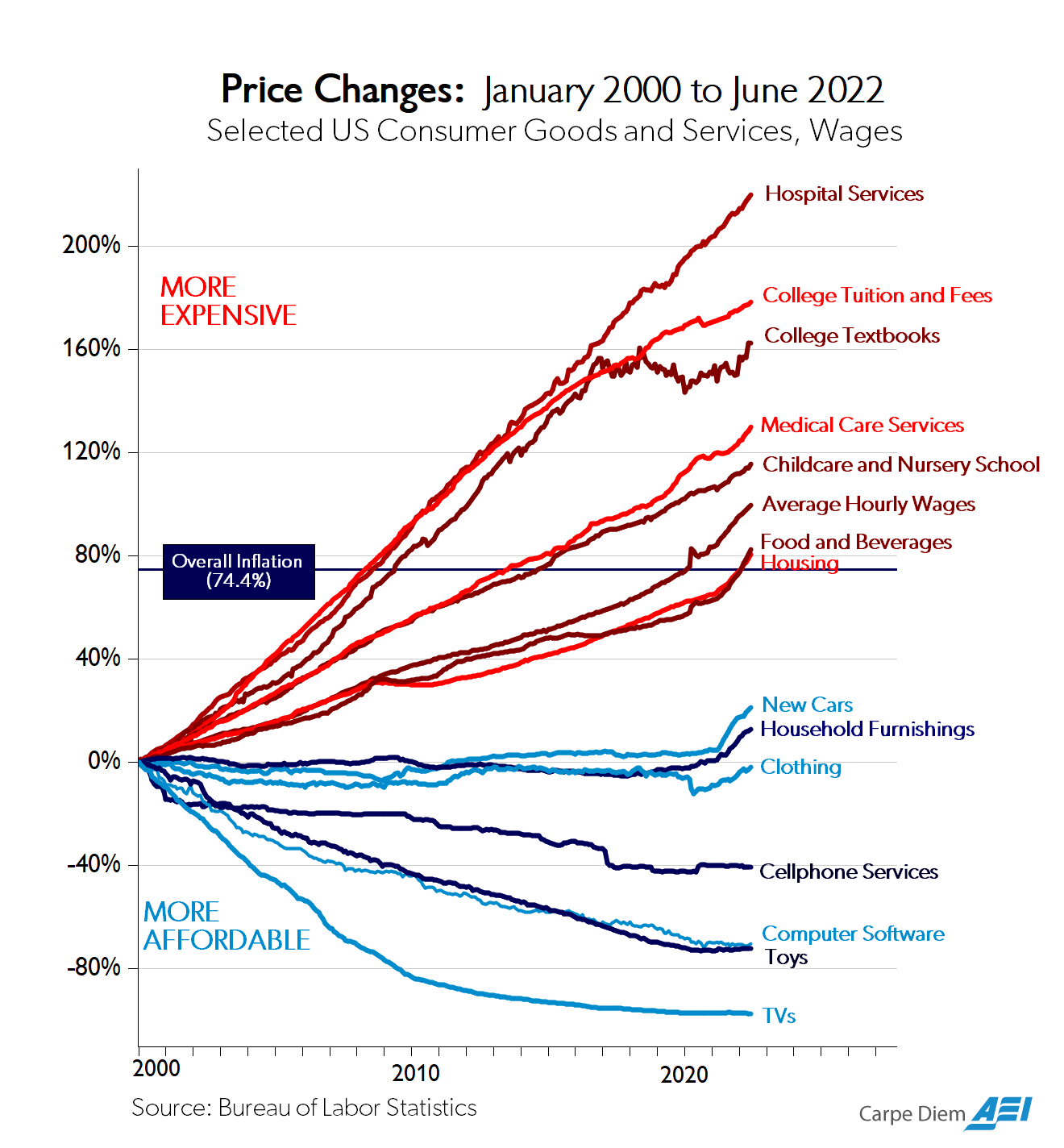
> AI is simply already illegal across most of the economy, soon to be virtually all of the economy.
This just isn't true - AI won't necessarily be a product in the sectors he's talking about, but it'll absolutely improve them. Hospital services? AI is clearly going to be involved, at least in things like radiology. College tuition? I suppose that depends on how much the value of higher education remains in scarce brand names vs. education, but clearly AI is going to open up educational opportunities in a way that brings the costs way down.
And then AI will eventually (and to be clear, it might be a while) get us to general-purpose robots. He says "Those industries are monopolies, oligopolies, and cartels, with extensive formal government regulation as well as regulatory capture, price fixing, Soviet style price setting, occupational licensing, and every other barrier to improvement and change you can possibly imagine." but in an industry like construction, if you accept what he's saying, all of that control is in the hands of the rich folks at the top. What he's suggesting is that they'll protect the jobs of construction workers when they can replace them with cheaper, more efficient robots who are exempt from safety standards.