By that logic everyone in a car should wear a helmet in case of an accident.
Head trauma is a real danger in car accidents. Wearing a helmet in your car will help with any head trauma. Why don't car drivers wear a helmet?
The modern car itself, and several of its safety features, act as a fairly effective "helment".
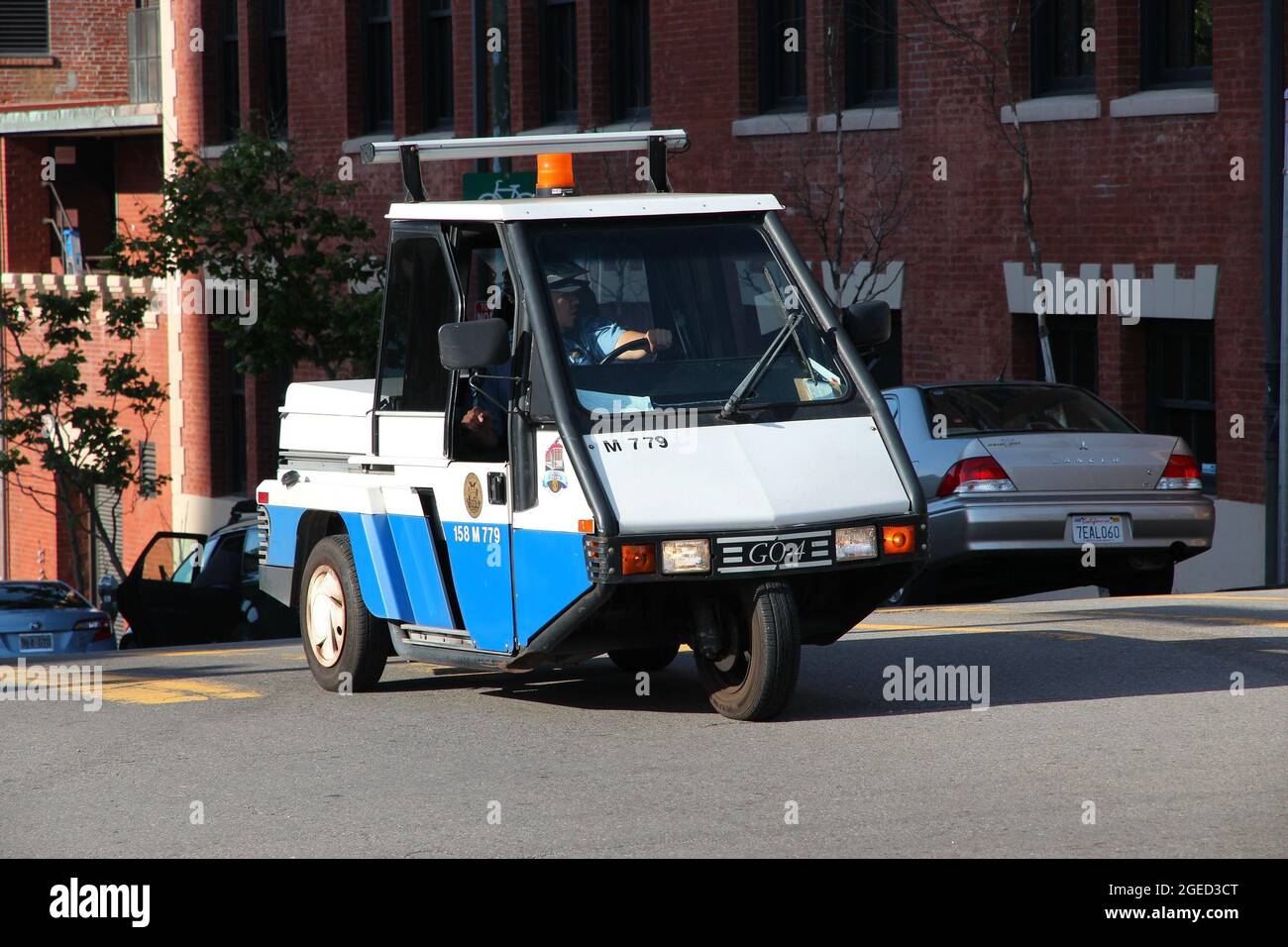
In San Francisco (and I assume many other places) the parking enforcement cops ride these little things called "interceptors"[0]. They're little more than 3-wheel motorcycles with a body around them. They don't really have much in the way of safety features, so the drivers wear bike helmets.
It's about gauging risk and determining what's likely to help. I would bet that if everyone wore helmets in cars, it wouldn't change injury/fatality stats a meaningful amount, beyond what seatbelts, airbags, etc. already do. But for bicycles (and perhaps these "interceptors", they perhaps do make a difference.
You're probably aware of other cases where people wear helmets, for example on construction sites and while riding motorbikes or indeed bicycles. A lot of people riding cars wear seatbelts. I don't understand what's supposed to be so baffling about wearing helmets in this case, as well.
Bicycle helmets are virtually useless when involved in a multi-vehicle collision (e.g. a cyclist and a car driver). They are typically tested IIRC for speeds of up to 12mph onto a static surface from a height of 2m or so. The forces involved when colliding with a motorised vehicle are orders of magnitude greater.
and what percentage of bike accidents are collisions with cars? I've had a few bike accidents, none were head on collisions, mostly unexpected obstructions, gravels like ball bearings and one time a love tap by a car where I got a bruise and the driver got yelled at for not paying attention.
Because car drivers, unlike ebike riders and buggy drivers, are surrounded by a metal cage built to some level of crash protection standard. Car drivers also largely wear seat belts that prevent them being thrown through the air and impacting trees, kerbs, etc.
A closely related argument is that we should encourage shower helmets due to the chances of head injury whilst showering. Also, ladder helmets and light-bulb changing helmets.
Bikes, especially e-bikes, go routinely around 40mph and share the road with huge chunks of metal (cars) that go even quicker. You head will cave in if you hit the ground or get hit by a car at these speeds. You really don’t see the need for a helmet?
Drivers in modern cars also wear “helmets” btw. The car (roll cage and airbags) is specifically designed to fulfill the exact same purpose.
Cycle helmets are not designed to cope with those kinds of impacts and are mostly useless for typical traffic collisions with other vehicles. The safety standards are designed around a cyclist falling off at up to 12mph.
Which is is a perfectly fine design goal for hitting the ground, because riding faster does not increase the speed component orthogonal to the road surface. That's always roughly like dropping while standing still, slightly more when the crash starts with some upwards tumble.
The same it true for motorcycle helmets, effective protection for going into a brick wall at speed would require helmets with a crumple zone thickness approaching the length of a car crumple zone. Get ready for hearing the term ludicrous speed a lot when wearing that.
Yes, I agree that cycle helmets are appropriate for non traffic collisions. The problem is that mainstream media and popular culture like to portray them as essential for riding in traffic despite them not being suitable for that. It's largely victim blaming.
If 2 tons of steel hit you at 40mph+, you will die. You can be dead wearing a helmet if you wish.
Trying to find a way out of that situation is futile, you're trying to fight the laws of physics. The solution is to not be there in the first place, not trying to add 5cm of padding on top of your head.
The way to do so, at policy level, is building a network of dedicated cycling paths physically separated from motor traffic and protected intersections where bike traffic is priviledged over motor vehicles.
But regardless of the state of infrastructure, recommending helmets to cyclists has overwhelmingly negative consequences. The minor safety benefits pale in comparison to the damage done by the reduced amount of bicycle trips caused by the friction introduced by needing a helmet. Cycling has such immense benefits that virtually any reduction in trips due to helmet advocacy will have devastating health outcomes. This isn't a matter of comparable numbers that can be discussed either, we're talking orders of magnitude here.
If the above is unconvincing, some research follows (quotes presented to be read in order):
[1]: "Cycling UK wants to keep helmets an optional choice. Forcing - or strongly encouraging - people to wear helmets deters people from cycling and undermines the public health benefits of cycling. This campaign seeks to educate policy makers and block misguided attempts at legislation."
[2]: "Even if helmets are 85% effective (and assuming q = 0.5 as above), the number of cyclists’ lives saved will still be outnumbered by deaths to non-cyclists if there is a reduction in cycle use of more than 2%"
[3]: "Enforced helmet laws and helmet promotion have consistently caused substantial reductions in cycle use (30-40% in Perth, Western Australia). Although they have also increased the proportion of the remaining cyclists who wear helmets, the safety of these cyclists has not improved relative to other road user groups (for example, in New Zealand).
The resulting loss of cycling’s health benefits alone (that is, before taking account of its environmental, economic and societal benefits) is very much greater than any possible injury prevention benefit."
[...]
"Evidence also suggests that even the voluntary promotion of helmet wearing may reduce cycle use."
[...]
"Even with very optimistic assumptions as to the efficacy of helmets, relatively minor reductions in cycling on account of a helmet law are sufficient to cancel out, in population average terms, all head injury health benefits."
[4]: "With 290 cyclist fatalities in 2022, cyclists were the largest group of road casualties. Of these, most were killed by collision with a vehicle (206 bicycle deaths)."
[5]: "Cycling levels in the Netherlands have substantial population-level health benefits: about 6500 deaths are prevented annually, and Dutch people have half-a-year-longer life expectancy. These large population-level health benefits translate into economic benefits of €19 billion per year, which represents more than 3% of the Dutch gross domestic product between 2010 and 2013.3.
The 6500 deaths that are prevented annually as a result of cycling becomes even more impressive when compared with the population health effects of other preventive measures. In an overview, Mackenbach et al.11 showed that the 22 new preventive interventions that have been introduced in the Netherlands between 1970 and 2010 (e.g., tobacco control, population-based screening for cancer, and road safety measures) altogether prevent about 16 000 deaths per year.
Still, our results are likely to be an underestimation of the true total health and economic benefits."
[6]: "Riding a bicycle to work every day reduces the risk of premature death by 41% (risk of dying from heart disease: -52%; risk of dying from cancer: -40%)."
[...]
"Regular cycling boosts physical fitness and compares to 1 to 2 weekly gym sessions."
[...]
"Bicycle use not only improves physical health, but also has a positive impact on mental health and subjective well-being."
I used to live in NY state. I remember reading about this group of motorcyclists protesting the states motorcycle helmet law by riding around at rallies helmet-less. Their argument against helmets was the usual “I’ll be dead anyway with or without a helmet” or “I’d rather be dead than a cripple.” Then at one of these rallies, while riding at fairly low speed, this guy hit a rock or oil patch or something, dropped his bike, hit his head and died. Medical experts agreed if he was wearing a helmet he’d almost certainly be fine.
And chances are he was dead without his head being caved in. That's simply the wrong model when talking about head protection from traffic dangers.
Where the helmet protects from small but fast-moving masses (weapons, falling rock or tools), protection of the skull structure can absolutely be the helmet's job. But where the danger is hitting a large mass like a car or a planet, the acceleration involved is the dominant problem and it will get you long before "caved in". Helmets provide a bit of a crumple zone that can certainly be very valuable, but at impact speeds that would be "cave in" without the helmet, even a crumple zone precisely tuned to exactly this impact (chances are that would be a wildly suboptimal configuration for many many other impacts) would fail to flatten the acceleration curve to survivable levels. "handsome corpse" wasn't aimed at helmets in general, it was aimed at the mental model of protecting from cave-in.
Because the added weight at high velocity would result in more severe whiplash. This, wearing helmets in a car could actually increase rather than decrease injuries following a crash, especially in children who wear harnesses. This is the reason why HANS devices are used in racing.
Because you're in a steel cage surrounded by air bags. It's about statistics, not "perfect safety". Head injuries per bike rider are far worse in bike accidents (and motorcycle) than in cars. It's about being reasonable but not being a bubble boy.
Your car will most likely have an explosive charge inside the steering wheel that quickly inflates a cloth bag with air to cushion your head and prevent it from smacking hard against the steering wheel. They're called "airbags".
For example, if you had protective headgear guarding you the innumerable number of times you were dropped as an infant then this conversation wouldn't be necessary, but society is forced to pay the price for enabling bad faith actors asking "questions" about an extremely well researched topic that you've either chose not to do any knowledge seeking on your own for, or are willingly ignoring to postulate another topic that absolutely no one who values their time would want to discuss with you about.
Maybe someone like you SHOULD wear a helmet in a car though, so good suggestion! :)
That is a broad generalization that can't be right. I wear a helmet because I don't want to bust my head open like a dropped cantaloupe. Am I missing something here? Same when I'm on a motorcycle. I've never lived anywhere that adults -had- to wear a helmet, but kids often are required to, legally speaking.
I've had a serious head injury, though not from cycling. Hurting your limbs is painful and may cause you to lose mobility. Brain damage affects your very ego and ability to experience the world - permanently. I have a headache and fatigue as I write this comment, my eyes aren't quite focused on the text like they used to be, and I am considerably less intelligent than I was. This will probably last for the rest of my life - for most of my existence.
It's difficult to put into words just how soul-crushing it is to have your inner monologue disrupted, slowed, and impaired. To sit in a class and listen, just as you used to, yet not comprehend or learn. To sit in front of your IDE expecting to accomplish a once-trivial task, yet feel nothing but overwhelming nausea and your working memory being overloaded.
It hammers home that consciousness is not special and that we're nothing more than biological machines.
Protect that consciousness. It is precious and it is vulnerable. Wear a helmet.